PSA Sabre 300 Blackout Review: Building Our First Suppressed 300 BLK (2026)
Our first fully suppressed 300 Blackout build on the PSA Sabre 10.5: three range days, gas tuning, an ammo education, and a rifle that ended up quiet, accurate, and genuinely fun.
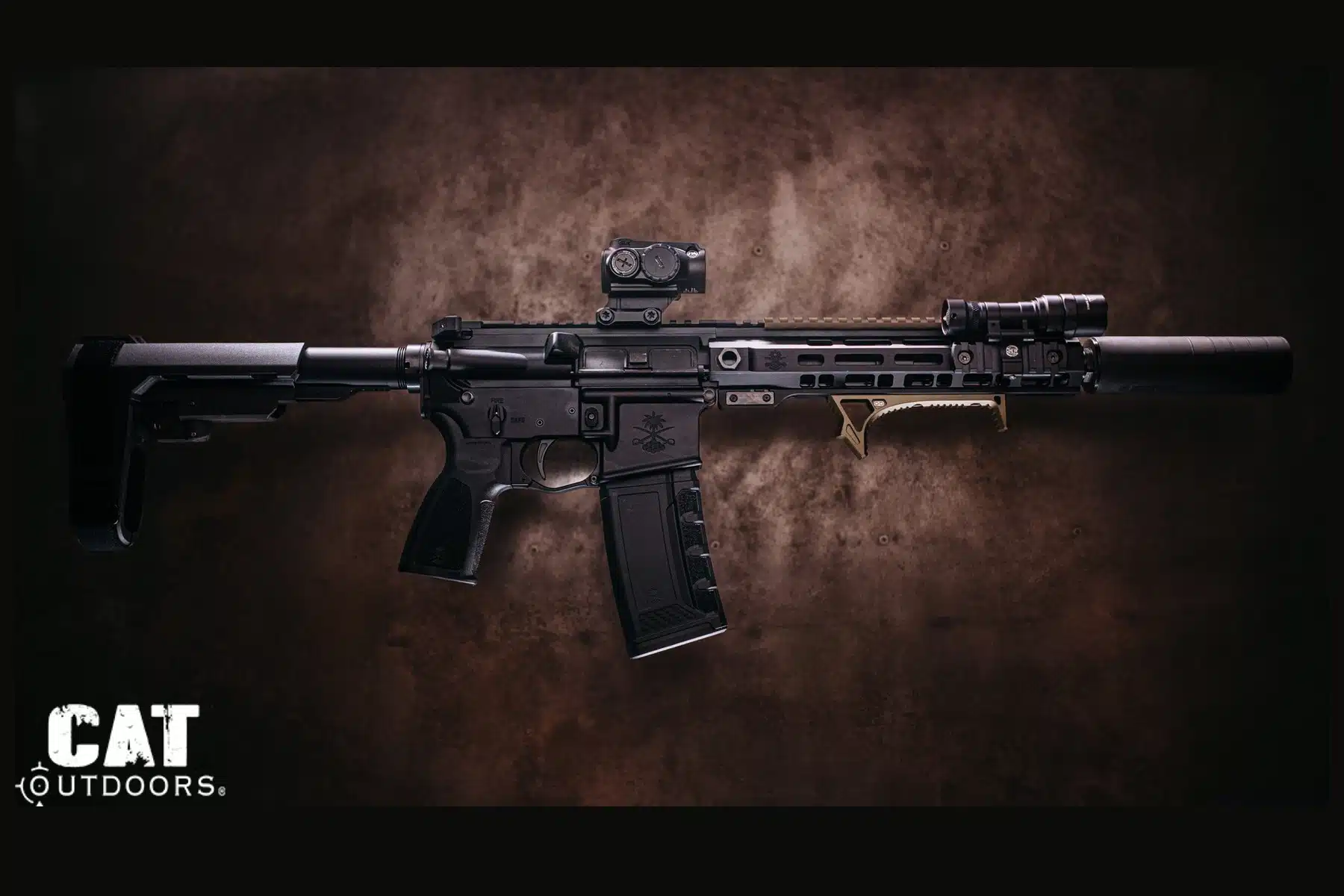
The PSA Sabre 10.5-inch 300 Blackout proved to be a capable and versatile suppressor host, swapping between quiet subsonic and full-power supersonic loads with nothing but a magazine change. It did not run perfectly out of the box: getting there took two range sessions, an ammo change, and a crash course in gas tuning, and that homework is part of suppressed 300 BLK ownership. The end result was a smooth-operating, accurate, quiet rifle that is genuinely enjoyable to shoot, and the process made me a more knowledgeable shooter. Expect around $1,000-1,250 depending on configuration as of this writing.
Reasons to Buy
- True two-in-one versatility: quiet subsonics or full-power supersonics with a magazine swap
- Suppressor-ready design with a tool-adjustable gas block for tuning
- Excellent fit and finish with zero manufacturing defects across the whole project
- Factory Sabre trigger genuinely surprised us at 2 lb 14 oz average
- Really comes alive suppressed: soft recoil, pleasant report, and the quiet this cartridge was built for
- Outstanding value for the features delivered
Reasons to Skip
- Not ready out of the box for suppressed use: expect gas tuning and ammo homework
- Documentation gap: nothing in the manual prepares you for a suppressed setup
- Ammo-sensitive: our Hornady loads kept jamming even after gas tuning, while Winchester 200 gr subs ran clean
- The complete ecosystem (suppressor plus subs and supers) costs considerably more than a comparable 5.56 setup
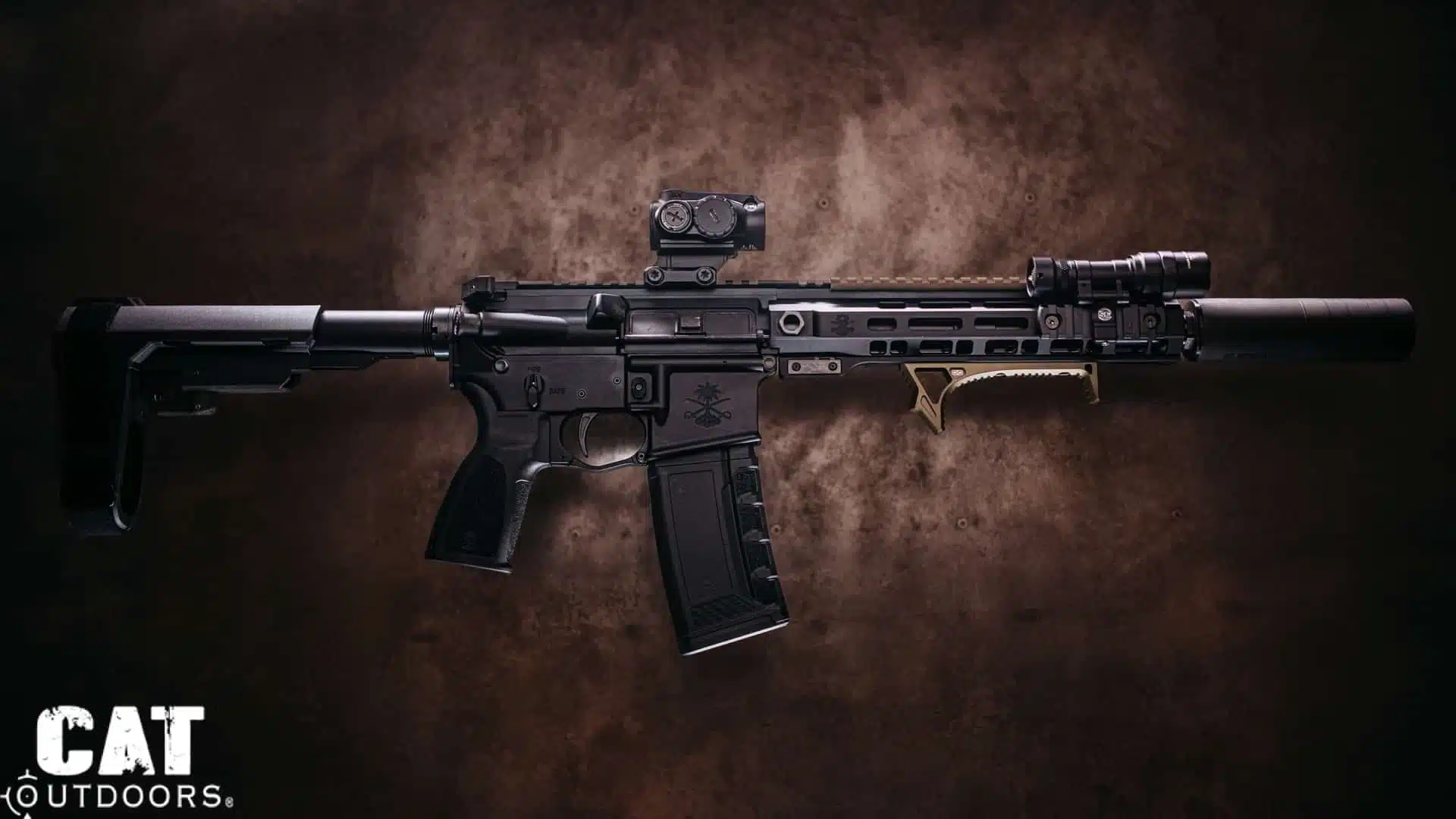
This PSA Sabre 300 Blackout review is the story of our first fully suppressed build: a $1,000-class 10.5-inch suppressor host, two range sessions, three ammunition types, one crash course in gas tuning, and a pile of damaged brass on the way to quiet.

There’s more to building a successful .300 Blackout than bolting on a few accessories and heading to the range. I know that now. I learned it at roughly $1.25 per round.
Here’s the good news up front: the Sabre got there. Once the gas system was tuned and the right ammunition was in the magazine, this rifle became exactly what I hoped it would be. Smooth, quiet, accurate, and genuinely fun.
This review is the whole journey: the build, the baseline numbers, the malfunctions, the troubleshooting, and the two range sessions it took to get from a growing pile of damaged ammo to a rifle that finally ran quiet. If you’re thinking about your first suppressed 300 BLK, consider this the quick-start guide PSA forgot to write.
.kb-table-of-content-nav.kb-table-of-content-id46728_f2c4b9-3e .kb-table-of-content-wrap{padding-top:var(–global-kb-spacing-sm, 1.5rem);padding-right:var(–global-kb-spacing-sm, 1.5rem);padding-bottom:var(–global-kb-spacing-sm, 1.5rem);padding-left:var(–global-kb-spacing-sm, 1.5rem);background-color:var(–global-palette9, #ffffff);border-top:2px solid var(–global-palette3, #1A202C);border-right:2px solid var(–global-palette3, #1A202C);border-bottom:2px solid var(–global-palette3, #1A202C);border-left:2px solid var(–global-palette3, #1A202C);box-shadow:0px 14px 25px -10px rgba(0, 0, 0, 0.5);}.kb-table-of-content-nav.kb-table-of-content-id46728_f2c4b9-3e .kb-table-of-contents-title-wrap{padding-top:0px;padding-right:0px;padding-bottom:0px;padding-left:0px;}.kb-table-of-content-nav.kb-table-of-content-id46728_f2c4b9-3e .kb-table-of-contents-title-wrap{color:var(–global-palette3, #1A202C);}.kb-table-of-content-nav.kb-table-of-content-id46728_f2c4b9-3e .kb-table-of-contents-title{color:var(–global-palette3, #1A202C);font-weight:bold;font-style:normal;text-transform:uppercase;}.kb-table-of-content-nav.kb-table-of-content-id46728_f2c4b9-3e .kb-table-of-content-wrap .kb-table-of-content-list{color:var(–global-palette1, #3182CE);font-weight:inherit;font-style:normal;margin-top:var(–global-kb-spacing-sm, 1.5rem);margin-right:0px;margin-bottom:0px;margin-left:0px;}.kb-table-of-content-nav.kb-table-of-content-id46728_f2c4b9-3e .kb-table-of-content-wrap .kb-table-of-content-list .kb-table-of-contents__entry:hover{color:var(–global-palette2, #2B6CB0);}.kb-table-of-content-nav.kb-table-of-content-id46728_f2c4b9-3e .kb-toggle-icon-style-basiccircle .kb-table-of-contents-icon-trigger:after, .kb-table-of-content-nav.kb-table-of-content-id46728_f2c4b9-3e .kb-toggle-icon-style-basiccircle .kb-table-of-contents-icon-trigger:before, .kb-table-of-content-nav.kb-table-of-content-id46728_f2c4b9-3e .kb-toggle-icon-style-arrowcircle .kb-table-of-contents-icon-trigger:after, .kb-table-of-content-nav.kb-table-of-content-id46728_f2c4b9-3e .kb-toggle-icon-style-arrowcircle .kb-table-of-contents-icon-trigger:before, .kb-table-of-content-nav.kb-table-of-content-id46728_f2c4b9-3e .kb-toggle-icon-style-xclosecircle .kb-table-of-contents-icon-trigger:after, .kb-table-of-content-nav.kb-table-of-content-id46728_f2c4b9-3e .kb-toggle-icon-style-xclosecircle .kb-table-of-contents-icon-trigger:before{background-color:var(–global-palette9, #ffffff);}@media all and (max-width: 1024px){.kb-table-of-content-nav.kb-table-of-content-id46728_f2c4b9-3e .kb-table-of-content-wrap{border-top:2px solid var(–global-palette3, #1A202C);border-right:2px solid var(–global-palette3, #1A202C);border-bottom:2px solid var(–global-palette3, #1A202C);border-left:2px solid var(–global-palette3, #1A202C);}}@media all and (max-width: 767px){.kb-table-of-content-nav.kb-table-of-content-id46728_f2c4b9-3e .kb-table-of-content-wrap{border-top:2px solid var(–global-palette3, #1A202C);border-right:2px solid var(–global-palette3, #1A202C);border-bottom:2px solid var(–global-palette3, #1A202C);border-left:2px solid var(–global-palette3, #1A202C);}}Specs
- Caliber: .300 AAC Blackout
- Barrel: 10.5-inch nitride-treated, threaded 5/8×24
- Gas System: Adjustable gas block, tool-adjustable for suppressed or unsuppressed use
- Handguard: 10-inch knurled slant-cut rail with M-LOK slots
- Muzzle Device: Sabre compensator (factory installed)
- Trigger: Factory Sabre two-stage (2 lb 14 oz average on our gauge)
- Configuration: Ships pistol-configured with an arm brace
- Magazines: Standard AR-15 magazines
- Price: Around $1,000-1,250 depending on configuration (check current listings)
One configuration note before we go further: our test gun is the 10-inch slant rail model with the Sabre compensator, and it arrived as a large-format pistol with a brace, not a stocked rifle. If the pistol-versus-rifle distinction is new territory, our AR-15 pistol explainer covers what that means and why it matters.
Why You Can Trust This Review
Full disclosure: Palmetto State Armory provided the Sabre 10.5-inch .300 Blackout for testing and review, and CMMG provided the ZEROED 36K suppressor for testing and review. No compensation was received for this article, and every opinion in it is based on my own testing and experience.
- Rifle: PSA Sabre 10.5-inch .300 Blackout, provided by Palmetto State Armory free of charge
- Suppressor: CMMG ZEROED 36K, provided by CMMG free of charge
- Tested By: Brad Lanphear, across two range sessions: one on a private 50-yard range, one at a public range out to 200 yards
- Rounds Logged: 160 rounds and 11 malfunctions in the first session alone, plus a full second session after tuning
- Measurement Gear: Wheeler Digital Pull Scale for both trigger tests
One testing note: because this rifle was evaluated almost exclusively as a suppressed platform using multiple ammunition types and the CMMG ZEROED 36K, some observations reflect the behavior of the complete system rather than the rifle alone.
This review is based on our actual experience with the rifle, both the good and bad.
The Poll
Where does your carry gun ride?
This week's holster coverage has us curious. Tap your pick.
The Poll · Live Standings
Your vote is in.
0 votes so far. Winner announced in next week’s issue.
Want to Know the Final Results?
We tally the votes and name the winner in next week’s email. Sign up and the final standings come straight to your inbox, and you’ll be first to hear when the review goes live.
By signing up you agree to our Terms of Service and Privacy Policy. No spam, and we never sell your address. Unsubscribe anytime.
That didn’t go through. Check the address and try again.
Done. Watch your inbox.
You’re on the list. The final standings land in next week’s issue, and if your pick loses, take it up with the other voters.
Why .300 Blackout?
The .300 AAC Blackout exists because 5.56 NATO starts to lose some of its advantages when you chop the barrel down and add a suppressor.
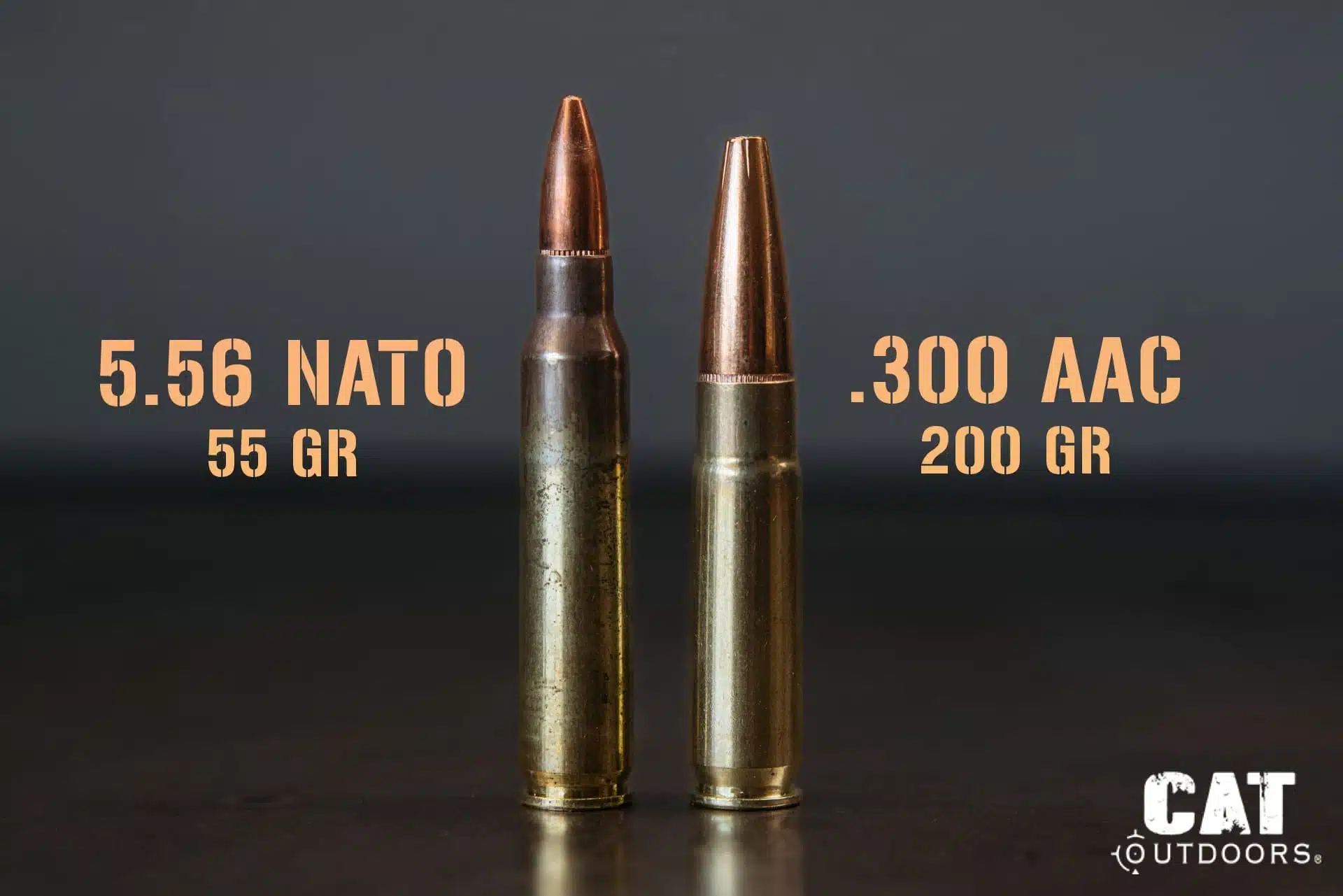
The cartridge was developed by Advanced Armament Corporation (AAC) to give shooters a round that performs well from short barrels while still living inside the AR-15 platform. The only physical difference between an AR chambered in 5.56 NATO and one chambered in .300 AAC is the barrel. Everything else is the same. Same lower receiver, same bolt, same magazines.
What really makes the caliber interesting is its versatility. With supersonic ammunition, .300 Blackout delivers solid rifle performance from compact barrels. Switch to heavier subsonic ammunition and the character of the rifle changes completely. Suddenly you’re launching a heavy bullet at speeds that stay below the sound barrier, which eliminates the sonic crack that normally follows a rifle shot.
That’s where suppressors enter the conversation.
Unlike 5.56, which was designed around velocity, .300 Blackout was engineered from the beginning with suppressed shooting in mind. The cartridge cycles reliably with heavy subsonic ammunition while keeping the compact size and familiar controls of an AR-15. A suppressed 5.56 is quieter than unsuppressed, but you still have the supersonic crack to deal with.
Why Not Just Make 5.56 Subsonic?
Glad you asked. The short answer: you can, but it doesn’t work very well.
A typical 55-grain 5.56 bullet leaves the muzzle around 3,000 fps. To make it subsonic, you have to slow it down to roughly 1,050 fps. The problem is that the bullet is too light.
Think about throwing a ping pong ball versus a baseball.
At subsonic speeds, a 55-grain bullet has very little energy and sheds it quickly. It also often won’t generate enough gas pressure to reliably cycle an AR-15.
That’s why .300 Blackout uses much heavier bullets. A typical subsonic load runs a 190-220 grain bullet, roughly four times heavier than a standard 55-grain 5.56 projectile. Even though both rounds are traveling at similar subsonic speeds, the heavier .300 bullet carries significantly more energy.
In simple terms, if your goal is to build a short, compact, suppressor-friendly rifle that can be quiet one magazine and hard-hitting the next, .300 Blackout was practically designed for that job.
Why Should a Civilian Own One?
Because suppressed shooting is cool and being cool matters.
That may be true, but joking aside, there are some genuinely practical reasons why .300 Blackout has become so popular.
Night Hunting
I live in Texas, where night hunting is common among farmers and ranchers dealing with predators like coyotes that kill livestock, as well as invasive species like feral hogs that cause billions of dollars in crop damage every year. (Rules on night hunting and suppressor use vary by state, so check your local regulations before you plan a hog patrol.)
A suppressor doesn’t make a rifle silent, but it does make it significantly more tolerable to shoot. The reduced noise is less disruptive to nearby homes, livestock, and hunting partners. It can also increase the chances of getting follow-up shots before an entire group of animals scatters after the first trigger pull.
For hunters running short rifles in tight spaces such as vehicles, blinds, or dense brush, .300 Blackout is particularly well-suited to the task.
Home Defense
Anyone who has ever touched off a rifle without hearing protection knows they are loud. Extremely loud.
Now imagine firing one inside a hallway or bedroom at two o’clock in the morning, when there’s no time to grab a pair of ear protectors. That concussive blast in an indoor space can cause instant hearing damage.
A suppressor won’t eliminate the noise, but it can reduce it enough to lessen the risk of permanent hearing damage while also making communication with family members or responding officers easier in the aftermath of a defensive encounter.
The compact size of a short-barreled .300 Blackout also makes it easier to maneuver through doorways, hallways, and other confined spaces than a traditional full-length rifle.
Range Use
Let’s be honest: this is probably where most civilian-owned .300 Blackouts spend their time.
Suppressors make shooting more enjoyable. Less muzzle blast. Less concussion. Less fatigue. Less annoying everyone else at the range.
And if you’re anything like me, there’s something incredibly satisfying about hearing the steel ring louder than the gunshot itself.

Building the PSA Sabre 300 Blackout
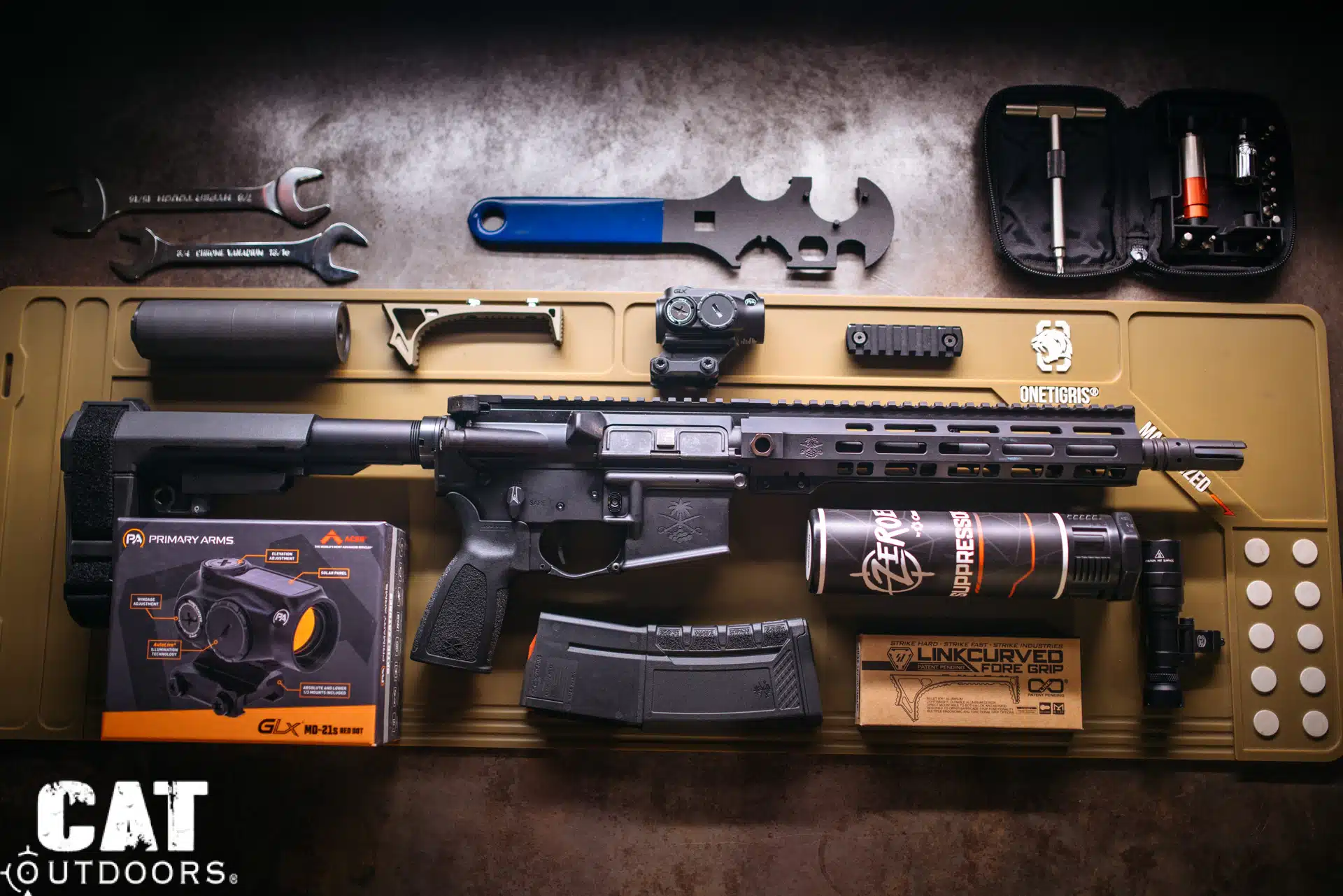
My components list:
- Rifle: PSA Sabre 10.5-inch .300 Blackout
- Suppressor: CMMG ZEROED 36K
- Optic: Primary Arms GLx MD-21 ACSS CQB
- Trigger Upgrade (Later): LaRue MBT-2S
- Light: SureFire Scout Light Pro
- Tools: Fix It Sticks, plus 3/4-inch and 7/8-inch open-end wrenches
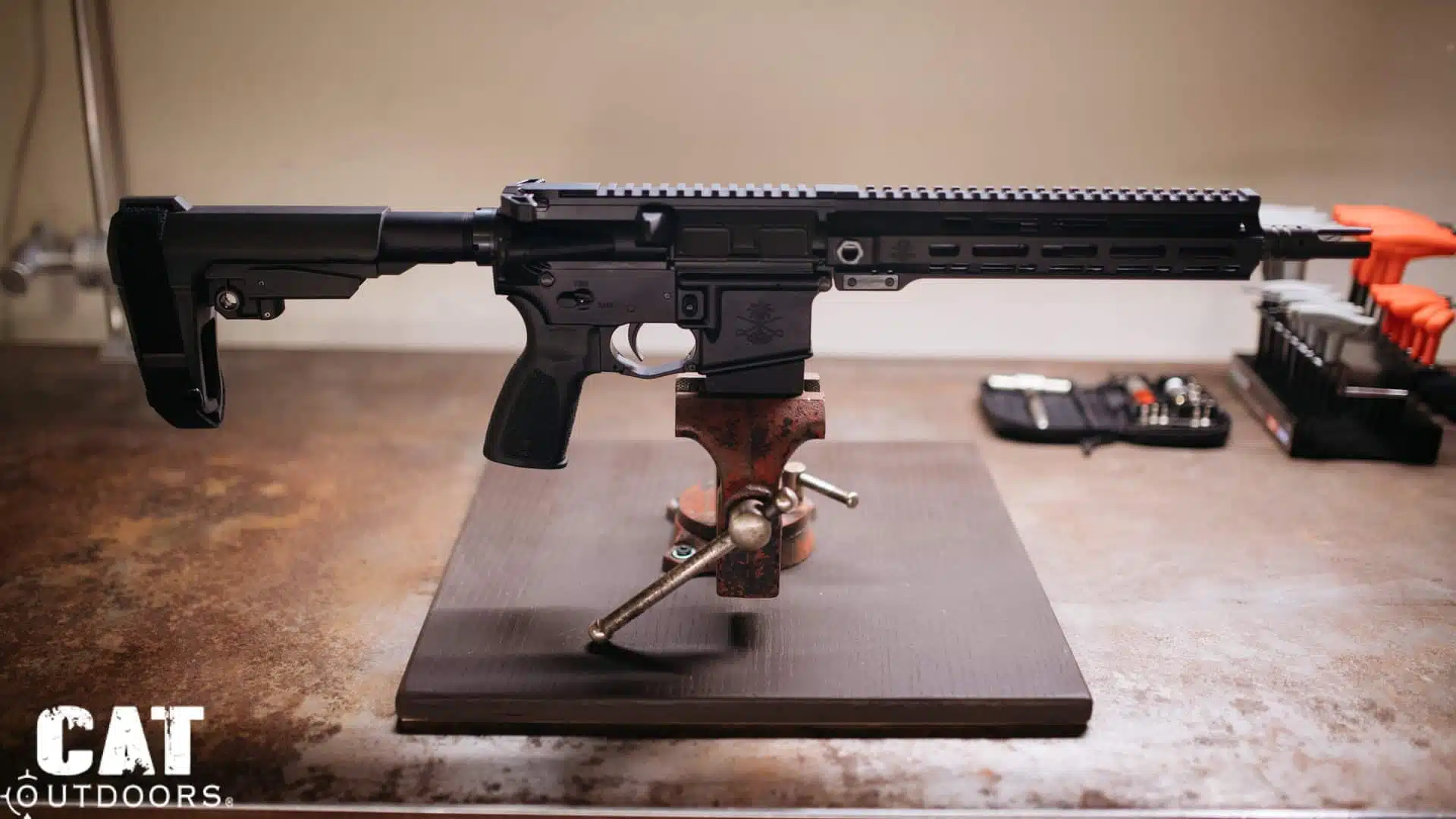
With everything laid out and the rifle locked in the vise, the first decision was glass.
One thing to note before we go further: if you already run a lower you love, PSA sells this same Sabre 10.5-inch 300 BLK setup as a complete upper. Uppers are not serialized, so it ships straight to your door with no FFL transfer, pins to any mil-spec lower in about a minute, and gets you into the same suppressor-ready barrel and adjustable gas block we tested here. We’re reviewing the complete pistol because that is what we tested, but the upper is available for anyone who is halfway there already.
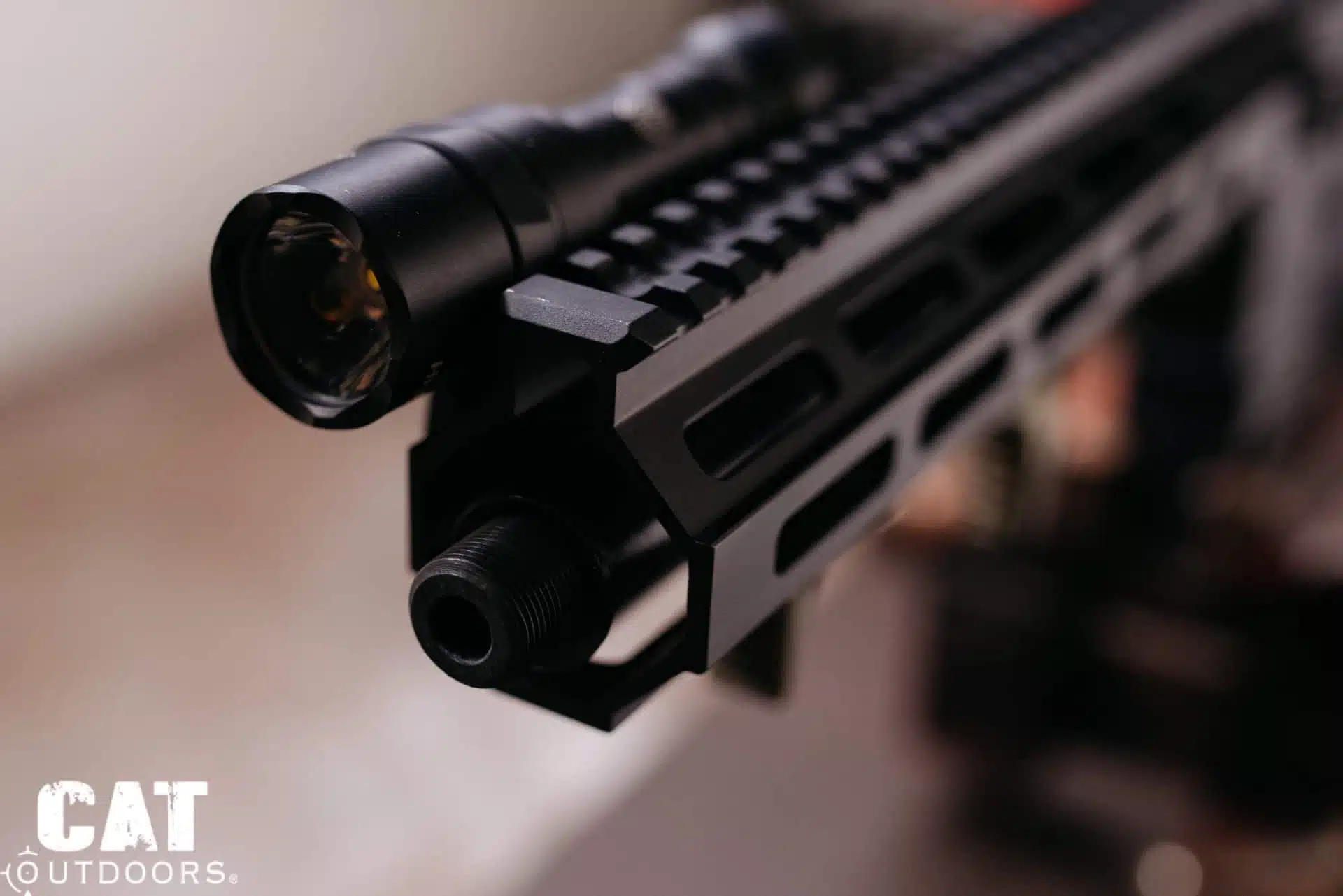
PSA Sabre 10.5-Inch 300 BLK Complete Upper
The same suppressor-ready barrel and adjustable gas block, minus the paperwork.
Optic Choice: Primary Arms GLx MD-21 ACSS CQB
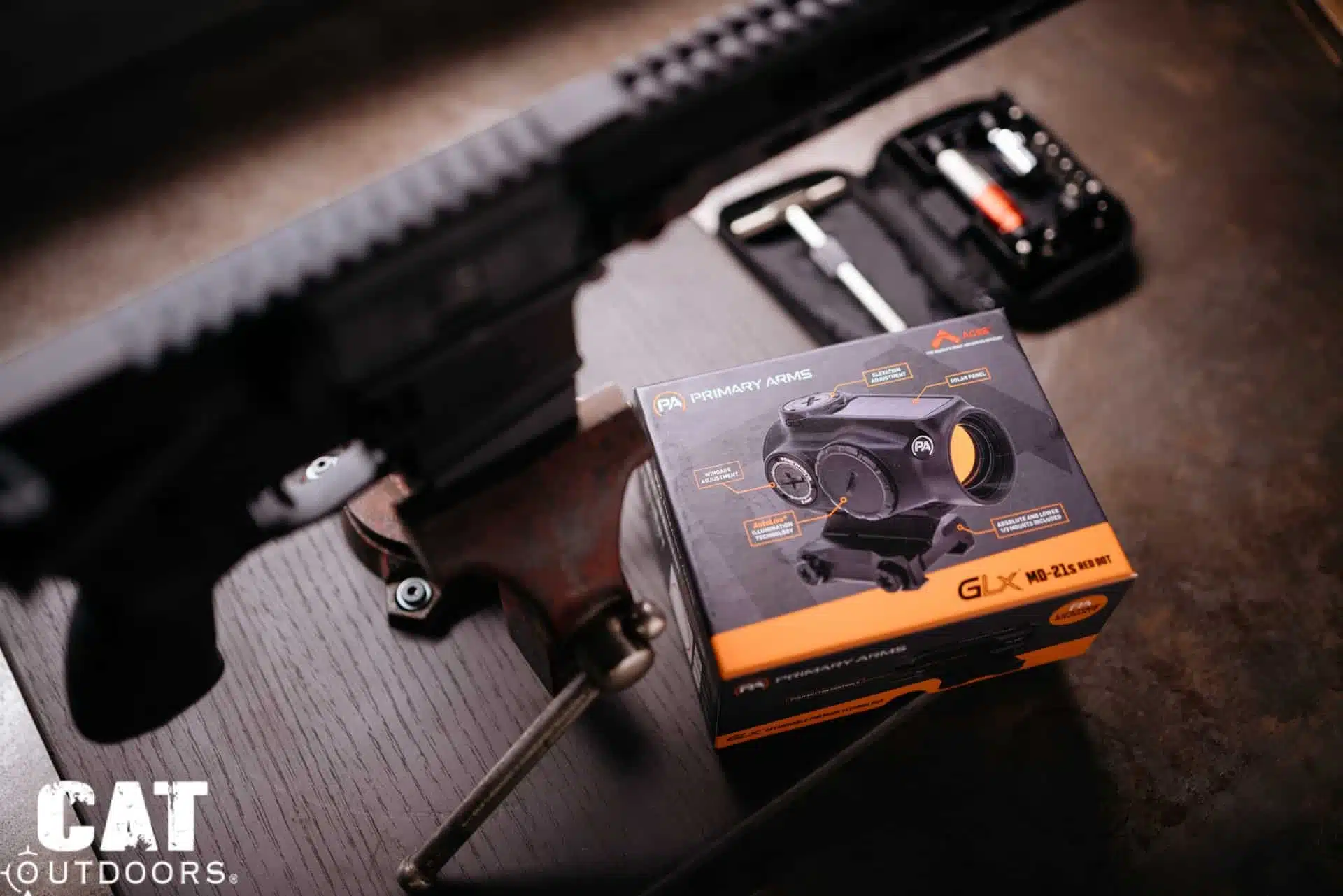
When it came time to choose an optic for this rifle, I had several options available, including a SIG Sauer Romeo5 I already own. (We put that one through its paces in our SIG Romeo5 review.) Ultimately, I chose the Primary Arms GLx MD-21 ACSS CQB because its feature set seemed particularly well-suited to the versatility of the .300 Blackout platform. (We since gave this optic the full workup in our Primary Arms GLx MD-21S review.)
Quick Comparison: GLx vs. Romeo5
| Specification | Primary Arms GLx MD-21 ACSS CQB | SIG Sauer Romeo5 |
|---|---|---|
| Street Price | ~$220-$260 | ~$100-$150 |
| Magnification | 1x | 1x |
| Objective Lens | 21mm | 20mm |
| Reticle | ACSS CQB Multi-Reticle System | 2 MOA Dot |
| Reticle Options | 4 Selectable Modes | Single Dot Only |
| Solar Backup | Yes | No |
| Motion Activation | AutoLive | MOTAC |
| Battery Life | Up to 50,000 Hours | Up to 40,000 Hours |
| Night Vision Compatible | Yes | Yes |
| Housing Material | 7075-T6 Aluminum | Aluminum |
| Mount Footprint | Aimpoint Micro | Aimpoint Micro |
| Warranty | Lifetime | Lifetime |
The Reticle
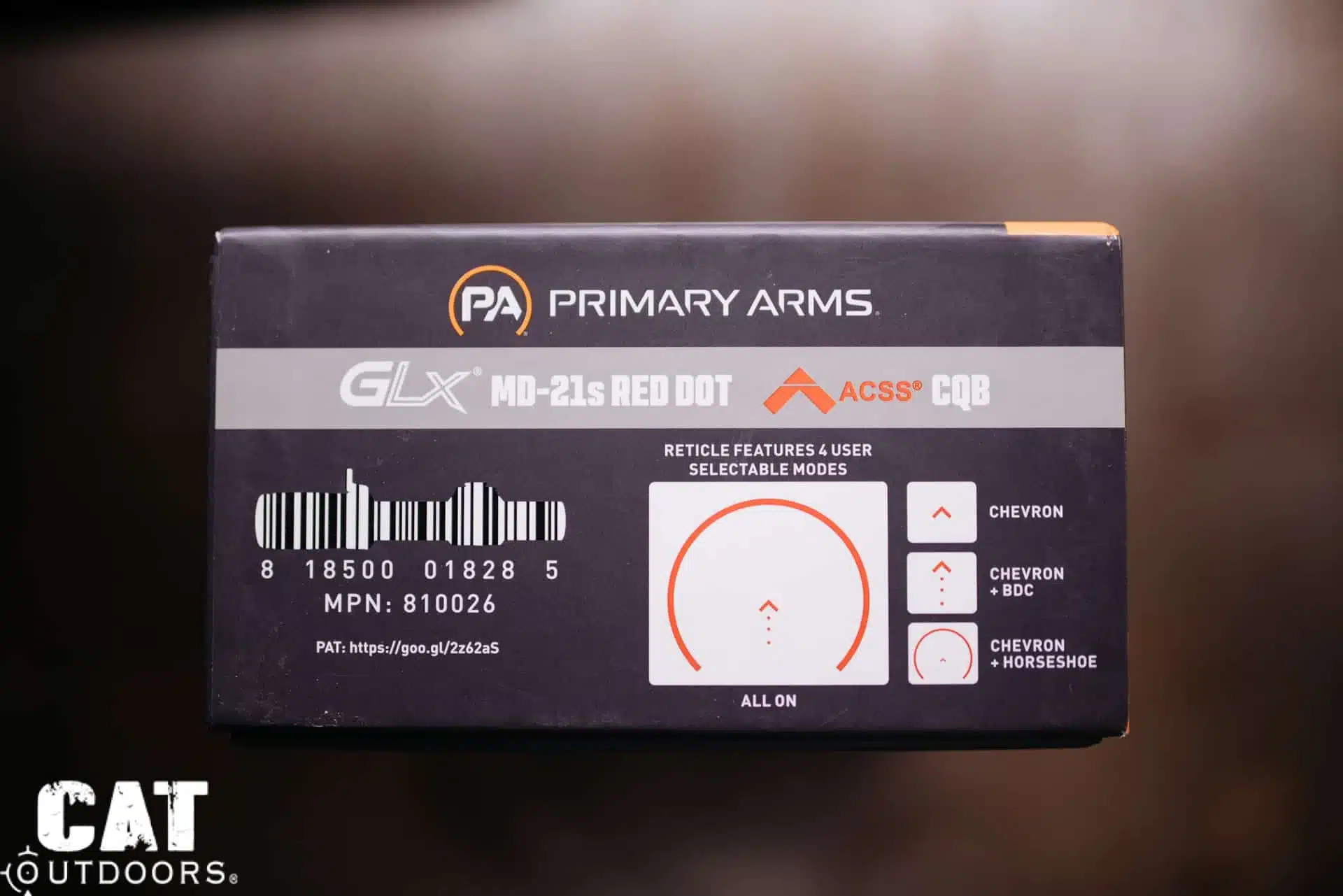
The GLx ACSS CQB offers four user-selectable reticle configurations:
- Chevron Only
- Chevron + BDC
- Chevron + Horseshoe
- Full ACSS CQB Reticle (Chevron, BDC, and Horseshoe)
By comparison, the Romeo5 uses only a traditional 2 MOA red dot.
For close-range shooting, I found the horseshoe reticle extremely quick to acquire. The chevron provides a precise aiming point for zeroing and accuracy work, while the BDC references offer additional holdover information when switching between supers and subs.
The Real-World Difference
If I were mounting these optics on matching 5.56 rifles, the performance gap would be much smaller than the price difference suggests. Both optics are durable, reliable, motion activated, have excellent battery life, and are fully capable of putting rounds on target.
Mount the GLx on a .300 Blackout, though, and the ACSS reticle starts to make a lot more sense.
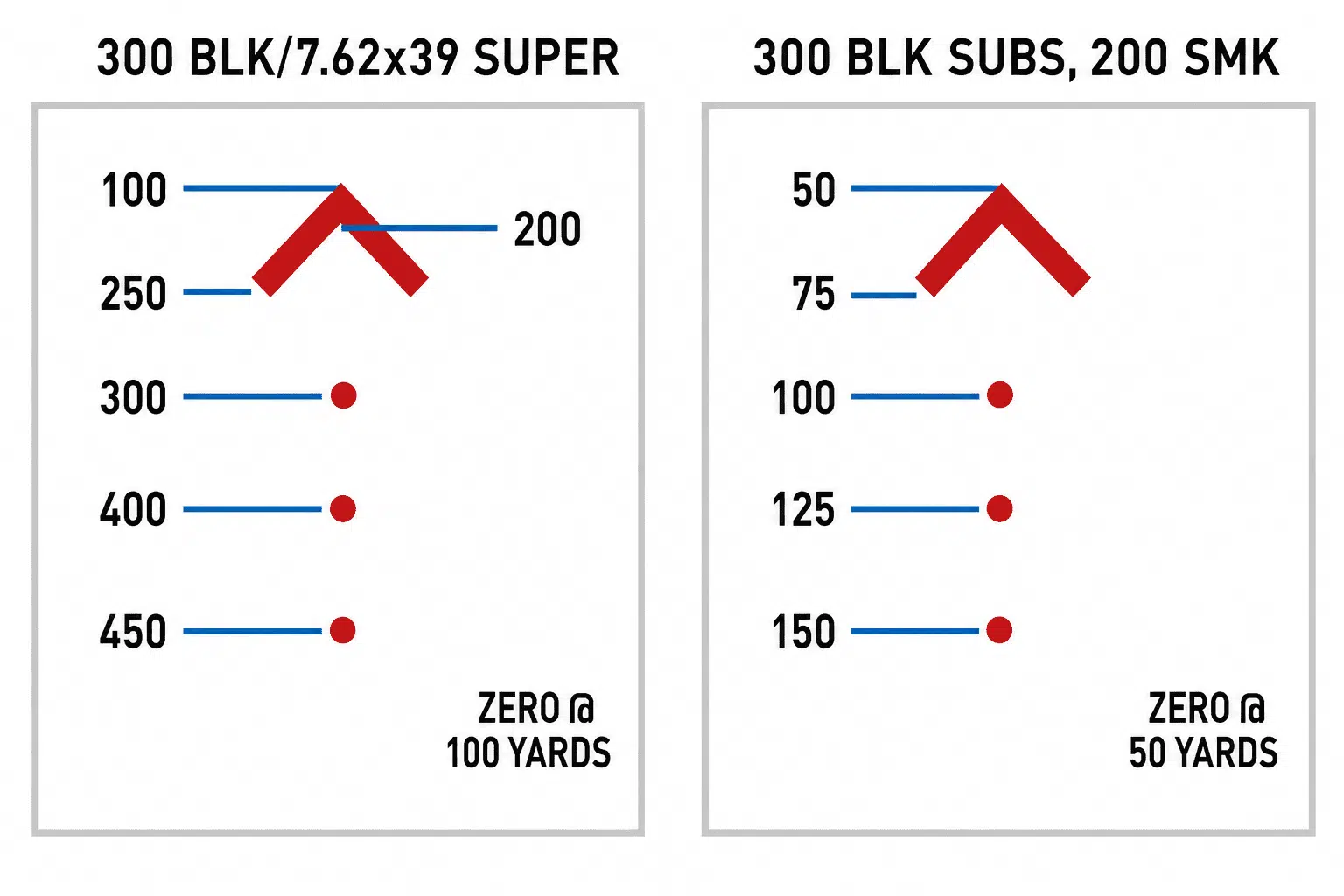
One of the defining characteristics of .300 Blackout is the ability to switch between supersonic and subsonic ammunition depending on the task at hand. On a standard 5.56 rifle, many shooters may never use the holdover references built into a BDC reticle. On a .300 Blackout, especially one that regularly alternates between supers and subs, those references become genuinely useful. What initially appears to be a luxury feature starts to feel like a practical tool.
The Romeo5 keeps things simple with a single dot, and there’s absolutely nothing wrong with that. In fact, I still believe it’s one of the best values in the red dot market. But for a rifle built around versatility, the GLx’s selectable reticles, solar backup, and ACSS system feel like a natural match for the platform. The more I learned about .300 Blackout during this project, the more I appreciated what the GLx was bringing to the table.
Mounting Up
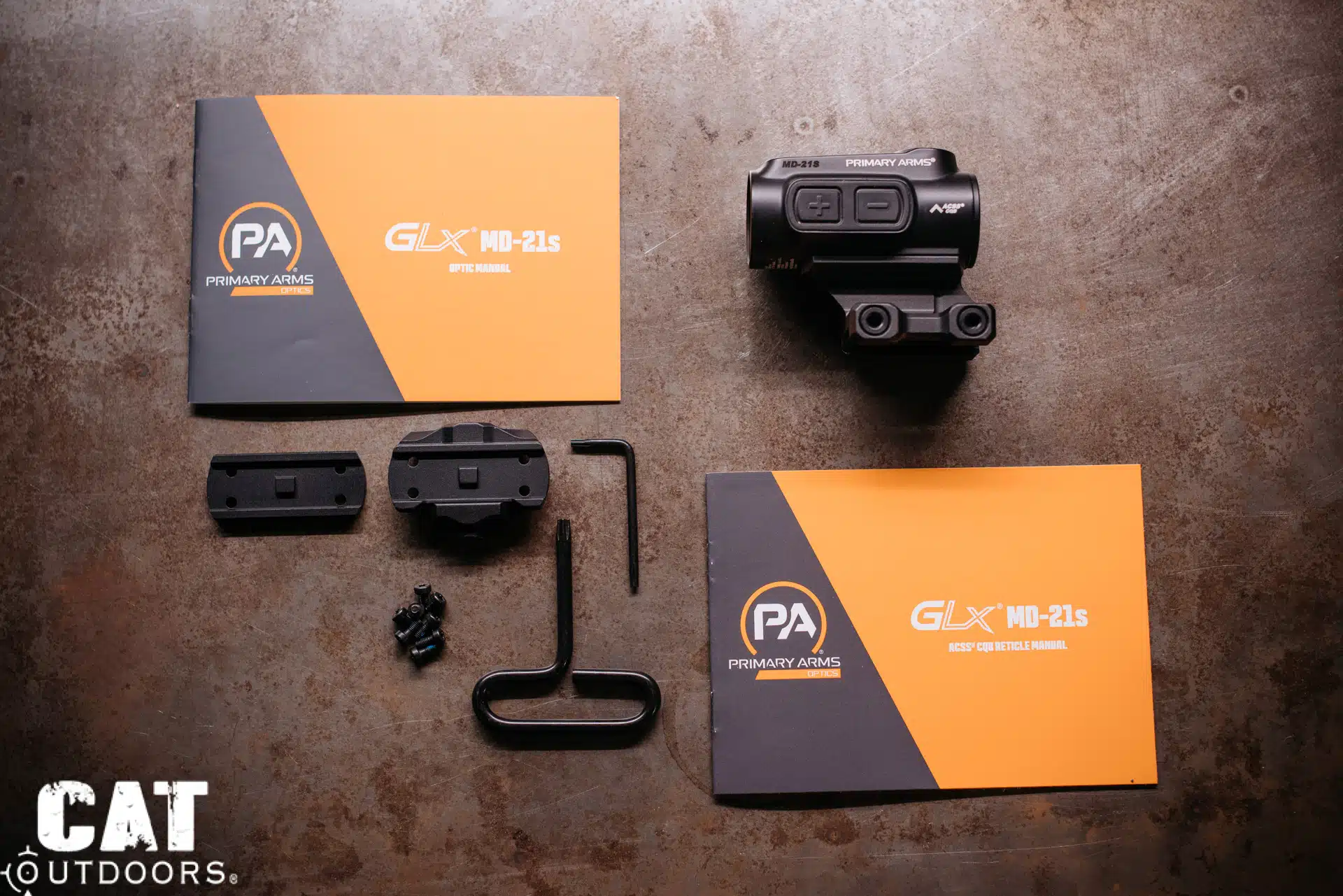
Hardware in the box includes both low-profile and high-profile mounts, screws, and Torx bit drivers. There are also two user manuals: a basic user overview and a detailed reticle-specific manual.
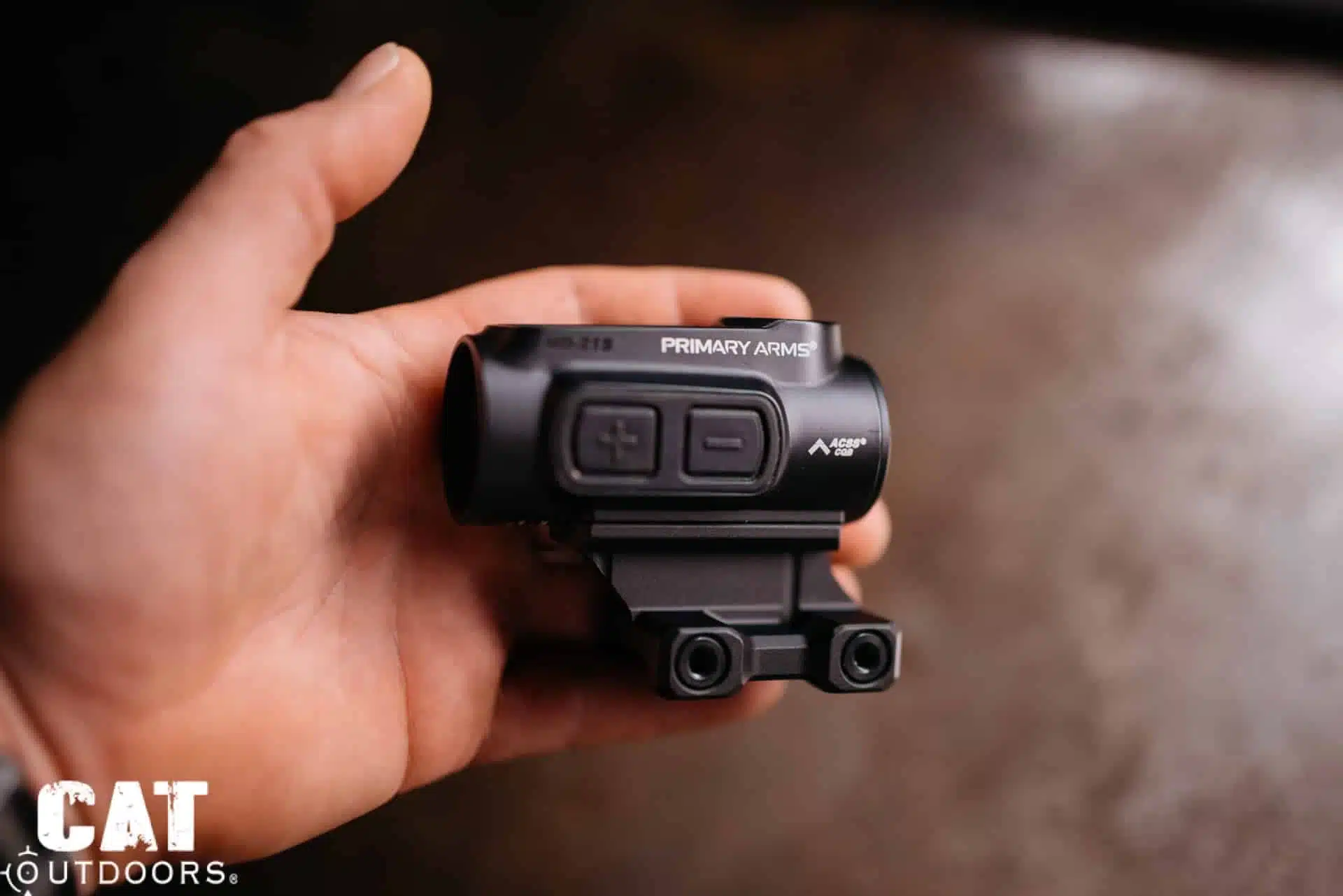
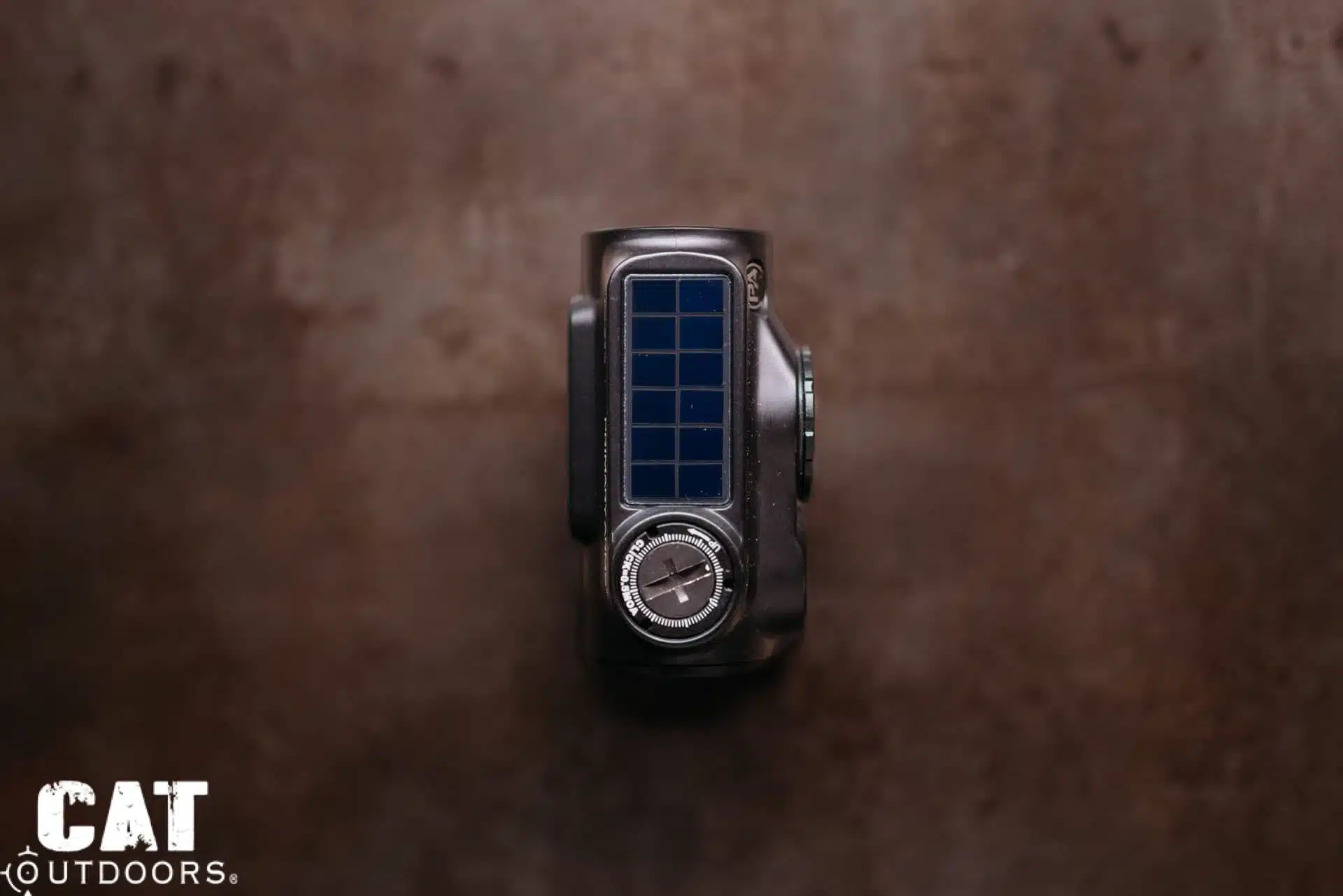
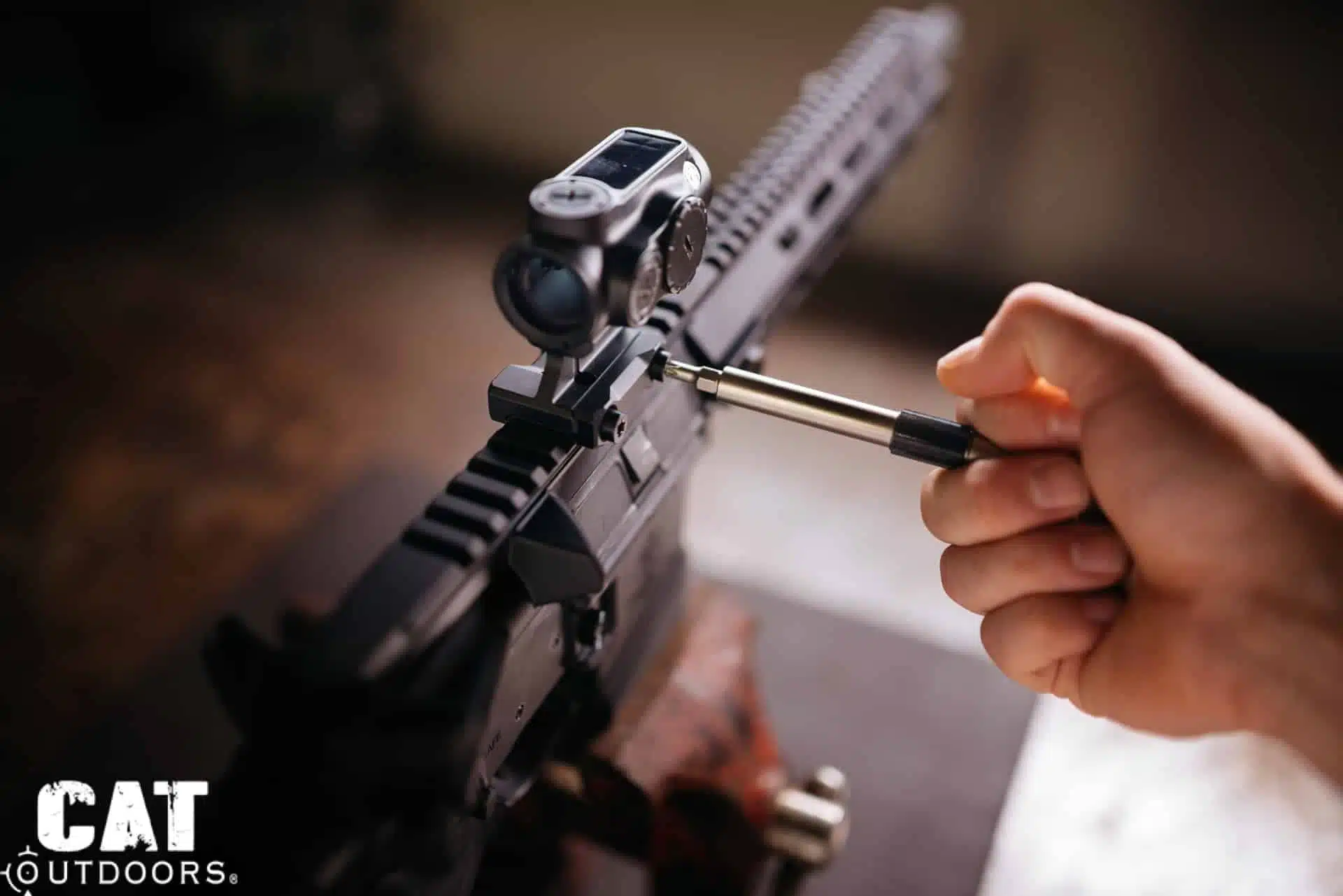
First choose either the low or high profile mount and attach it to the bottom of the optic. Then mount the optic to the Picatinny rail.
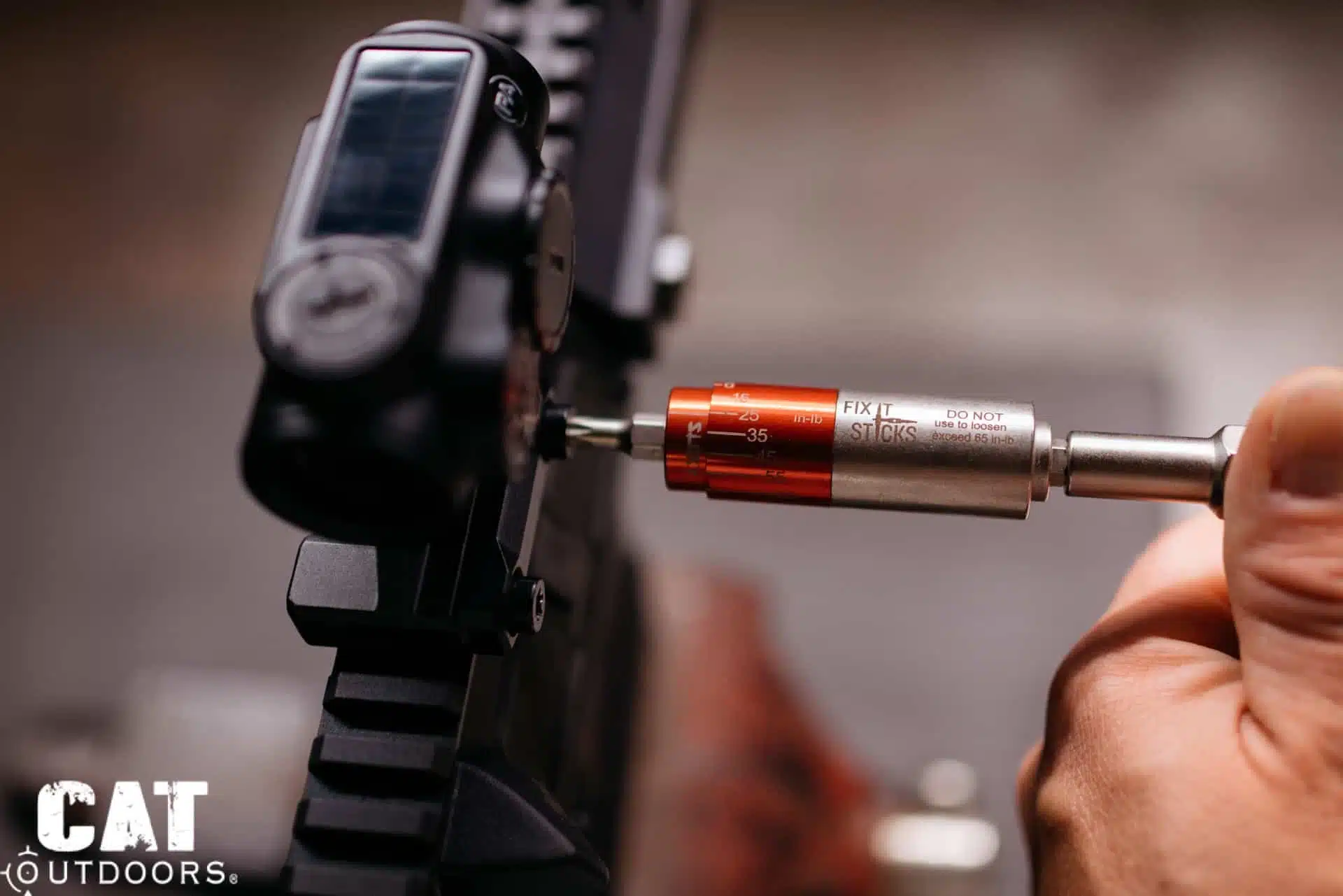
Mounting is just a matter of two screws and setting the torque to prevent under or over-tightening. If it’s under-tight, it might rattle loose. If you drive it too hard, you might strip the small screws. A good recommended torque setting is 20-25 inch pounds. For most of this assembly, I used only my set of Fix It Sticks and the universal torque limiter. If you want to know more about those, we have a full detailed Fix It Sticks review.
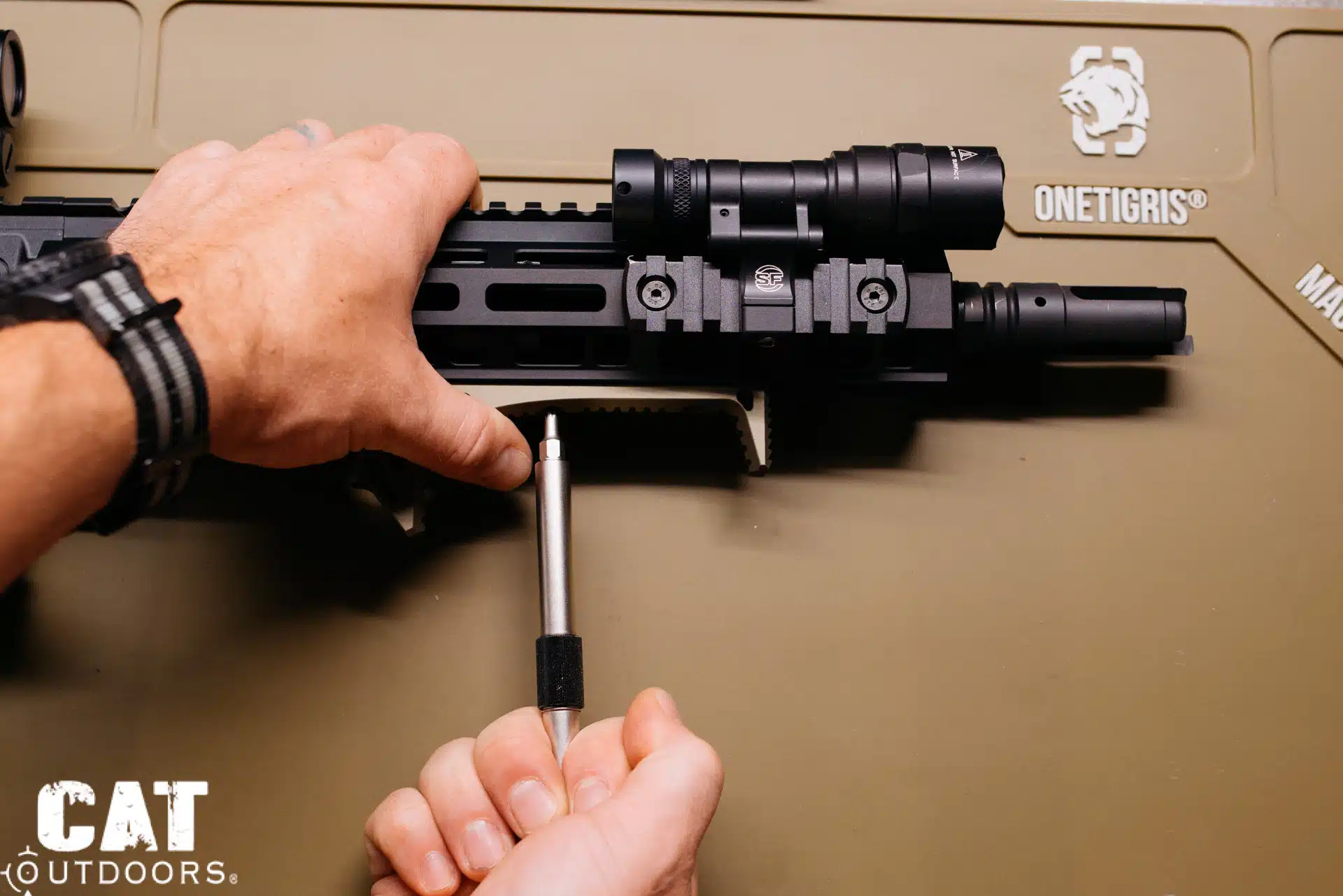
Moving toward the front end, I added a short section of M-LOK Picatinny rail to the right side and mounted my SureFire Scout Light Pro along with the Strike Industries LINK Curved Foregrip.
The Suppressor: CMMG ZEROED 36K
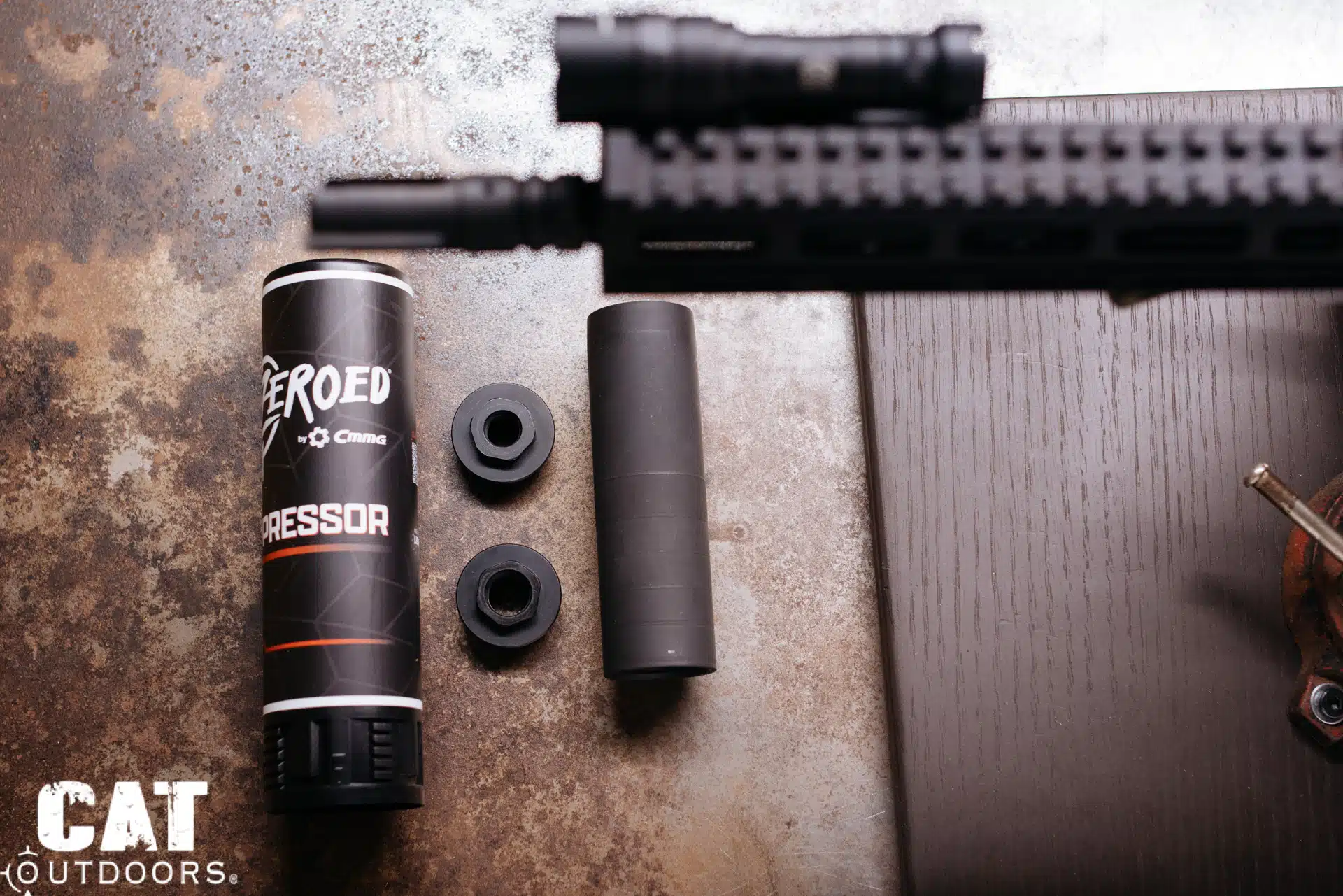
Next came the most exciting part: unboxing and mounting the CMMG ZEROED 36K. This is my first can.
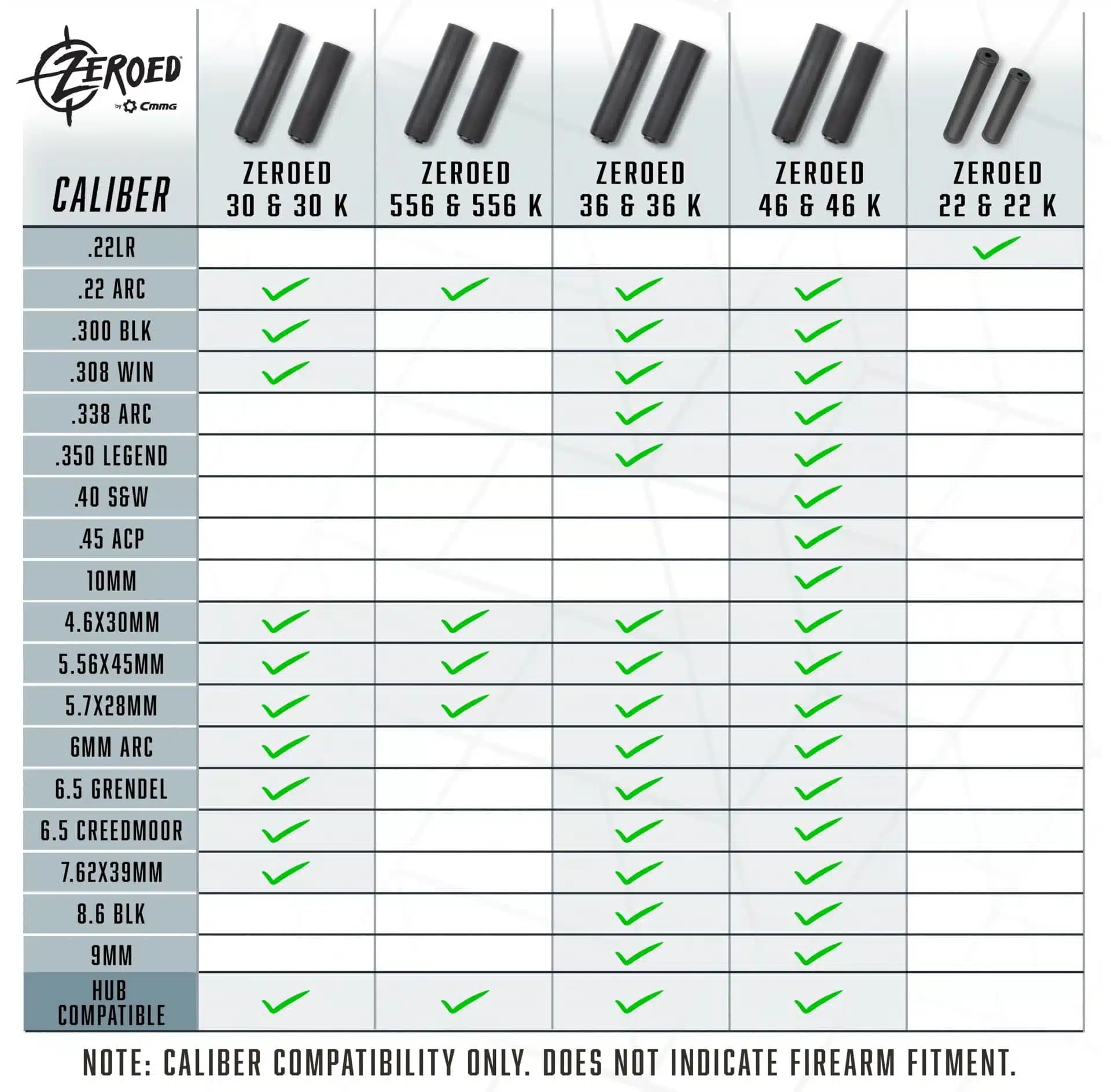
Many AR shooters choose a .30 caliber can, but I decided on the .36 cal for broader versatility. The drawback is that since the bore is larger, it’s not suppressing smaller calibers as well as a .30 cal can would. I wanted to be able to use it on multiple rifles and even pistols in the future, so I went with the larger one. Only time will tell if that was a good choice or not, but that’s what I did.
The 36K comes with direct thread hub mounts for both 1/2×28 muzzle threads for 5.56 barrels, and 5/8×24 muzzle threads, which is compatible with multiple calibers including 6.5 Creedmoor, .308, 7.62, and .300 Blackout.
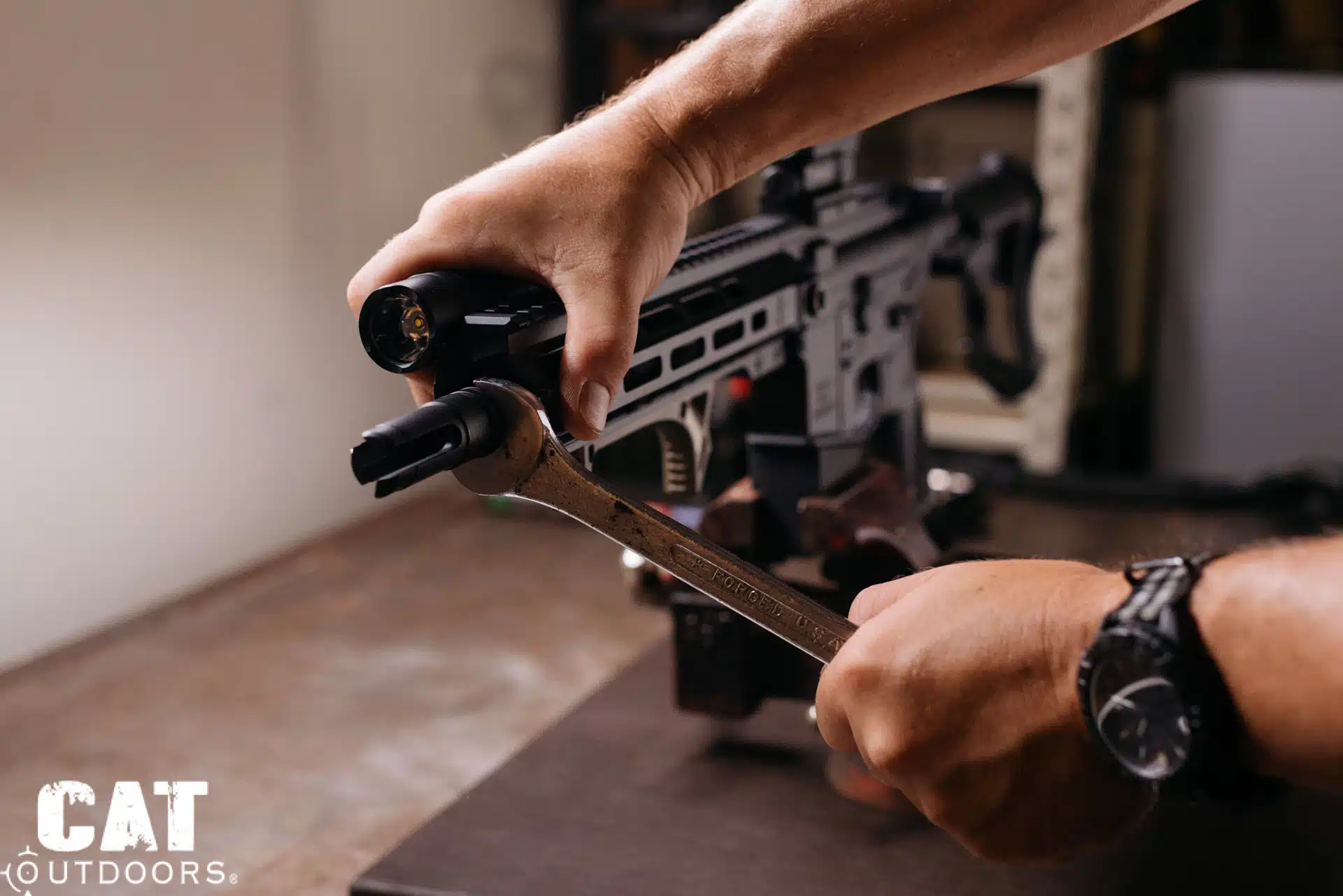
I removed the muzzle device using a 3/4-inch open-end wrench and mounted the suppressor.
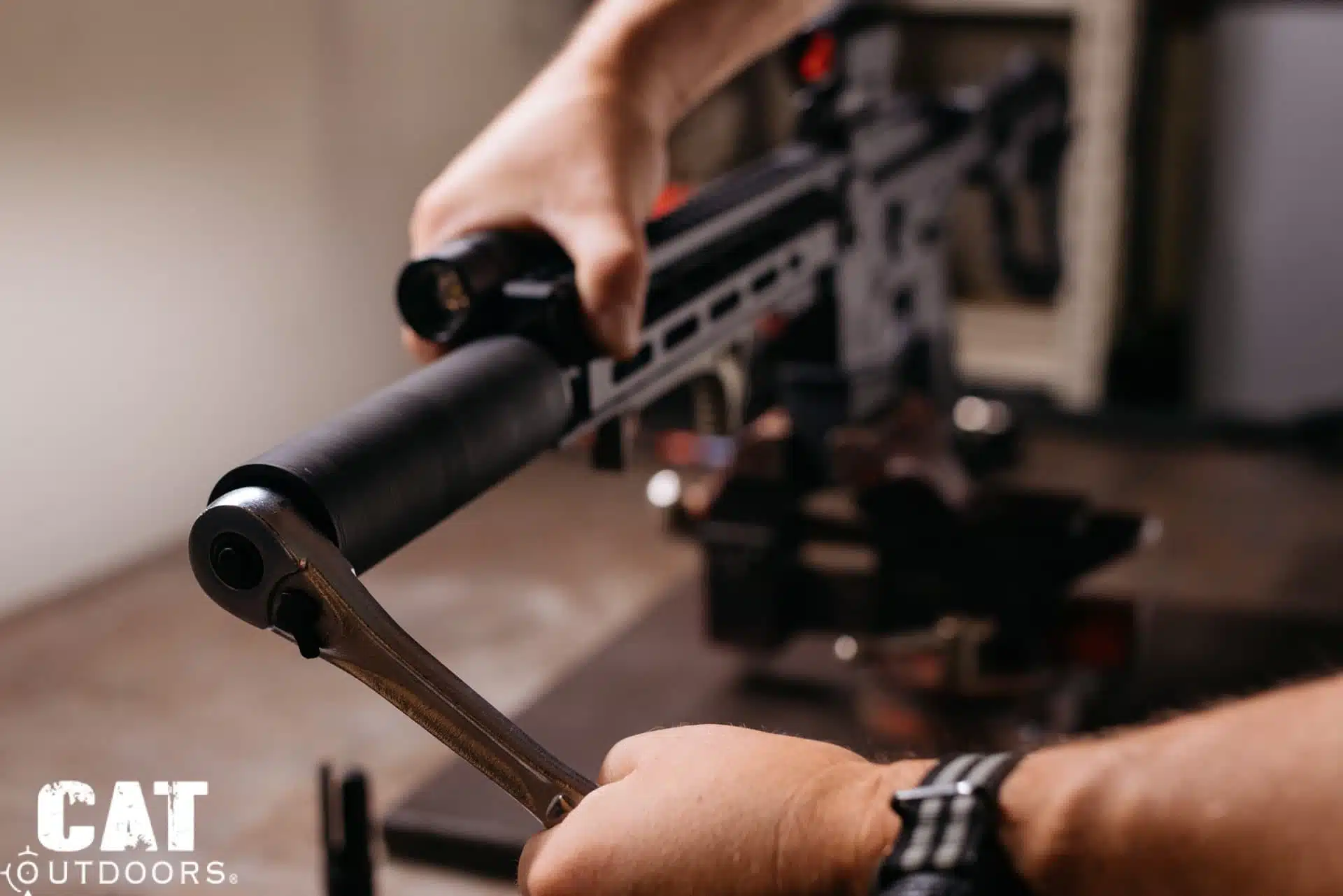
The muzzle of the suppressor features a square opening designed to fit a 3/8-inch drive ratchet wrench. This is especially useful if you choose to swap the can to a different gun while it’s hot.
A quick note on buying one, because suppressors don’t work like a normal checkout cart. The 36K runs roughly $500-550 depending on retailer. You can also buy it straight from CMMG, though an NFA transfer through a dealer is still part of the deal either way. Silencer Central handles the entire NFA process online (eForm 4, free trust setup, and the can ships to your door once approved). Brownells, GrabAGun, KYGUNCO (the lowest price we’ve seen), Guns.com, and BattleHawk Armory also stock it, with the transfer running through your local SOT dealer (a dealer licensed for NFA transfers).
Finishing the Build
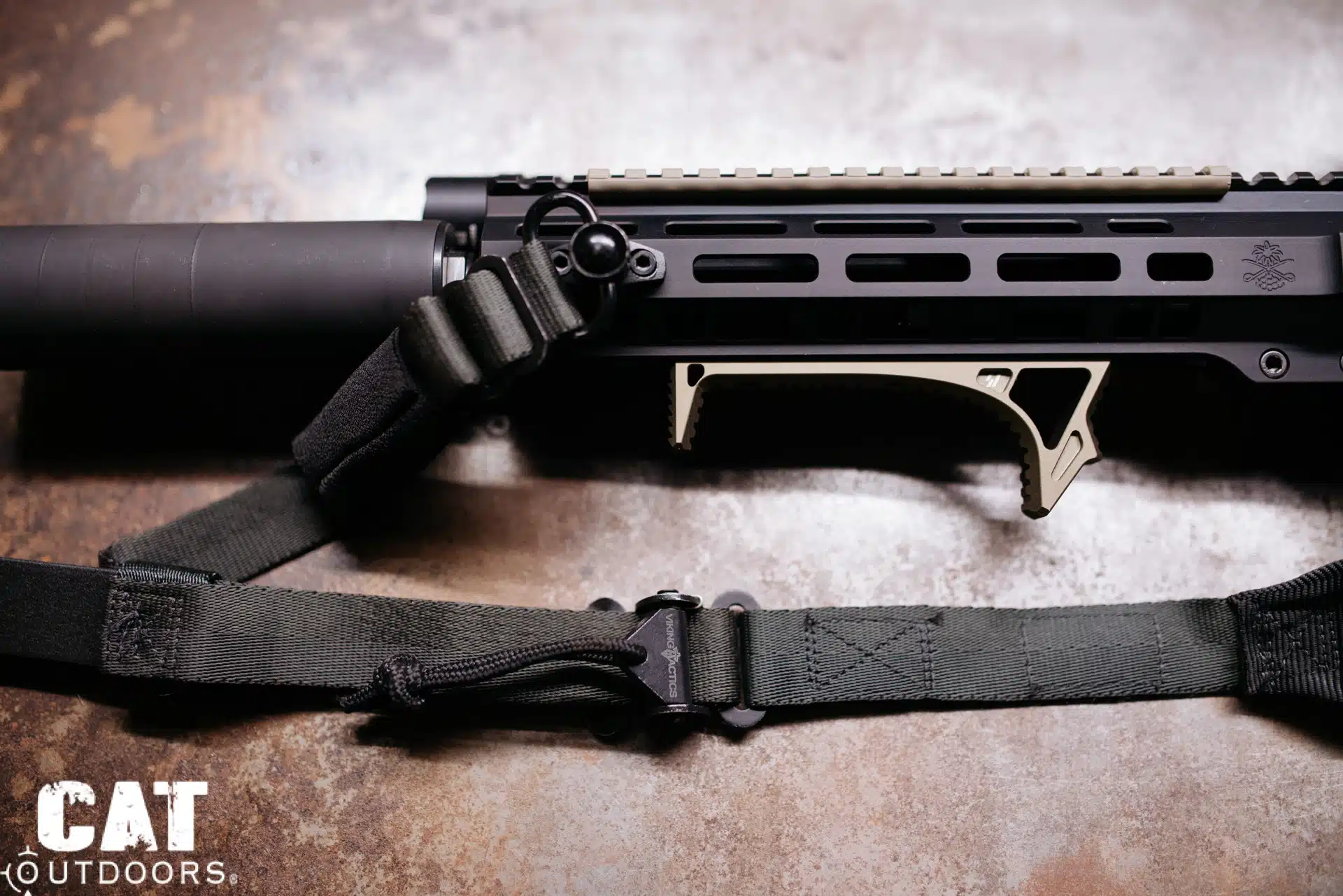
Finally, I like to attach my sling at the front end of the handguard instead of the rear where the factory mount is located, so I used the Continental Liberty M-LOK sling mount to attach my Viking Tactics sling.
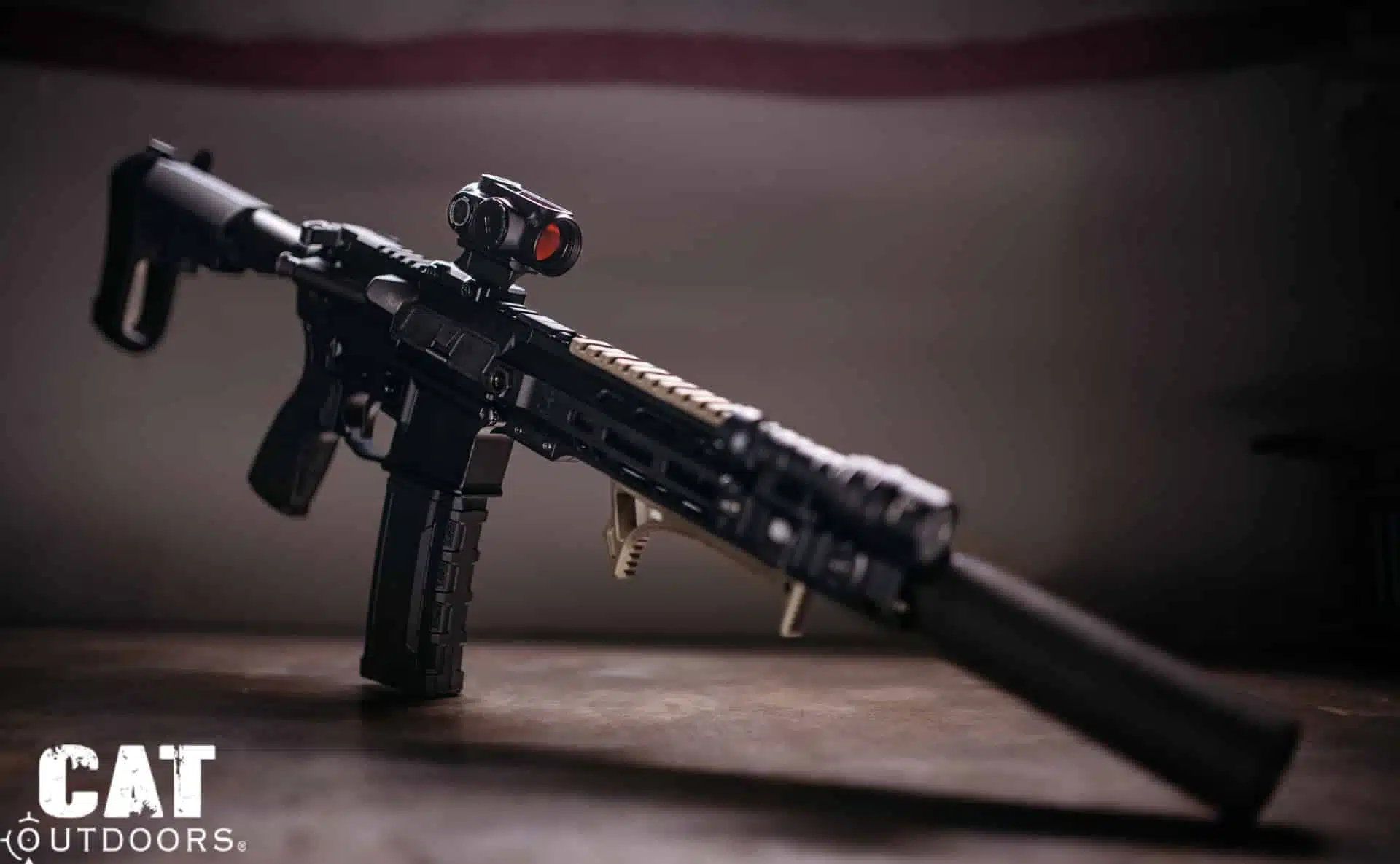
Voila! A complete rifle is born.
Or so I thought.
What I didn’t realize at the time was that assembling the rifle would be the easy part. Getting it to run exactly the way I wanted would require two separate range trips, multiple ammunition types, a chronograph, suppressor testing, and a crash course in gas system tuning.
Baseline Testing
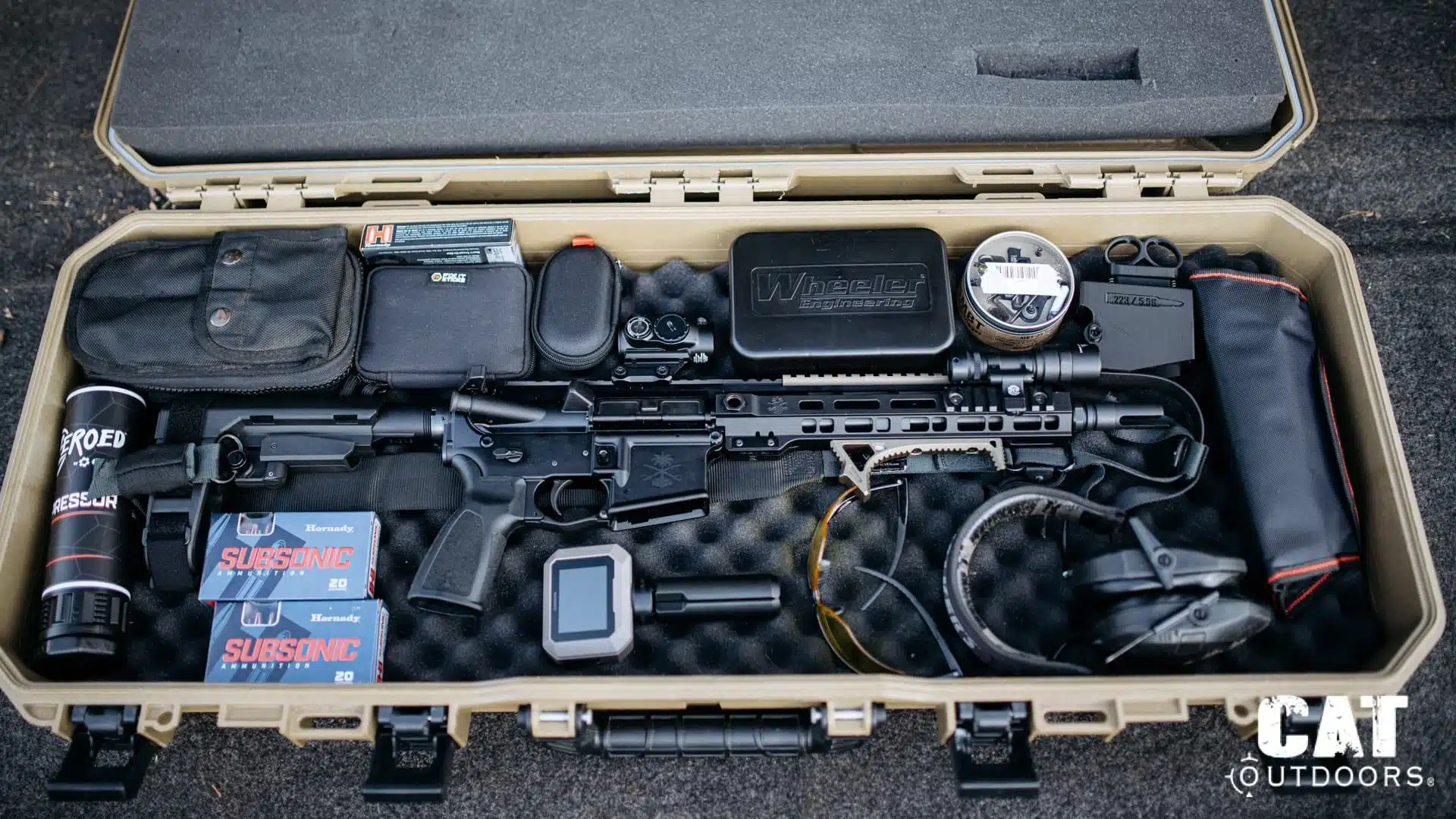
I knew going into this project that I was going to upgrade the trigger. But to do a proper review of the rifle itself, I first needed to establish baseline data on the rifle exactly as it arrived from PSA.
So when I got to the range, I removed the suppressor, reinstalled the factory muzzle device, and tested the rifle in its stock configuration with only the optic and foregrip attached.
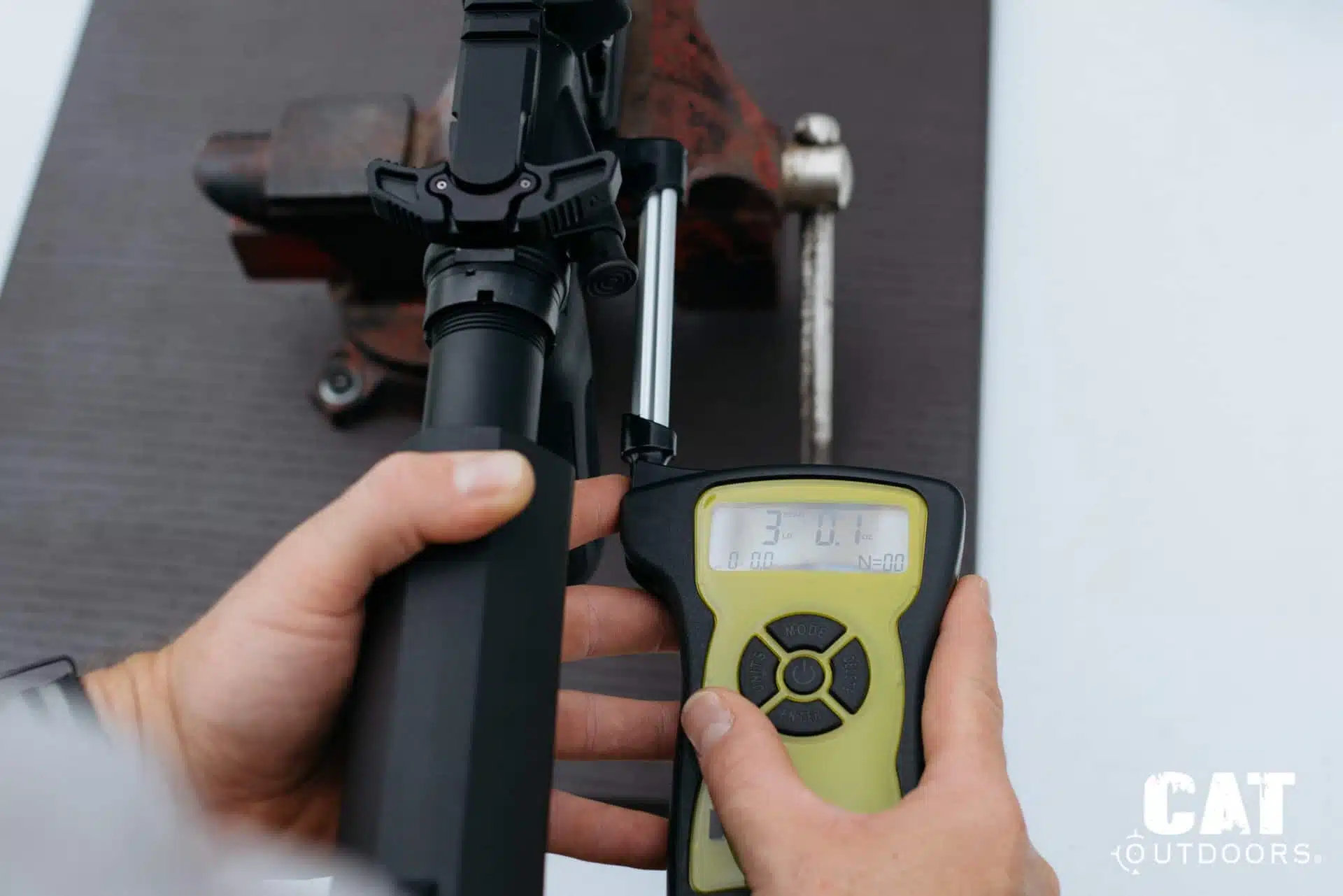
Factory Sabre mil-spec trigger, measured on the Wheeler Digital Pull Scale:
| Pull | Weight |
|---|---|
| #1 | 3 lb 8.9 oz |
| #2 | 2 lb 14.1 oz |
| #3 | 2 lb 7.3 oz |
| #4 | 2 lb 10.5 oz |
| #5 | 2 lb 13.1 oz |
| Average | 2 lb 14 oz |
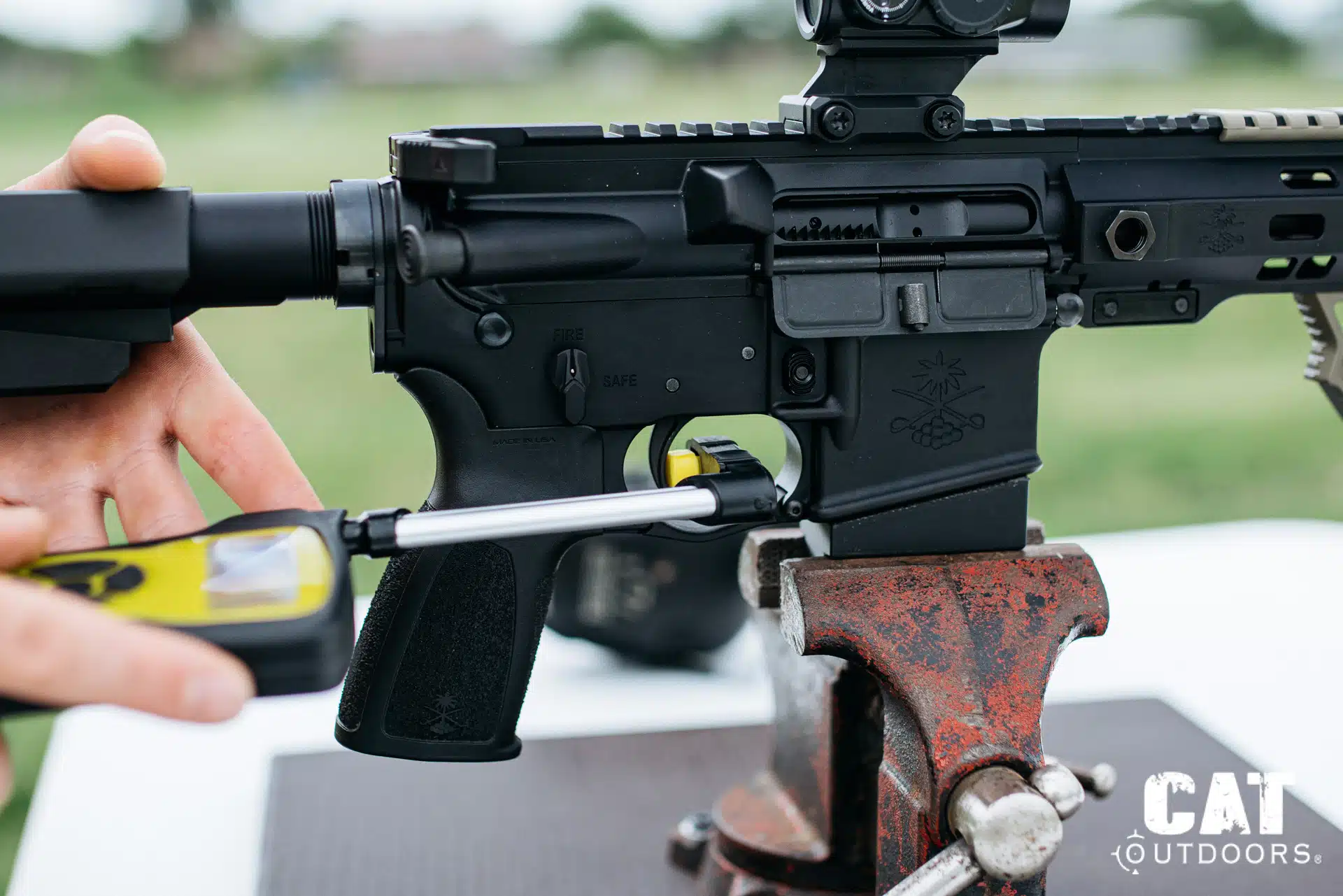
The first thing that surprised me was the light pull weight. An average of just under three pounds is considerably lighter than what most shooters expect when they hear the words “mil-spec trigger.” And it’s genuinely not bad at all.
The take-up is short (approximately 2mm) and smooth, and the wall (the point of firm resistance just before the break) is clearly defined. For the casual shooter, I’d say run it and don’t think too much about it.
If I put my connoisseur’s hat on, my biggest critique is what happens after you reach that wall. It doesn’t break immediately. There’s a slightly inconsistent amount of post-wall creep right before the shot breaks.
We’re talking about extremely small details here. If you’re rapidly shooting drills at the range, you’ll probably never notice it. But if you’ve spent time behind a truly exceptional trigger, you’ll know exactly what I’m talking about.
Rack the rifle, close your eyes, and slowly apply pressure while paying obsessive attention to what’s happening under your finger. That’s where you’ll feel the difference.
To be fair though, the Sabre trigger would probably improve and smooth out over time with use. Triggers rarely feel the same out of the box as they do after a few hundred or a thousand rounds. It’s a completely realistic use trigger, and noticeably better than a basic mil-spec unit. It just isn’t a trigger that gets you excited.
First Shots: Zeroing the GLx
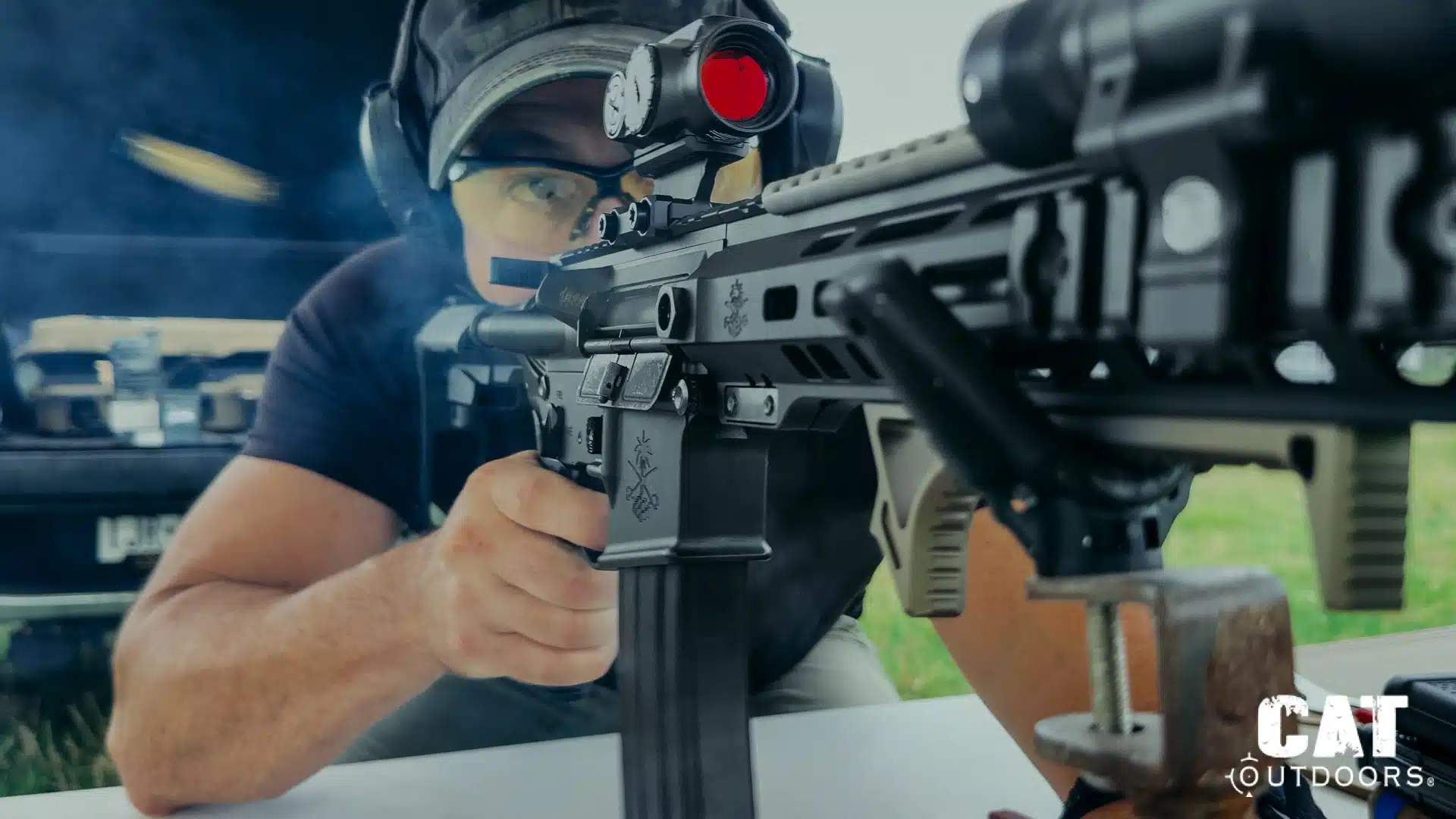
I split my testing across two range sessions with my brand new rifle setup. The first was on private property, where I could take my time, fuss over details, and record results, but I was limited to a max range of 50 yards. For the second I went to a public range with distances up to 200 yards, where I tested accuracy at distance, compared ballistics between supers and subs, and made use of the reticle holdover dots.
Range Day 1
Distance: 25 yards
Ammo: Hornady BLACK 110 gr V-MAX supersonic
My first three-shot group landed roughly 1.5 inches left and about 2 inches high. After a few windage corrections, the second group confirmed I was headed in the right direction. A final elevation adjustment brought everything where I wanted it.
11 rounds. 10 clicks right. 20 clicks down.
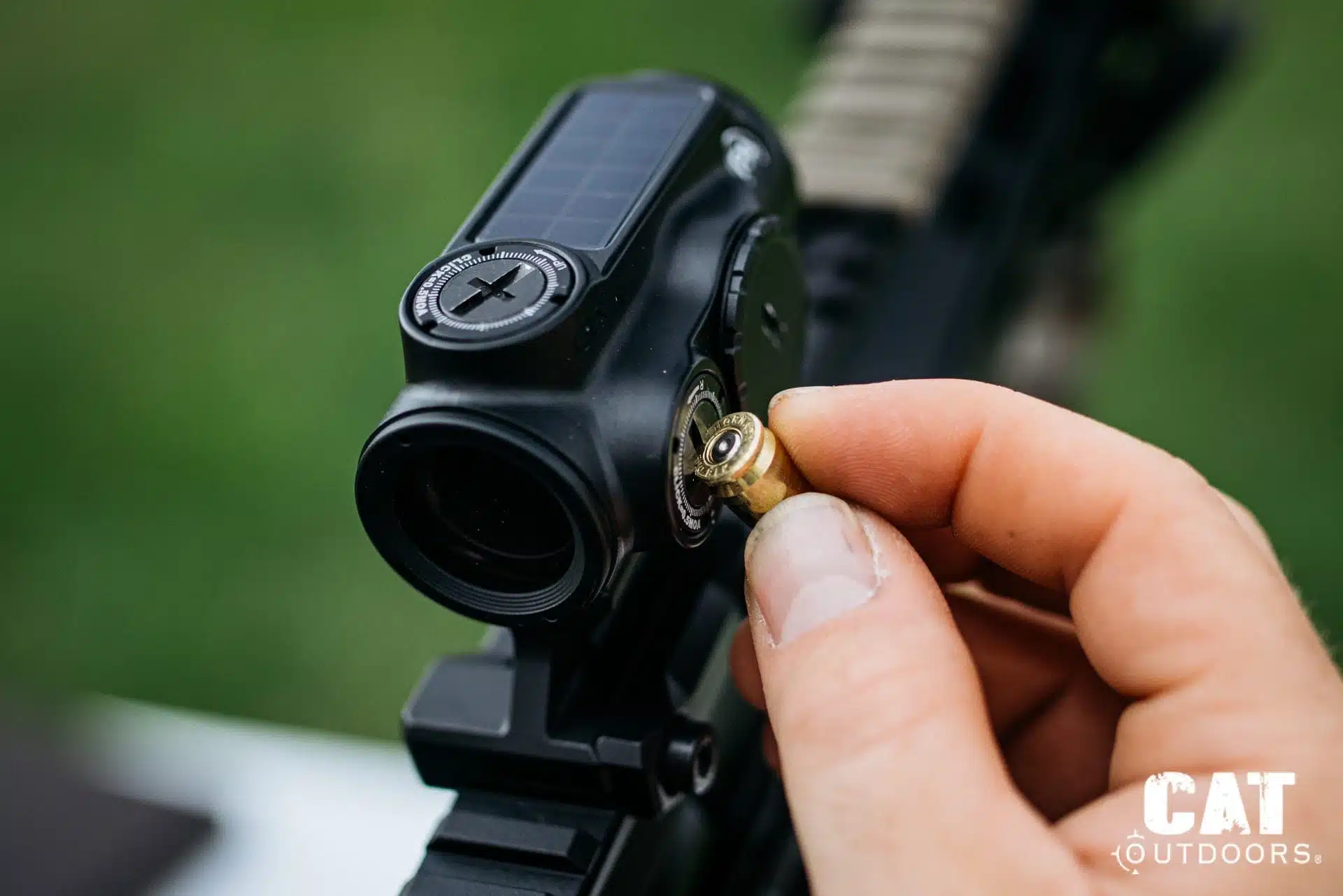
Many optics have protective screw caps covering the turrets, and they have to come off before you can make adjustments. The GLx does not. Instead, the turrets are slightly recessed into the aluminum housing and can only be turned with a tool: a screwdriver, a coin, a key, or just the edge of the back end of a round. You never have to worry about remembering to bring a tool, because you will almost certainly not have forgotten to bring ammo.
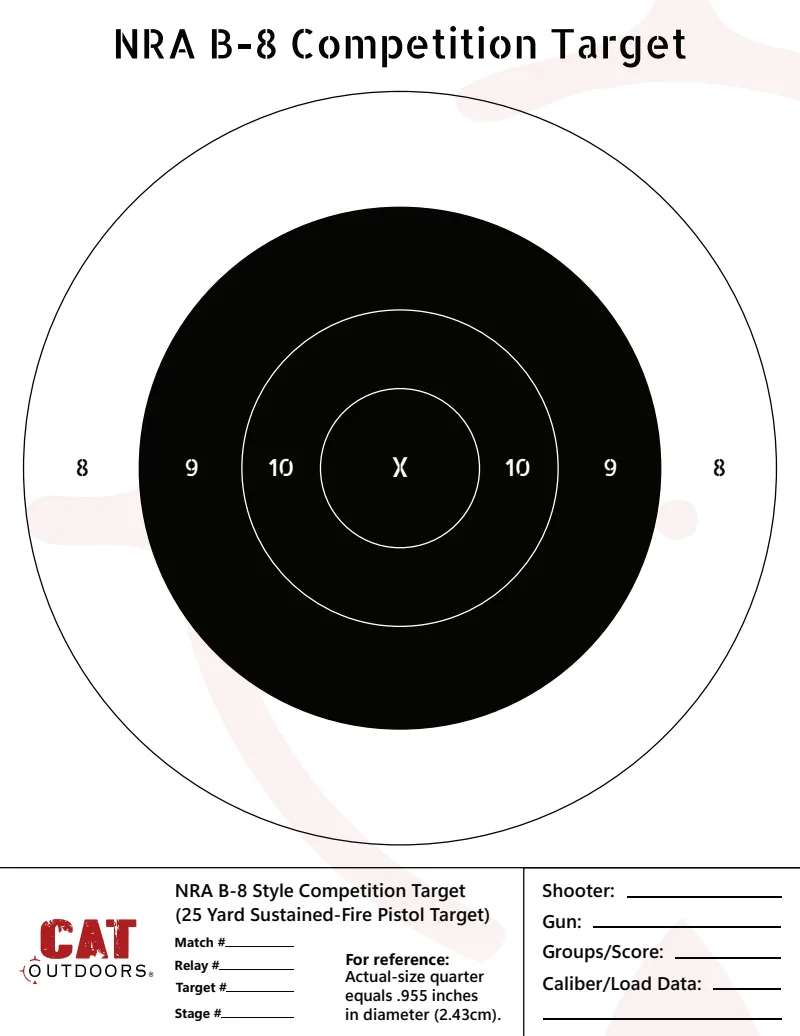
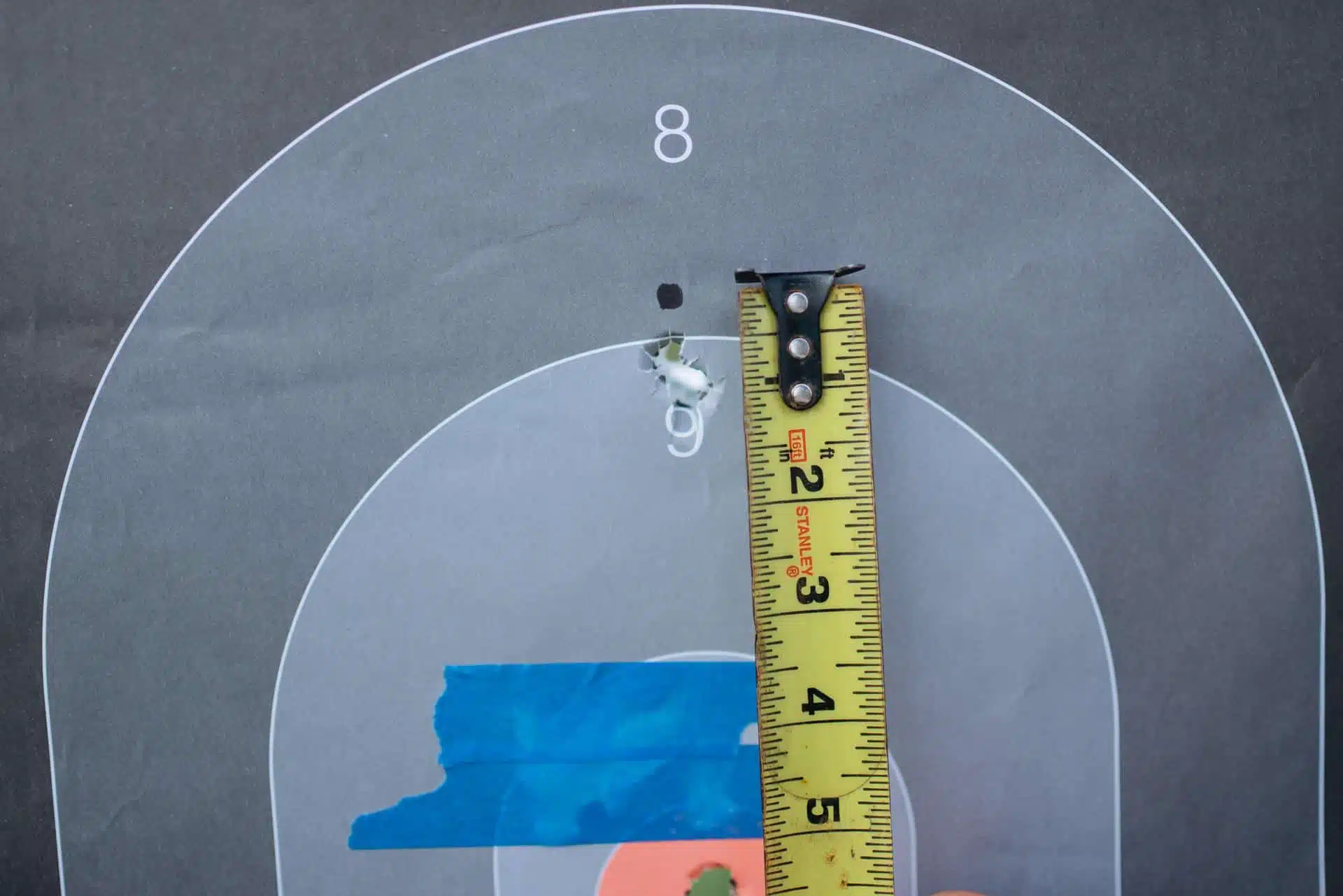
From 25 yards, I was aiming at a black marker dot one inch above the “9” on my target, and the impacts landed almost exactly where I expected for a provisional 50-yard zero. I wanted to hit the 9, but I knew the suppressor and the ammo experiments were still coming, and my final point of impact would probably shift with them. This was a good place to stop and reinstall the suppressor.
First Suppressed Shots
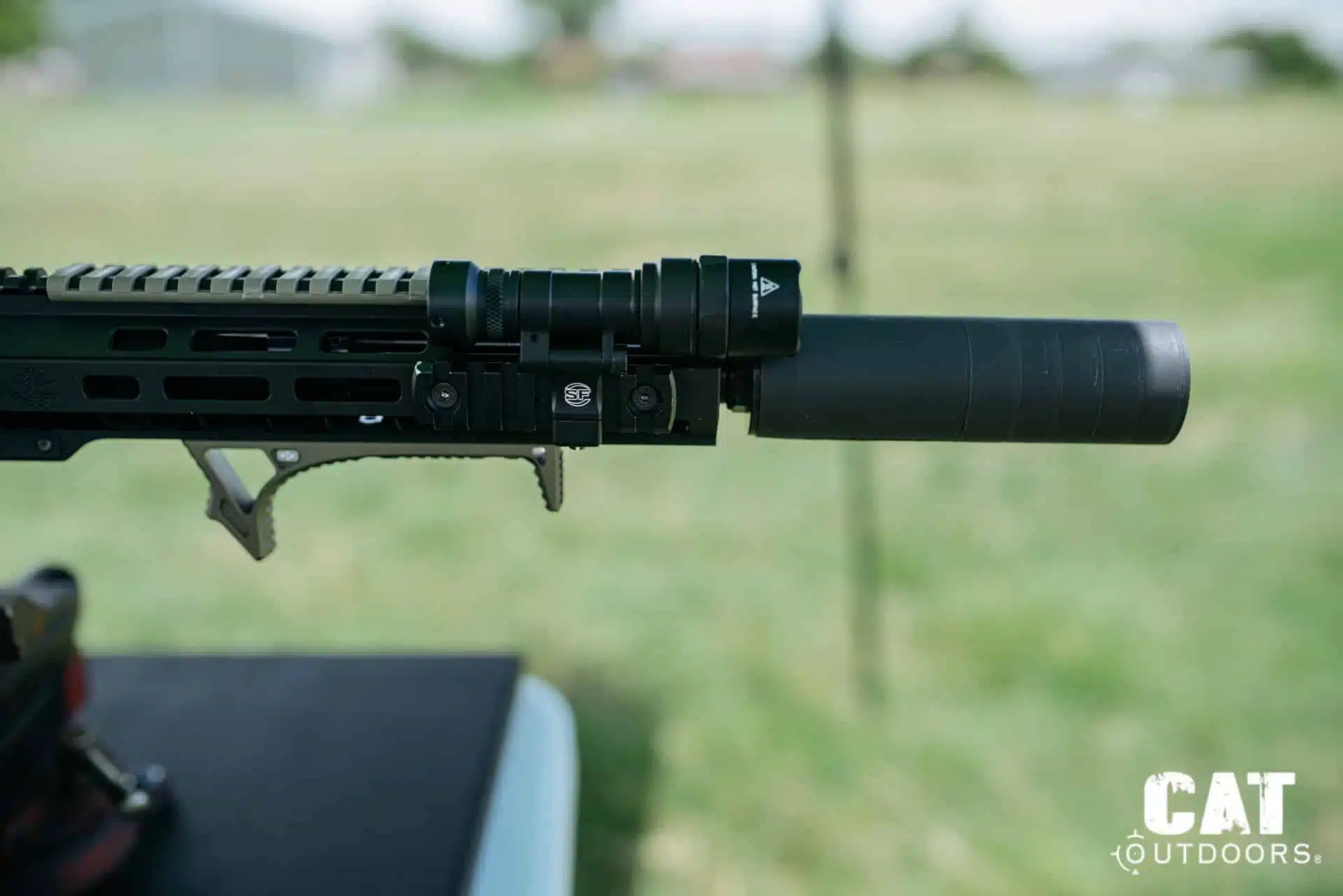
Ammo: Hornady BLACK 110 gr V-MAX supersonic
With my baseline testing complete, it was finally time for the part I had been looking forward to most: threading on the whisper pickle.
The first thing I noticed was that .300 Blackout simply isn’t as loud as a 5.56 to begin with. Even unsuppressed, it has a lighter concussive report that I would compare to an unsuppressed pistol cartridge rather than a rifle round. Once I mounted the suppressor, the rifle became noticeably quieter. The concussive report was practically eliminated, although the supersonic ammunition still produced the unmistakable crack of the bullet breaking the sound barrier.
Liking this one? Add CAT Outdoors as a preferred source on Google and stories like it show up first.
Add on GoogleMy first suppressed group also showed a shift in point of impact, landing low and left from my previous zero, so I made the necessary adjustments before continuing.
On the fifteenth suppressed round, while still shooting the Hornady 110-grain supersonic ammunition, I experienced what would become the first of many cycling malfunctions.
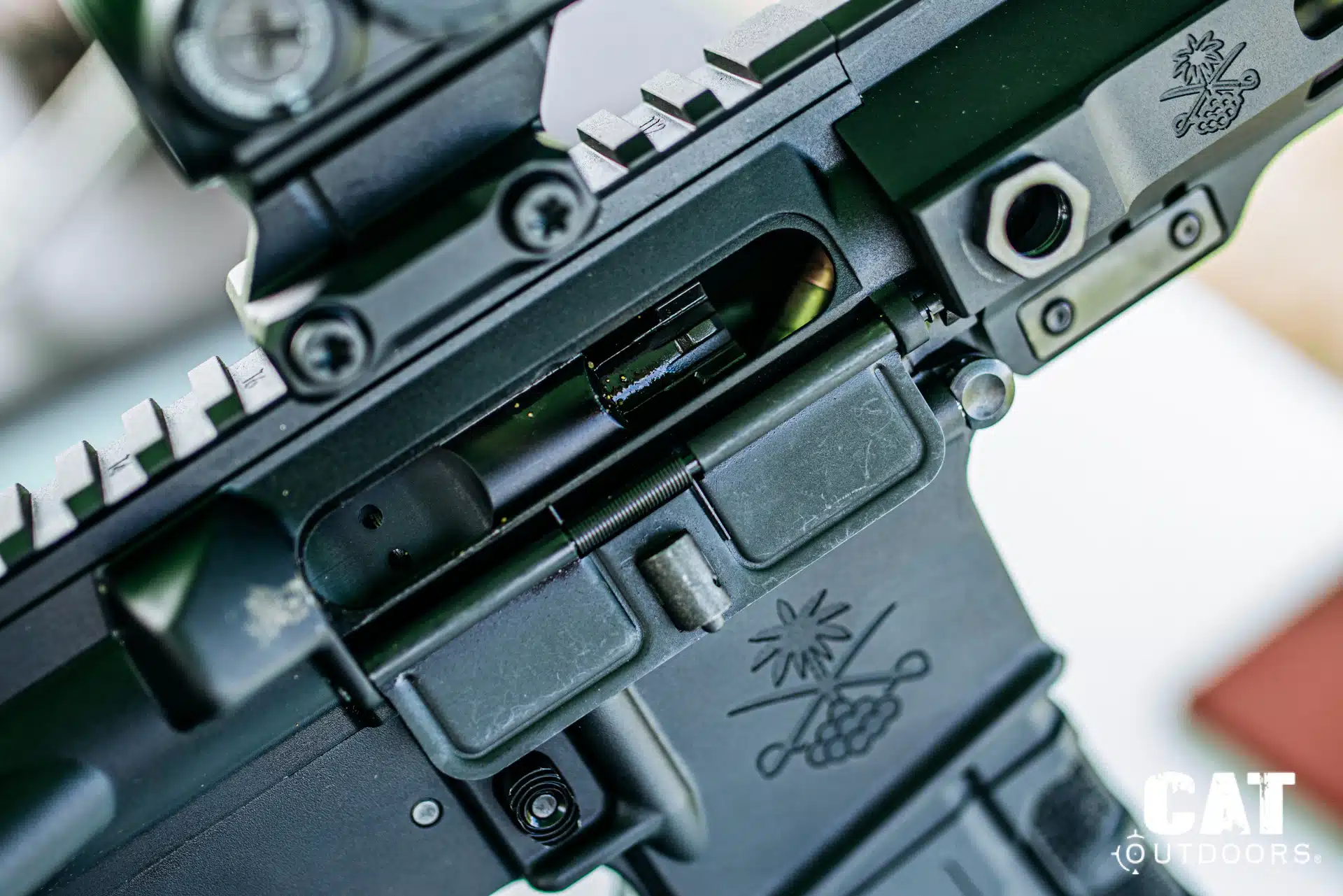
At the time, I wasn’t overly concerned. One malfunction on a brand-new rifle isn’t enough to establish a pattern, so I cleared it and finished the mag.
Time to Load the Subs
Ammo: Hornady Subsonic 190 gr Sub-X
My first impression was that it was louder than I had expected, but still surprisingly comfortable. I would describe it as sounding something like a nail gun. It certainly wasn’t silent, but it also wasn’t harsh. For slow, deliberate shooting, I found it comfortable enough that I wasn’t bothered shooting without hearing protection, although I still wouldn’t make a habit of that. Hearing damage is cumulative over time and through repeated exposure, and I’ve spent enough time around power tools to know that firsthand.
After confirming a point-of-impact shift with the subsonic load, I began experiencing a continuing pattern of malfunctions. Since I didn’t yet know where the problem originated, I started eliminating variables one at a time.
In all my years of shooting, I’ve never actually experienced a magazine-related defect, but that’s what I often hear other shooters suspect first. So I switched from using a Global Ordnance metal magazine to the factory PSA PMAG. When I experienced failures with that magazine, I switched again to a Magpul TMag. The malfunctions continued across a total of 7 different magazines:
- Magpul PMAG Gen M3 (x2)
- Magpul TMag
- Lancer Hybrid
- D&H Aluminum
- Global Ordnance
- PSA Sabre Mag
At that point, I was ready to cross off a magazine-related problem.
My first guess was that the rifle might be under-gassed with the subsonic ammunition. I switched back to the supers, ran another mag, and had similar malfunctions again. Since this was my first experience with a suppressed .300 Blackout, I didn’t yet have enough knowledge to know whether I was interpreting the symptoms correctly.
I didn’t have any cell service where I was, so I couldn’t ask the Googles for help at the moment, but I was starting to suspect a gas system issue. It could have been an ammo-related issue, but I had always known Hornady to be a good brand, so I was baffled if that was the source of the problem. And I had no experience adjusting gas systems, which meant I had homework coming.
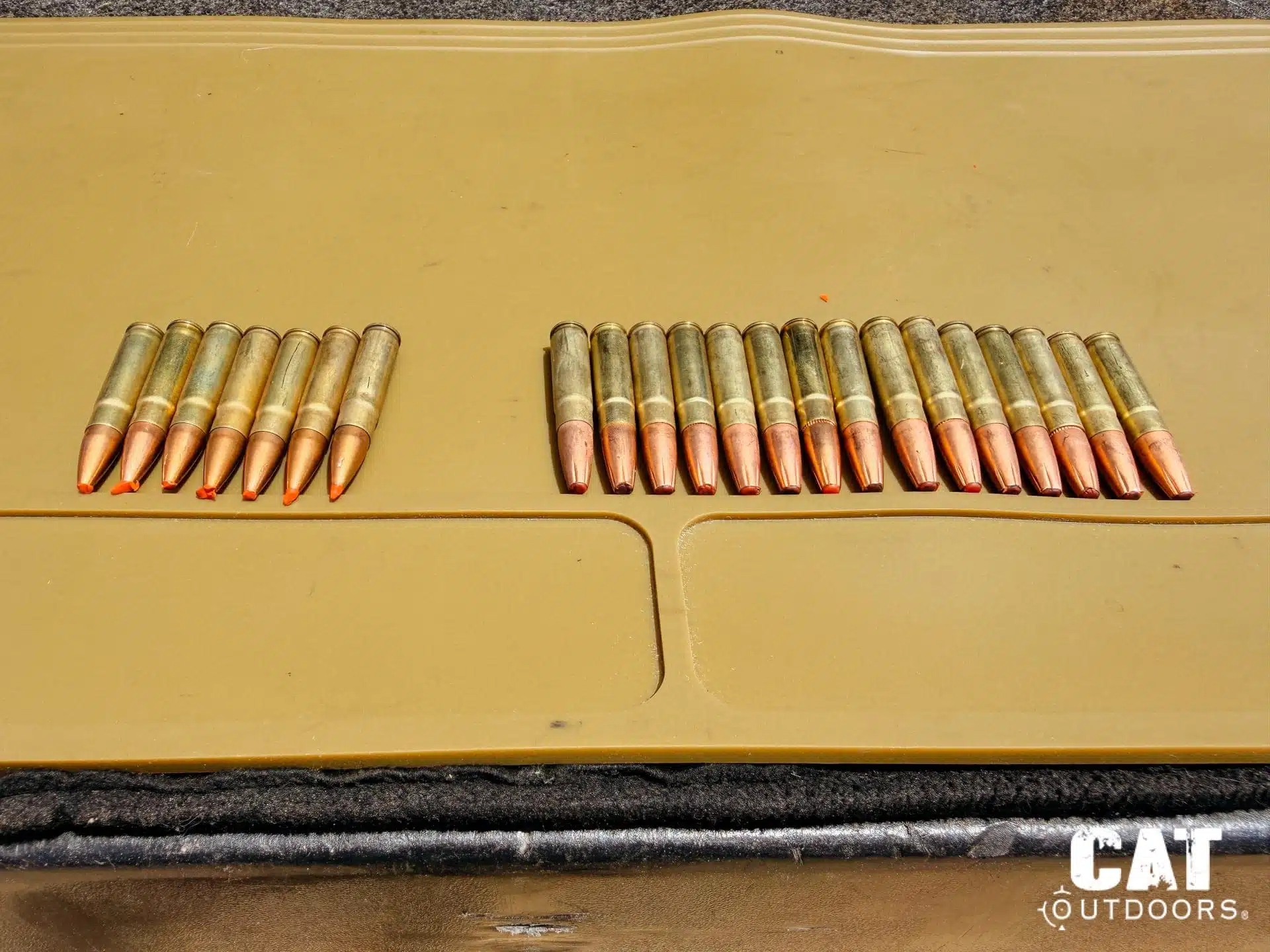
At roughly $1.25 per round, every malfunction felt expensive, and all I knew was that I was looking at a growing collection of damaged ammunition.
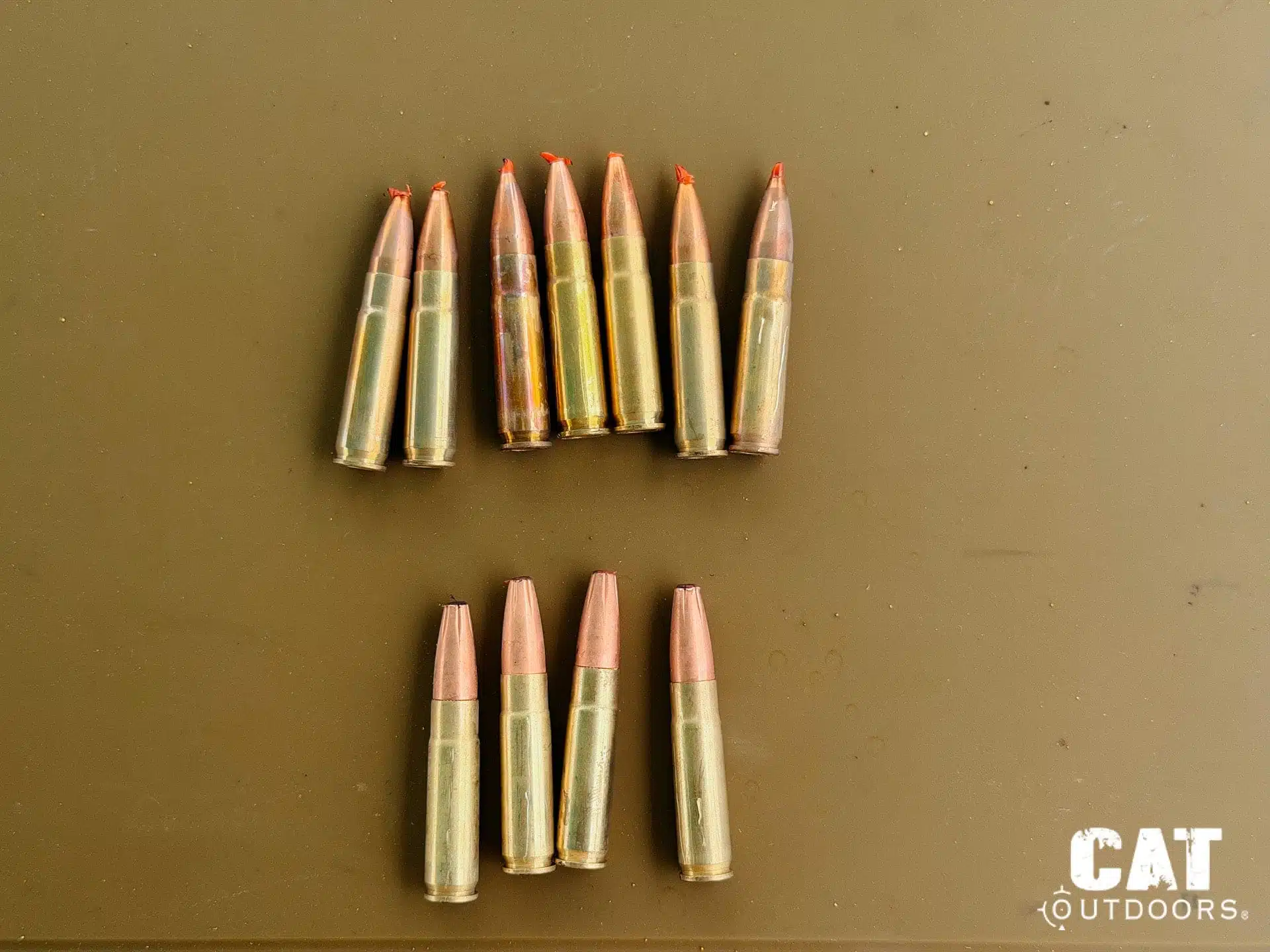
At the end of the day, I left with more questions than answers. For now, I would finish out the day by swapping the trigger and running a few rounds to feel the difference.
Trigger Upgrade: LaRue Tactical MBT-2S
I’m not a certified gunsmith, but I’ve swapped enough triggers to feel comfortable doing it in the field. It took about 15 minutes, and I was ready to send some more lead downrange.
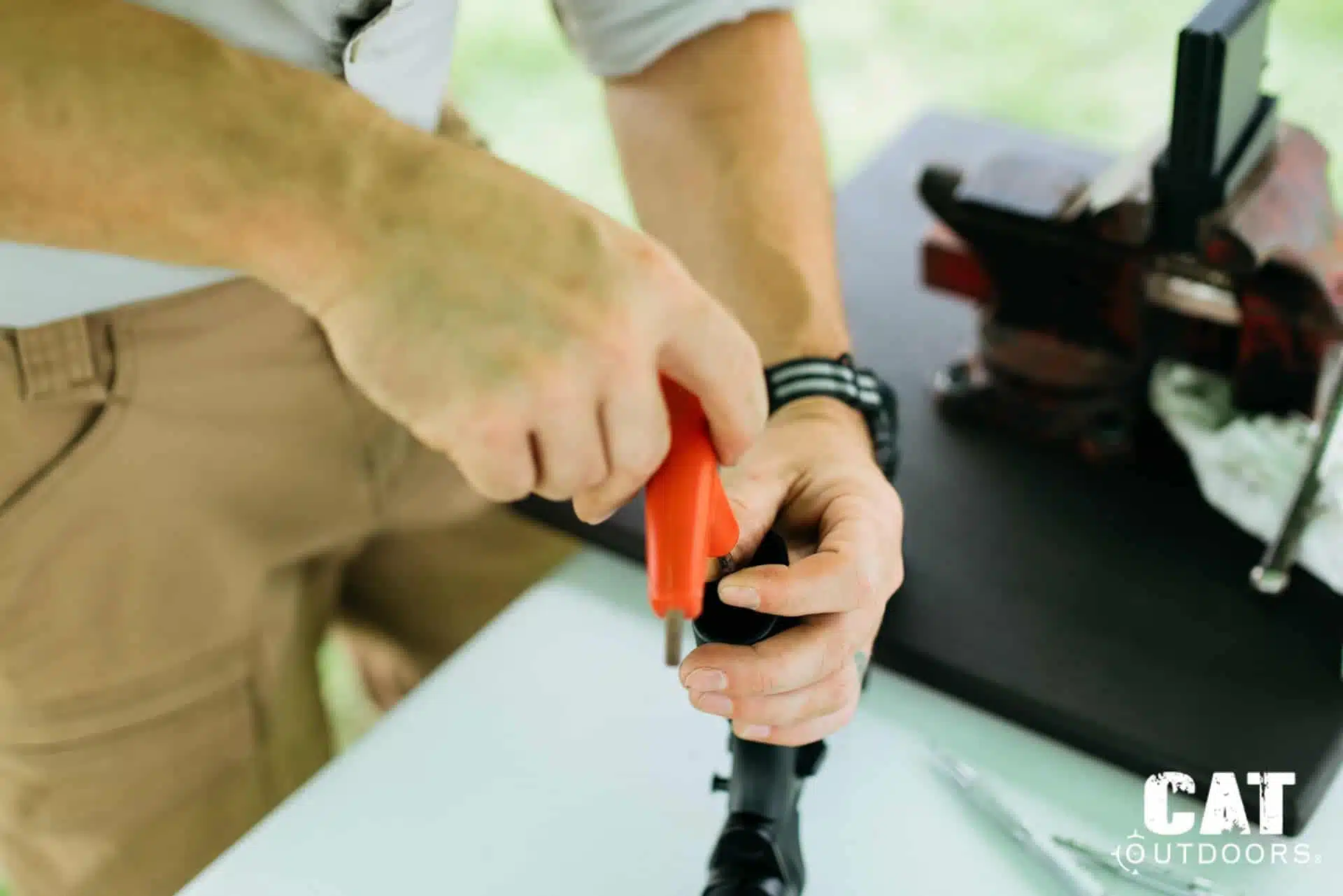
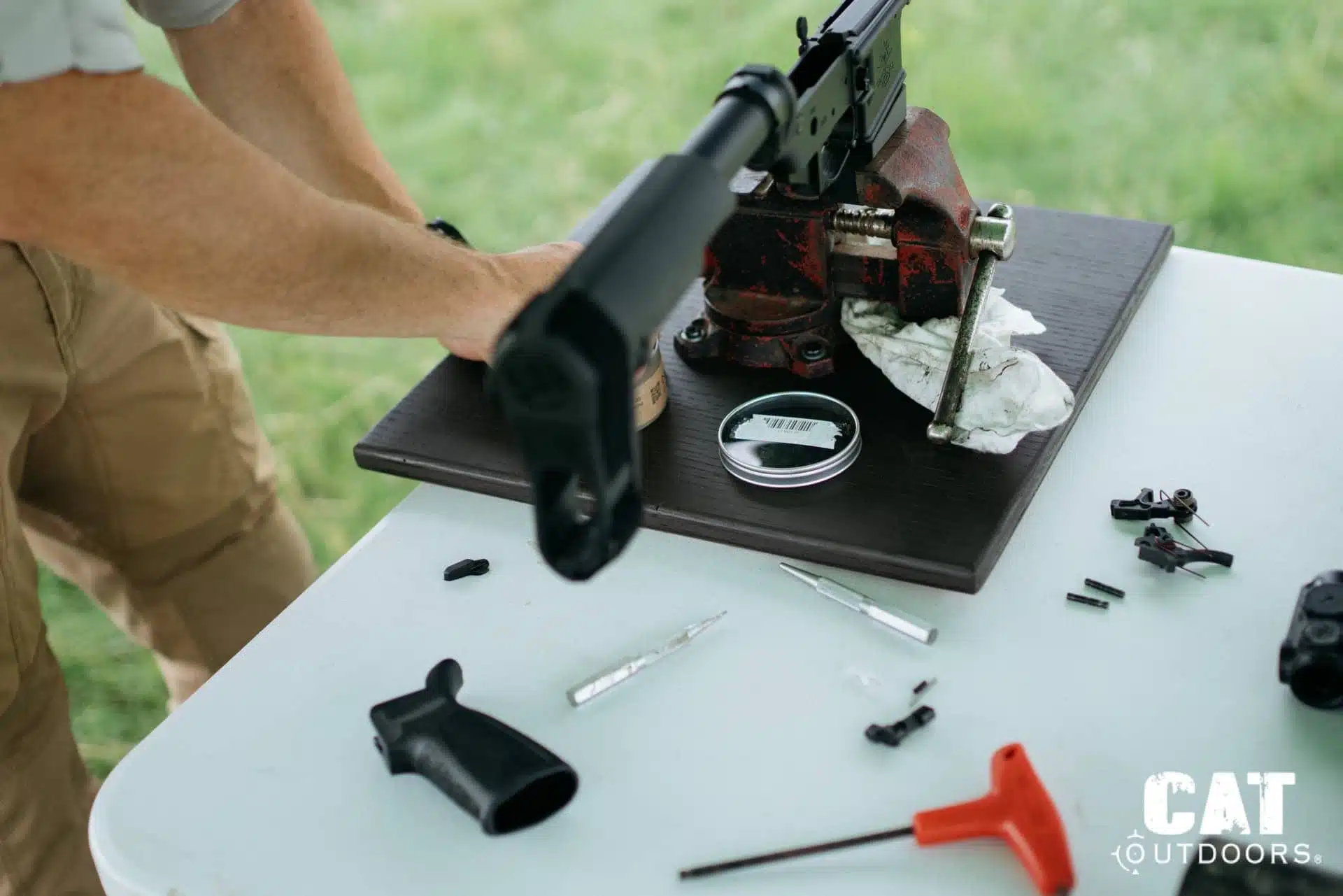
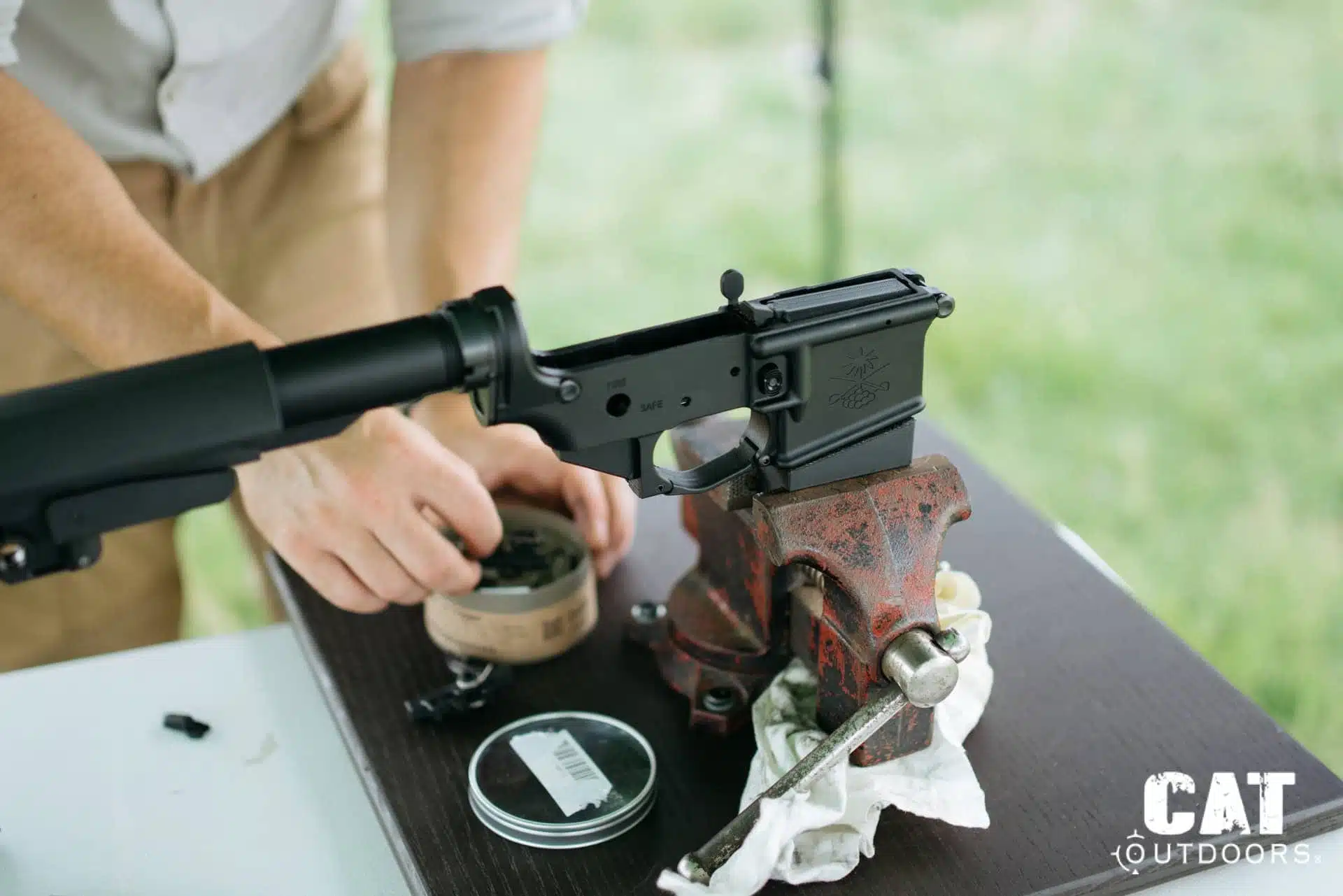
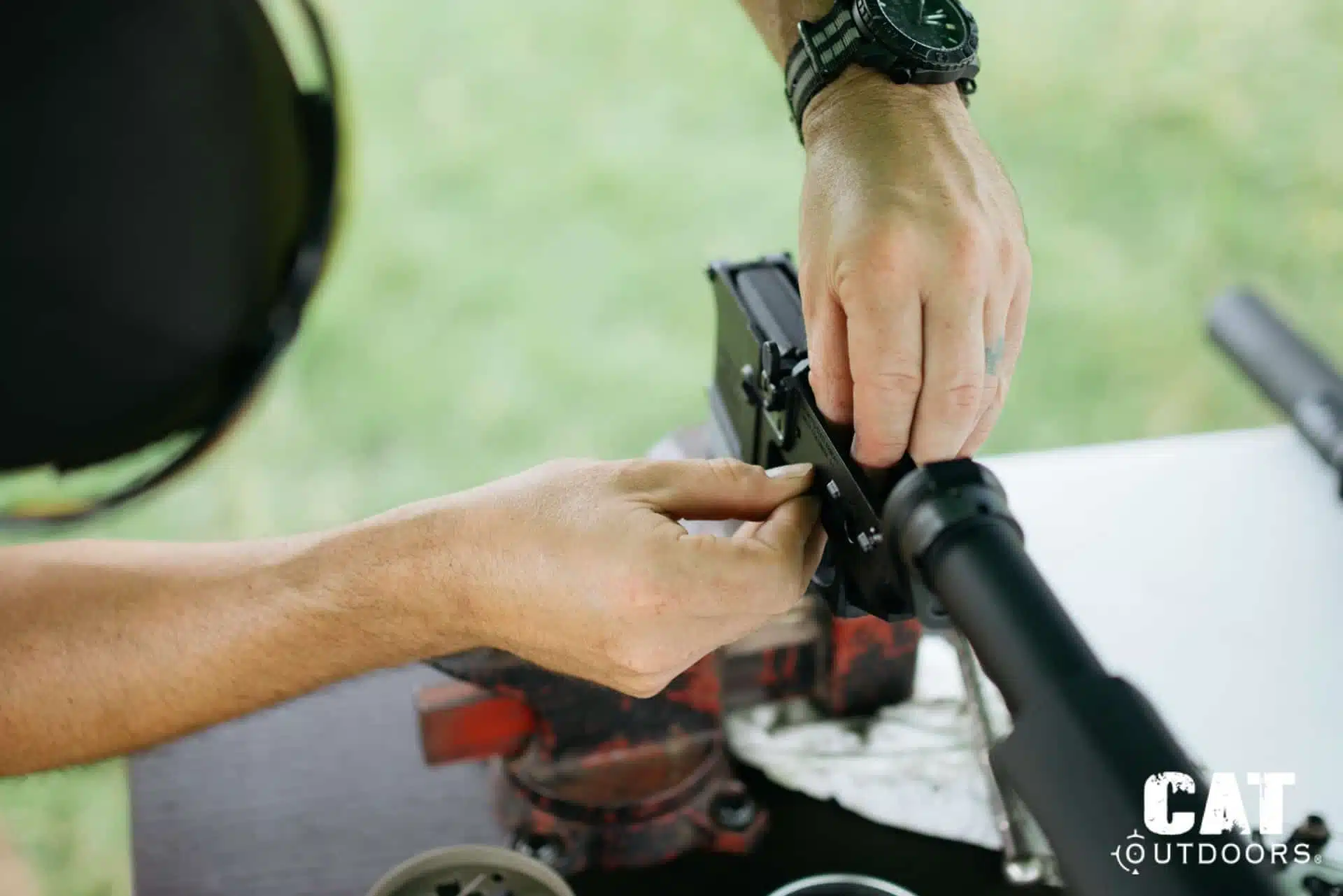
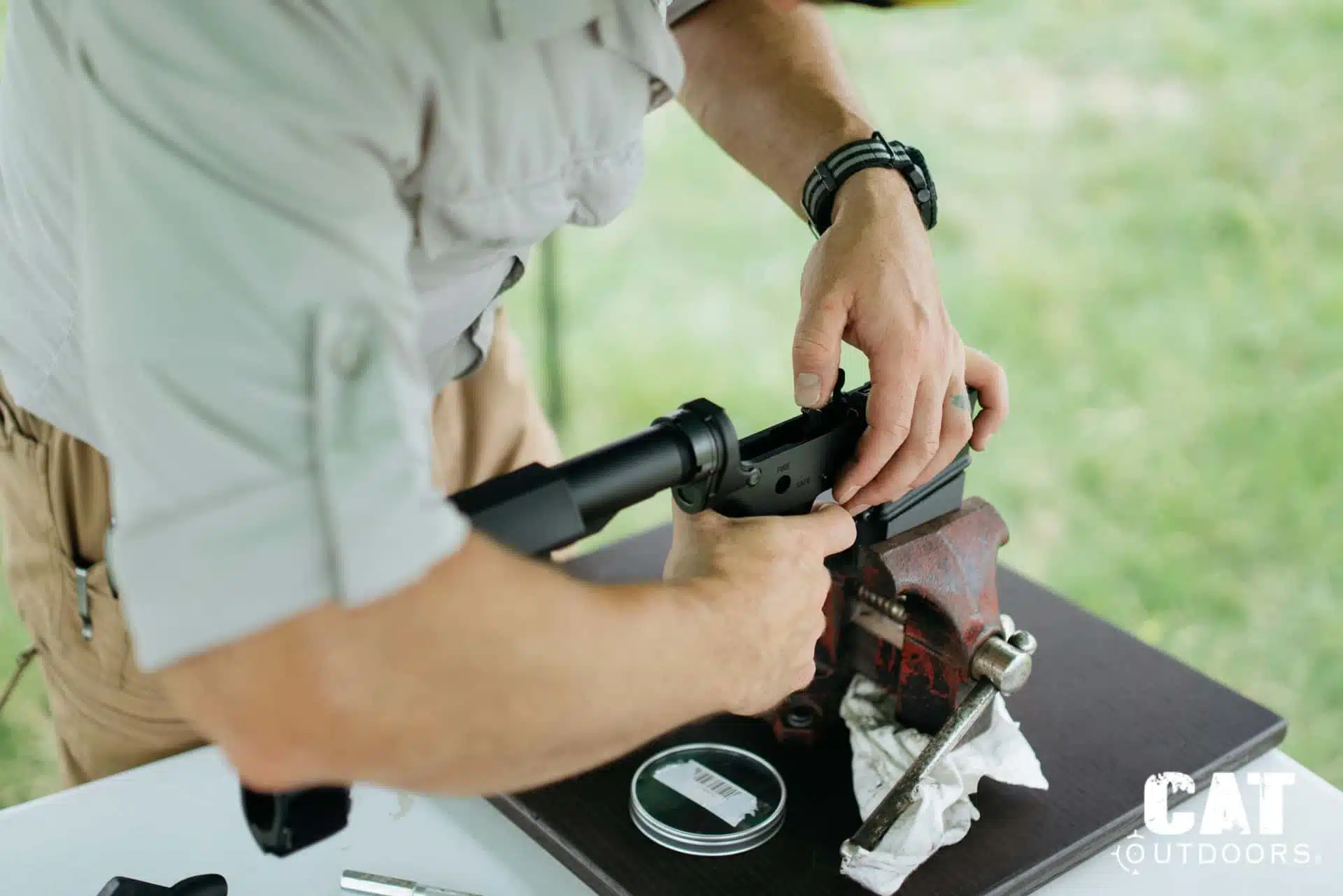
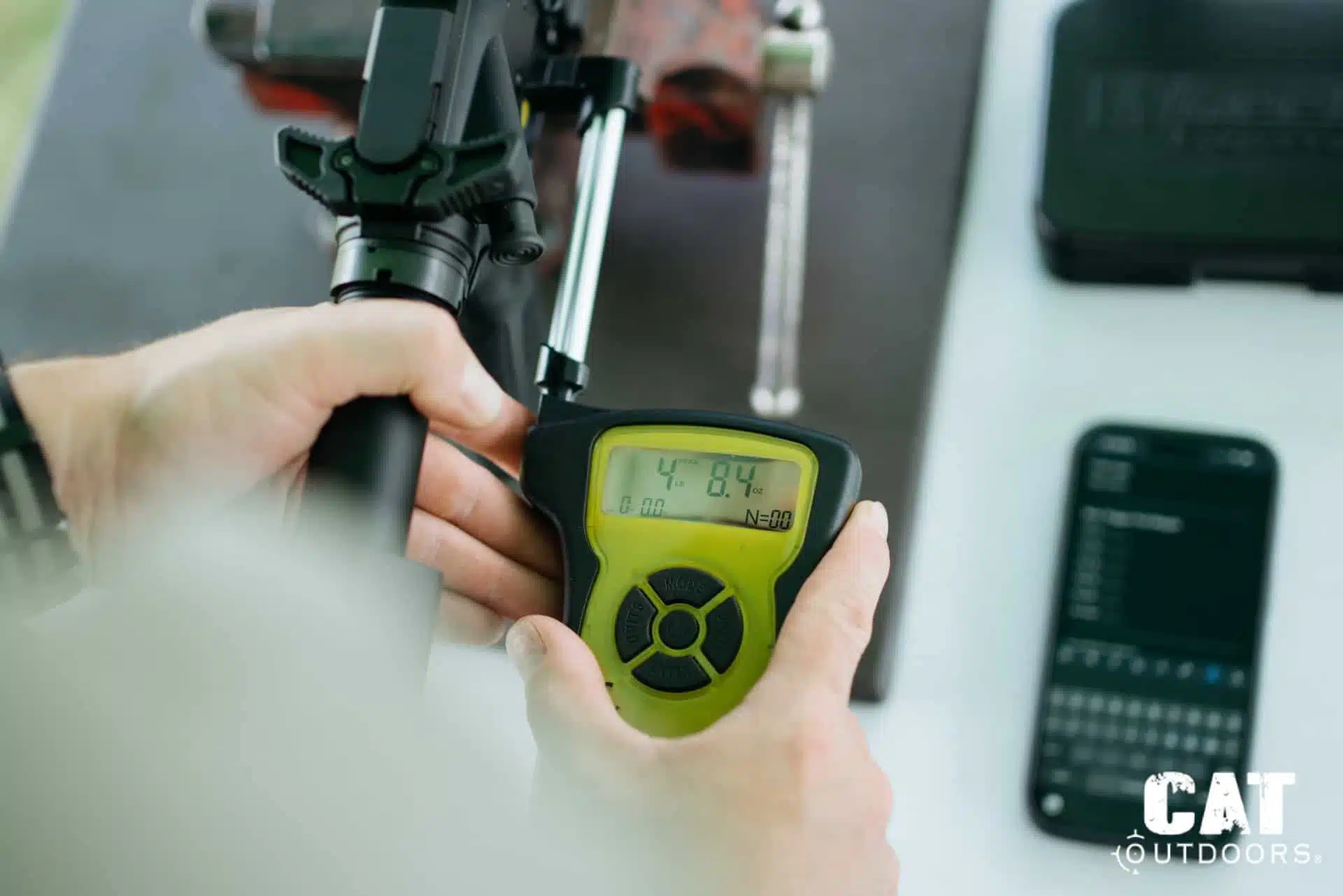
The first thing I noticed was the pull weight. At an average of 4 lb 8 oz, it was actually about a pound and a half heavier than the surprisingly light factory Sabre trigger. That wasn’t necessarily a bad thing. Just different, and unexpected, since I think most shooters equate “upgrade” with “lighter pull.”
What the LaRue gained was a cleaner break. The first stage was shorter than the Sabre’s and smooth. The wall was well defined, and once I reached it, there was very little movement before the trigger broke. Compared to the factory trigger, the break felt much crisper and more predictable.
That said, I don’t think it’s a night-and-day difference. The LaRue is unquestionably an upgrade, but the factory Sabre trigger had already set a fairly high bar for a mil-spec trigger. Ultimately, I realized I was comparing two triggers with more similarities than differences, because they are both two-stage designs.
I did several dry fires and then fired a few live rounds with it. Aside from the continuing bolt-over-brass malfunctions, I didn’t notice any meaningful difference in my practical shooting or shot placement.
Personally, I still found myself preferring the feel of a good single-stage trigger. That’s simply a matter of preference, not a criticism of the LaRue. Even before leaving the range, I was already thinking I’d probably swap it again in the future, because single-stage triggers are simply what I enjoy shooting most.
Final thoughts: the LaRue MBT-2S is an excellent two-stage trigger. I suspect its value as an upgrade would be more dramatic when replacing a typical heavy, sloppy mil-spec trigger. In this rifle, however, the surprisingly good Sabre trigger narrowed that gap considerably. If a two-stage is your speed, it’s stocked at Palmetto State Armory, Primary Arms, and AR-15 Discounts.
With that, I was ready to call it a day and go home to do some research on the malfunctions.
Total Rounds Fired: 160
Malfunctions: 11
Troubleshooting the Troubled Shoot
Calling on all my keyboard warrior skills and diving headfirst down the YouTube rabbit hole, I found a few resources that seemed to have some real answers. Or at least pointed me in the right direction.
Problem #1: I Had It Backwards. My first assumption was that the rifle was under-gassed. Seeing repeated bolt-over-brass jams, I figured the bolt wasn’t traveling far enough rearward before coming forward again to strip the next round. It turns out the opposite was more likely true.
What I learned was that most .300 Blackout ARs ship intentionally over-gassed to ensure reliable cycling across a wide variety of ammunition. Once I added the suppressor, the extra back pressure likely made things even worse. Instead of the bolt not traveling far enough, it was probably traveling too fast, outrunning the magazine spring before the next cartridge could rise fully into position. The bolt would then ride over the case instead of stripping it into the chamber.
That explanation fit what I had observed, especially since the problem occurred with both supersonic and subsonic ammunition.
Problem #2: Hornady Ammunition. The second clue came from researching ammunition. One video in particular explained how powder burn rate affects gas system performance in short-barreled, suppressed .300 Blackout rifles. The creator specifically called out Hornady and said, “It won’t cycle in anything.” There’s more to it than that, but you’ll have to go watch for yourself if you want to learn more. His first recommendation was Winchester 200-grain subsonic. I went and bought a box to try.
If you want to do the same homework, the two videos that actually moved the needle for me were “Tuning Your Adjustable Gas Block,” which walks through the exact steps I followed later, and “Cycling Subsonic 300BLK | Everything You NEED to Know.” If you want the shortcut answer in that second one, start at 13:58.
A few days later, I went back to the range armed with new knowledge and new ammo.
Range Day 2
Armed with a better understanding of how adjustable gas blocks work, my first step was to completely close the gas block.
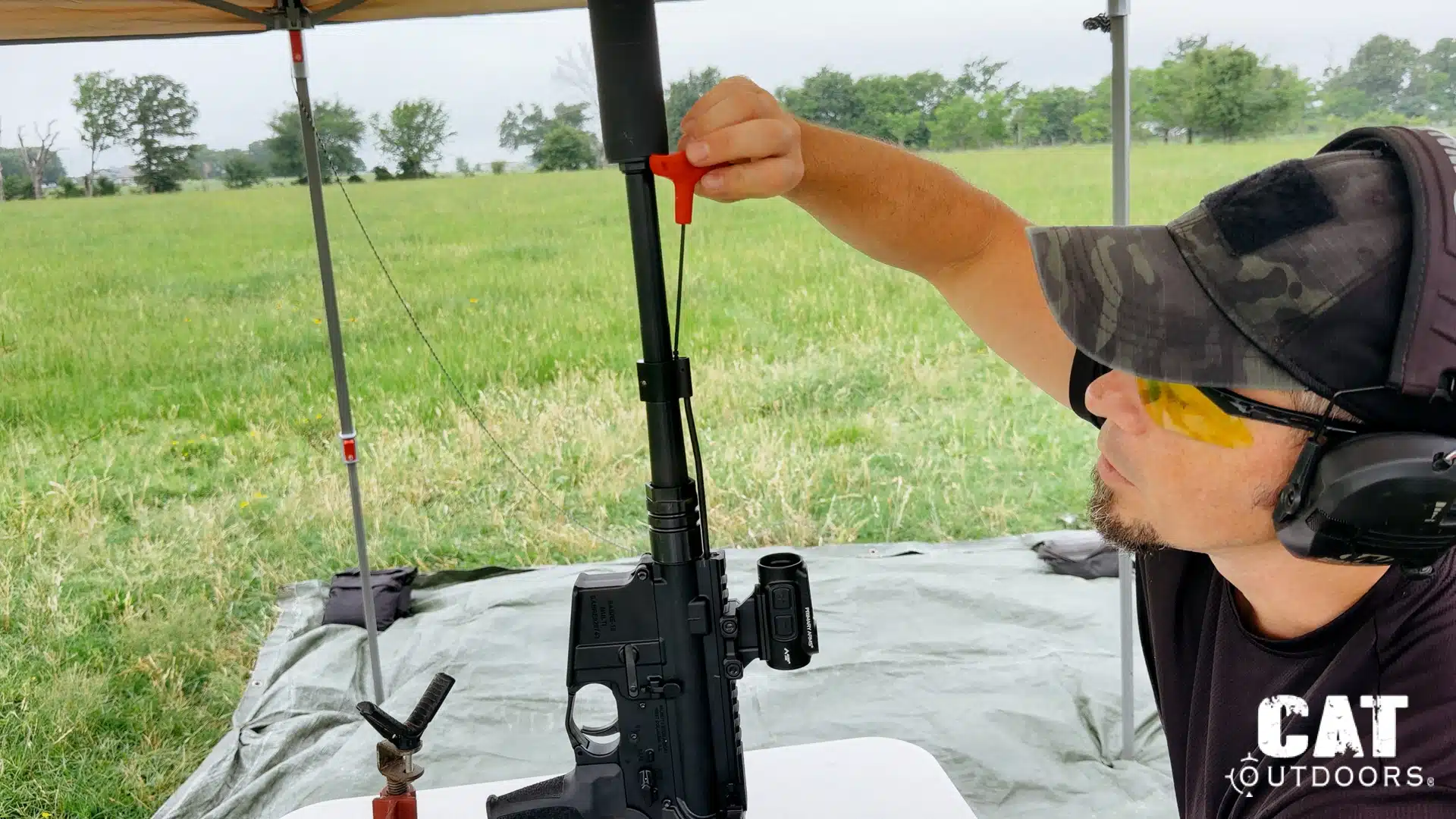
From the factory setting, it took 14 half-turns to close the adjustment screw completely. (I counted in half-turns because that’s as far as my T-handle wrench could travel before hitting the barrel.) I then began opening it back up one half-turn at a time, firing the same Hornady subsonic ammunition as before so I was only changing one variable at a time.
I fired a series of single shots and made half-turn adjustments on the screw. After about 4 or 5 rounds and a total of 3 half-turn adjustments, the rifle was ejecting consistently and locking the bolt open on an empty magazine.
I had just successfully gas tuned a rifle for the first time. Unfortunately, the celebration was short-lived.
Loading a full magazine immediately brought back the same bolt-over-brass malfunctions I had experienced on my first range trip.
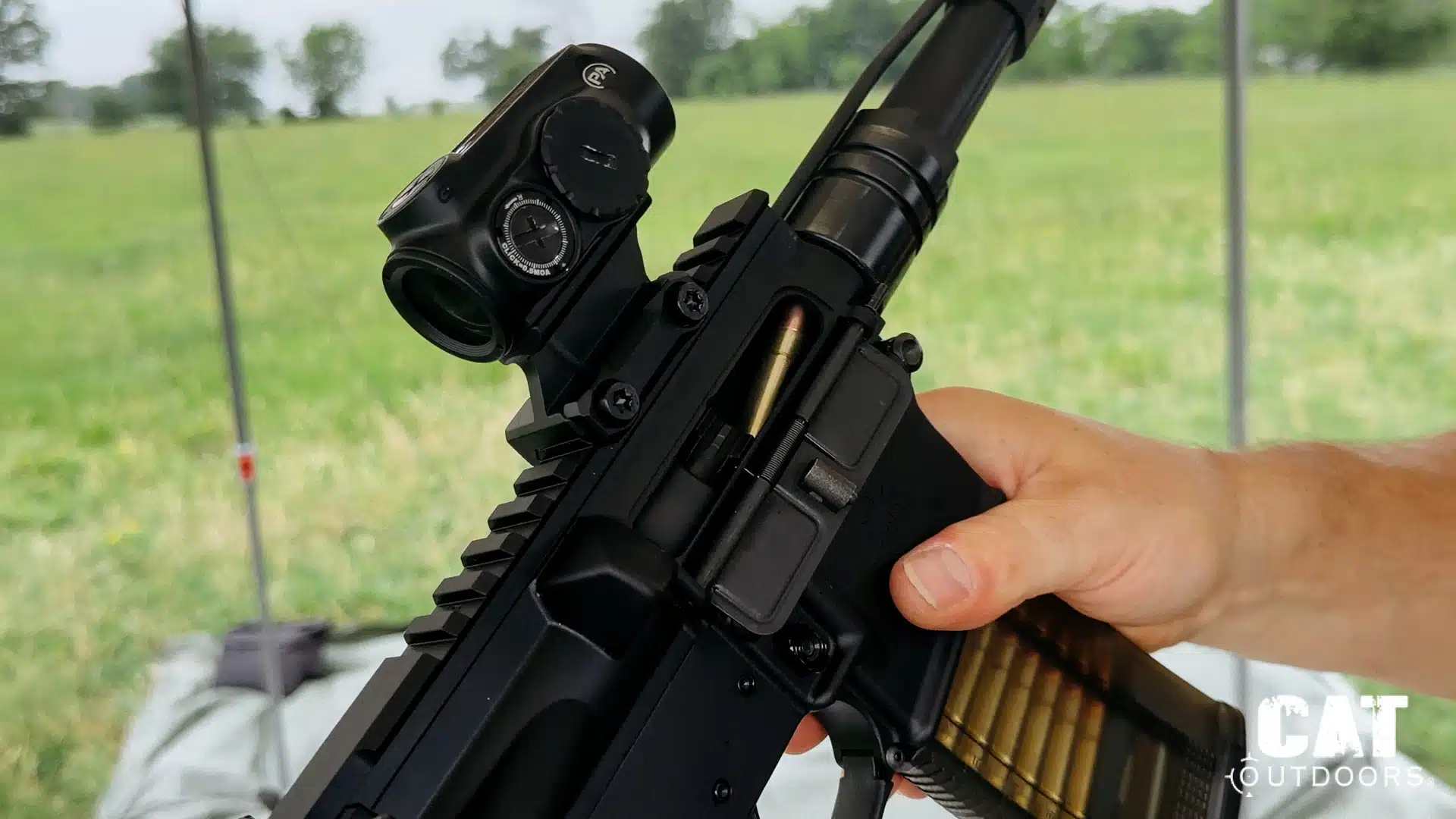
I cleared the jam and fired again. Same result.
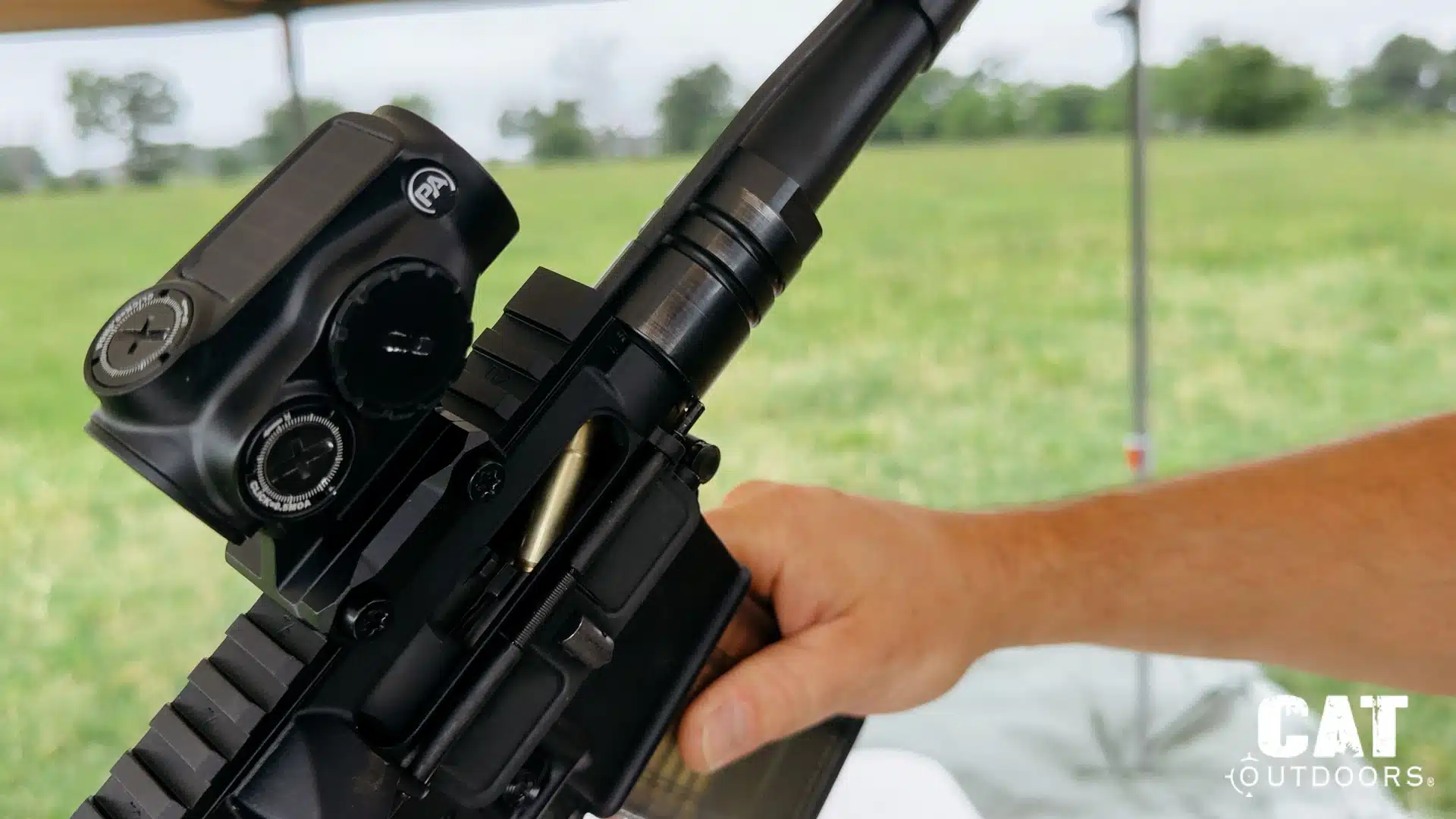
At this point, knowing that the system was working properly with single shots, I decided it was time to switch ammo.
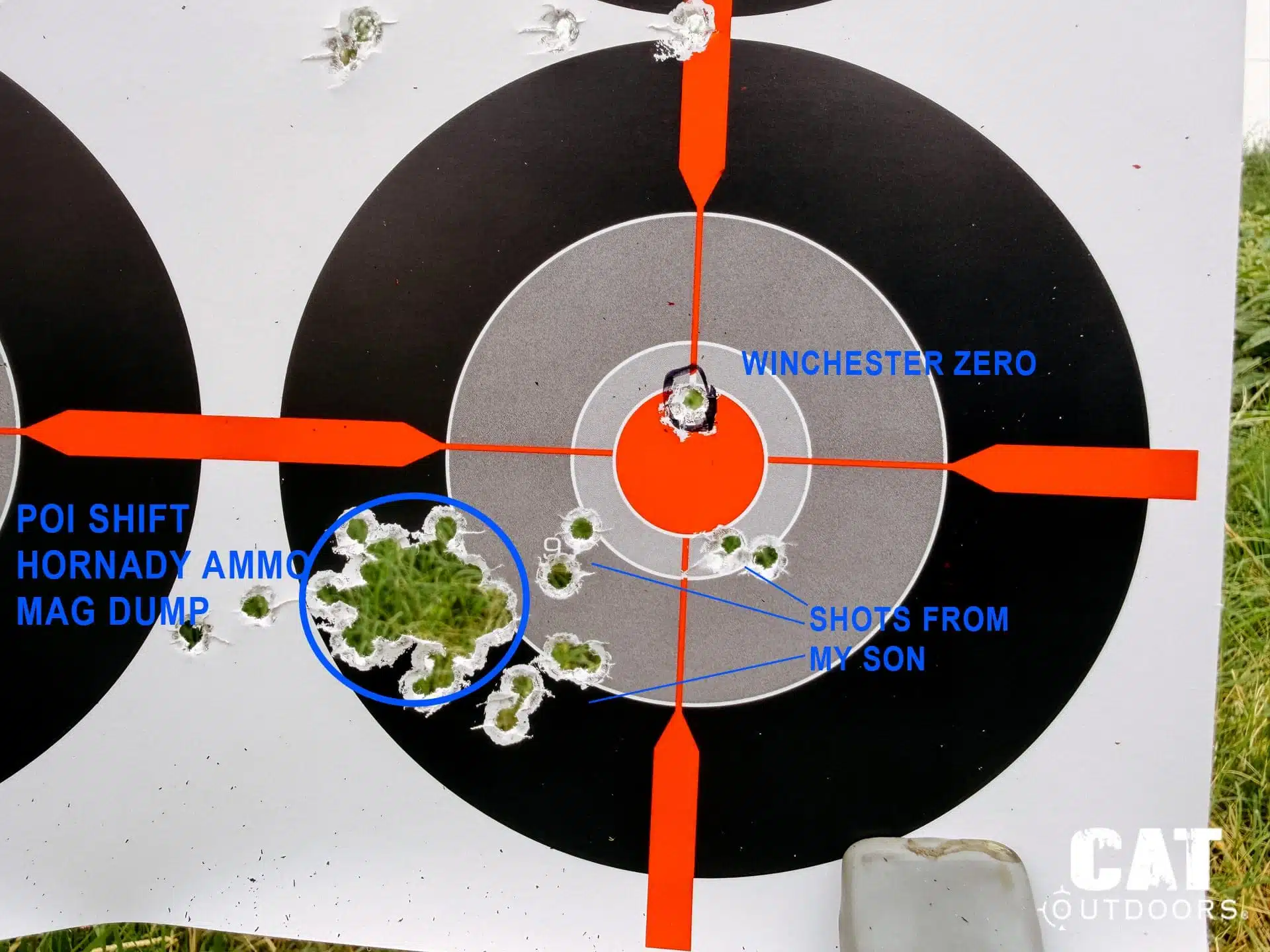
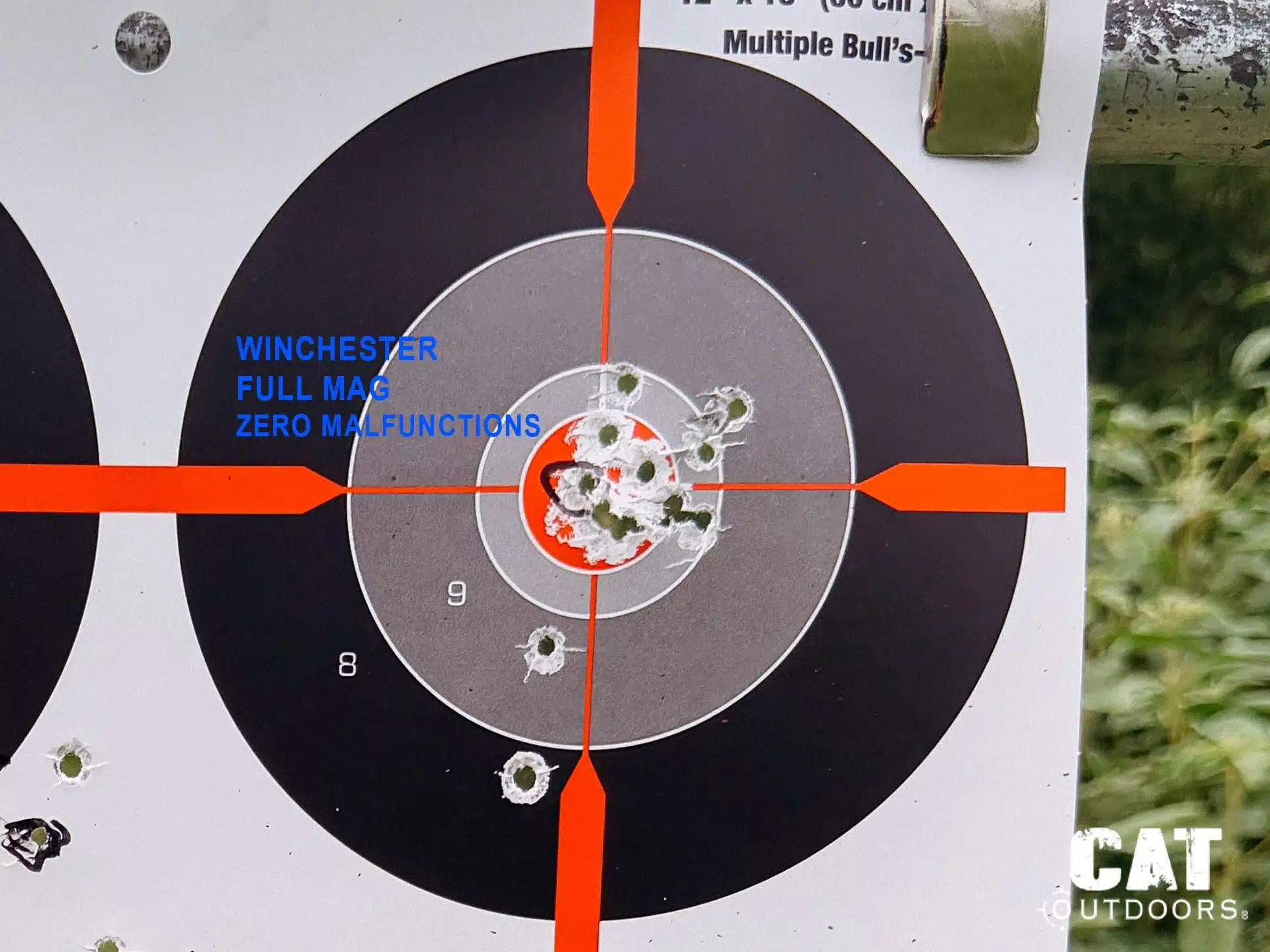
I loaded 6 rounds of Winchester 200-grain subsonic. Perfect.
Finally, I loaded a full mag, and the heavens opened and smiled down upon me. For the first time since beginning this project, the rifle ran flawlessly through an entire 30-round magazine.
From there, I moved back to 50 yards and re-zeroed the optic with the new ammunition. 7 clicks left and 6 clicks up put me right where I wanted to be.
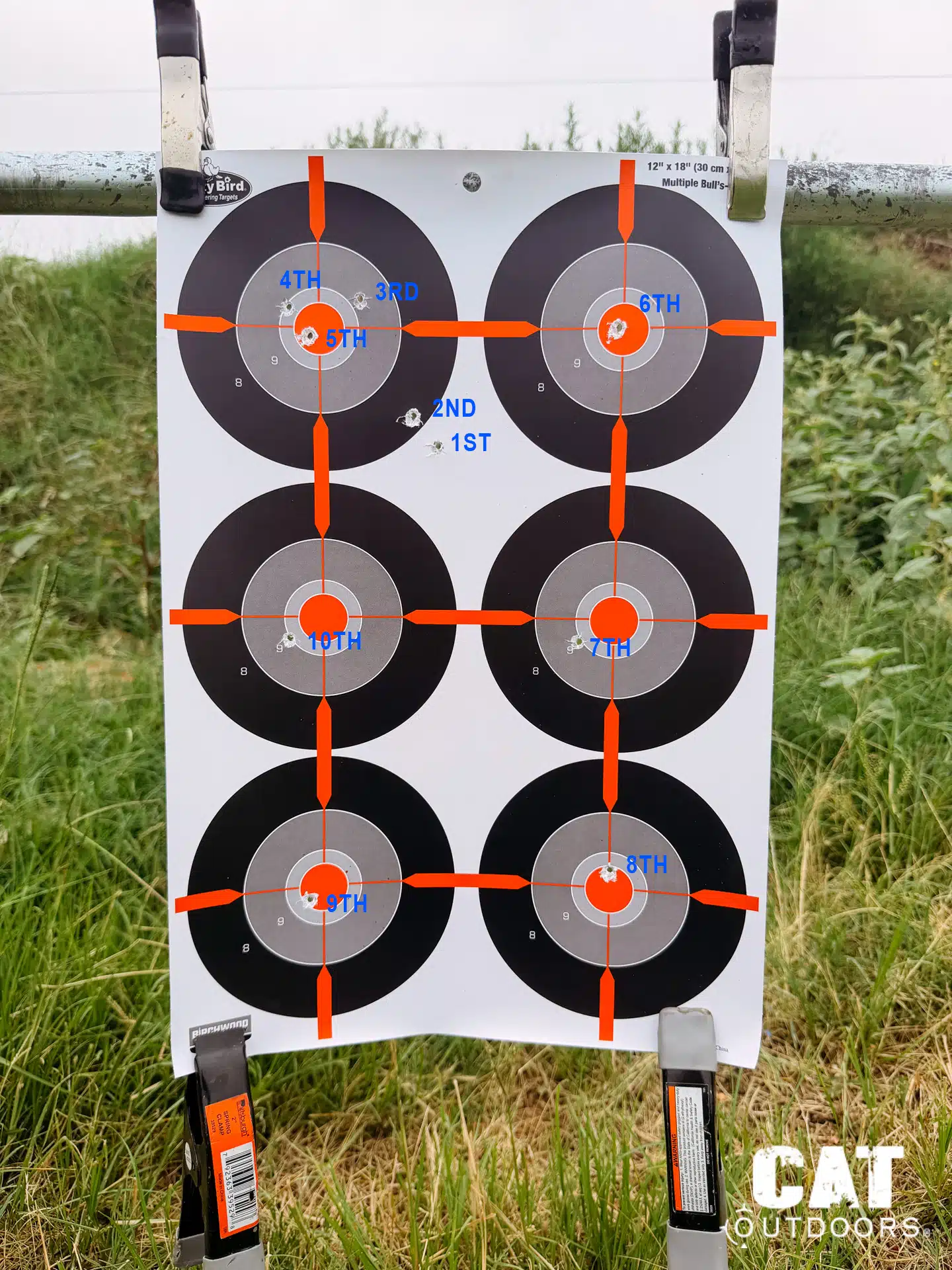
By this point, everything had finally come together. The rifle felt smooth, cycled perfectly, the suppressed shots were quiet, recoil was soft, and the chevron reticle gave me a very precise aiming point.
Next, I took a break from the technical stuff and let my son run a mag for fun.
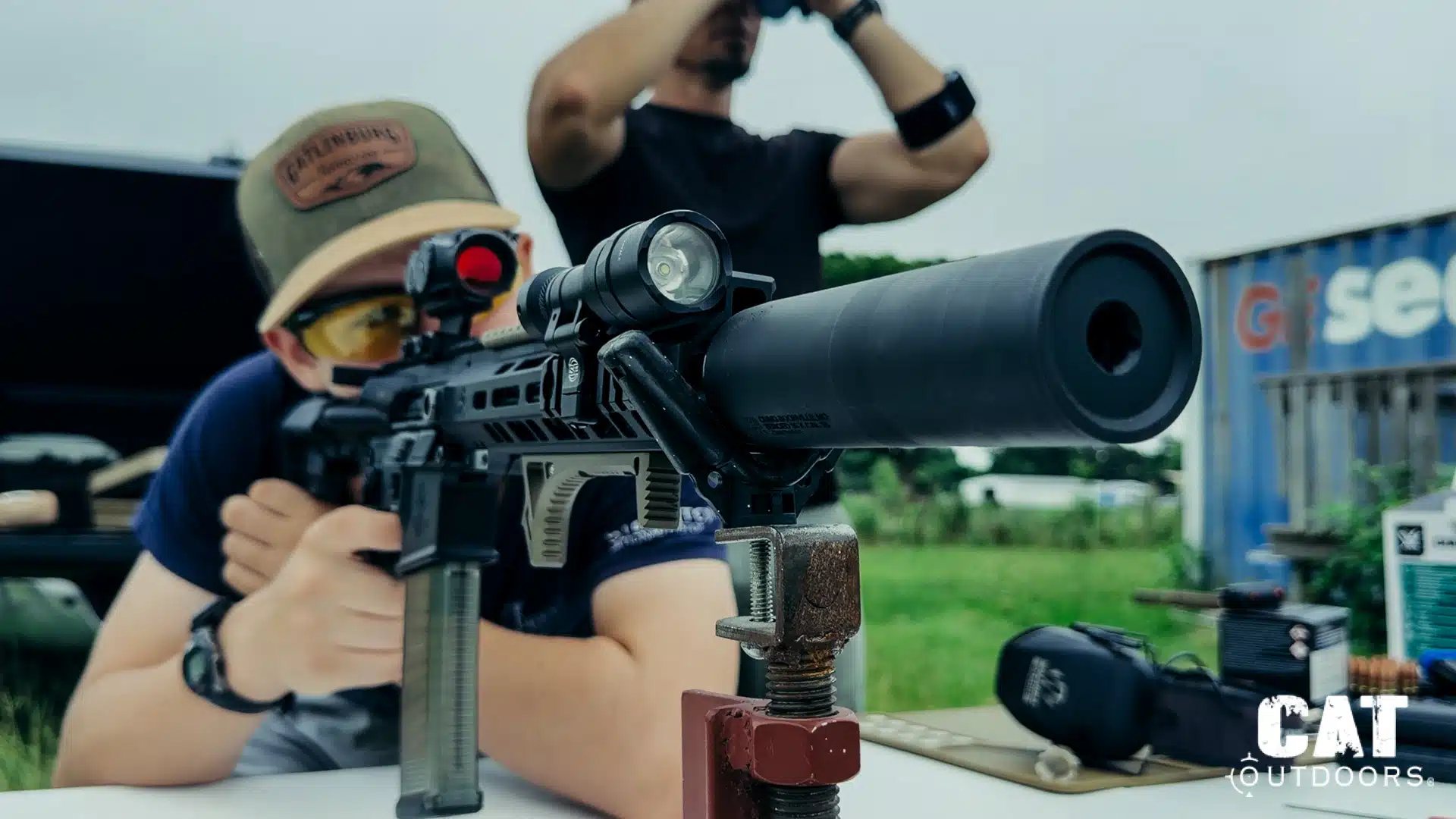
He did experience a single jam out of 20 rounds. I’m not sure what happened, though. He simply said “Jam!” and by the time I looked over to examine it, he’d already dropped the magazine, cleared the malfunction, reloaded, and was back on target. He finished the rest of that mag without further malfunctions. So not a perfect run, but definitely far better than what I was experiencing with the Hornady ammo.
Also a small proud-dad moment, made extra cool because it was Father’s Day weekend.
Next, together, we performed a suppressor heat test and took turns mag dumping.
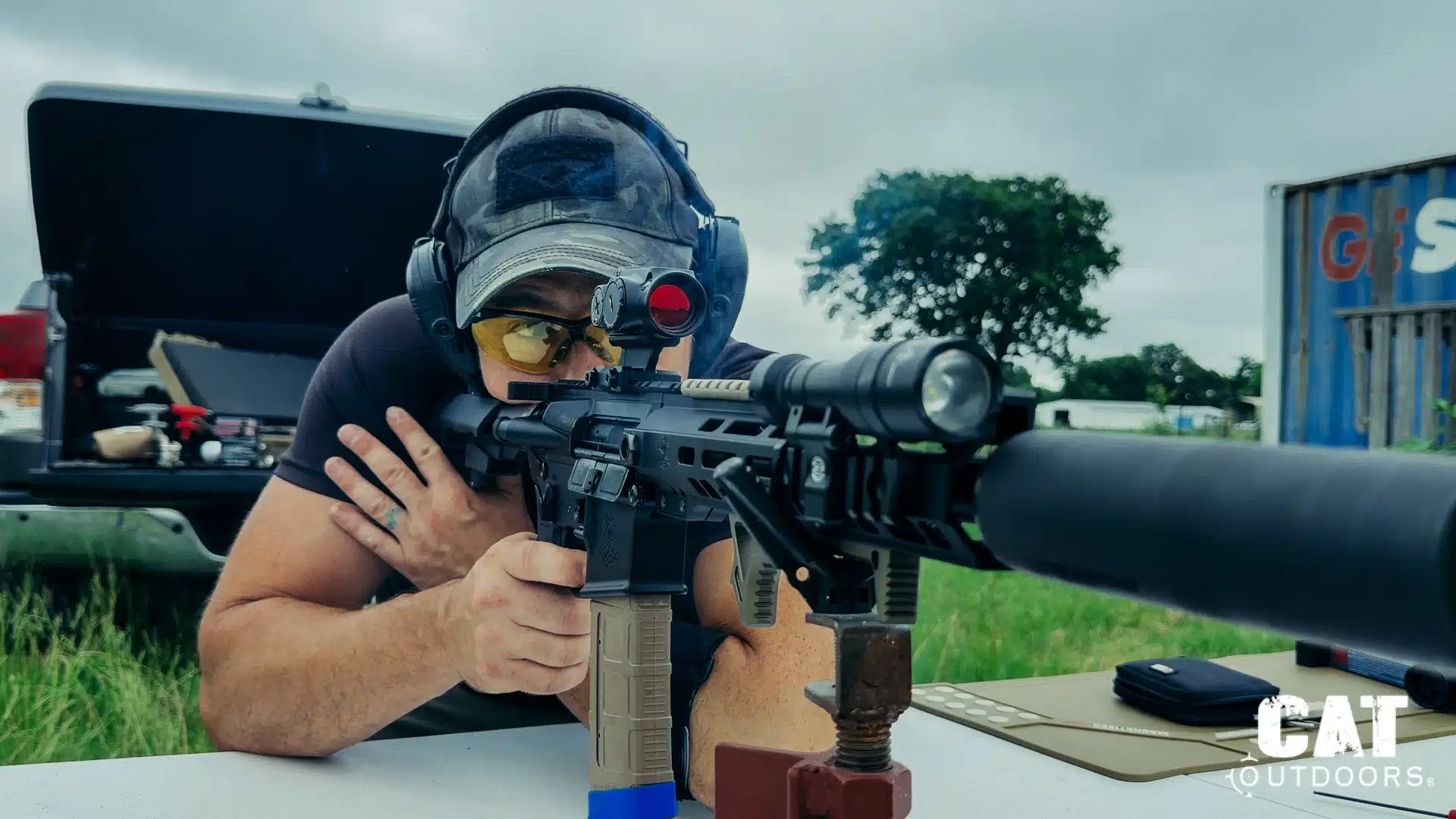
For this test, we intentionally switched back to the remaining Hornady ammunition. I had already decided I probably wouldn’t be buying it again, and since reliability wasn’t important for a heat test, it seemed like the perfect opportunity to use it up. As expected, we encountered plenty of bolt-over-brass malfunctions, but for this test we simply cleared each one and kept shooting.
It took 4 back-to-back magazines before the ZEROED 36K developed noticeable heat mirage. I expected it to happen much sooner. It may have heated up faster had we not been stopping to clear malfunctions, but even after four magazines, the mirage still wasn’t severe enough to noticeably affect my point of aim. To be fair though, I wasn’t necessarily shooting as fast as possible, just continuously: about 1 shot every 2-3 seconds until empty. Reload. Repeat.
I’m sure the results would be very different with supersonic .300 Blackout, or especially on a 5.56 rifle, and even more so with larger calibers. I guess that’s another test for another day.
But as for today, I was finally satisfied. And thrilled with my new rifle.
Who It’s For (and Who It’s Not For)
It’s for:
- Shooters looking for a compact, suppressor-friendly AR that can seamlessly switch between quiet subsonic ammunition and full-power supersonic loads
- Night hunters and ranchers dealing with predators and hogs, where shorter, quieter rifles earn their keep in blinds, vehicles, and brush
- First-time suppressor owners who want an affordable, capable host and don’t mind learning gas tuning along the way
It’s not for:
- Budget-minded shooters. The rifle itself is reasonably priced, but .300 Blackout reaches its full potential when paired with a suppressor and a steady supply of both subsonic and supersonic ammunition, and that complete ecosystem costs considerably more than a comparable 5.56 setup
- Anyone expecting perfection straight out of the box. Plan on spending some time tuning the rifle to your preferred ammunition and suppressor setup, because that’s part of the ownership experience for many suppressed .300 Blackout rifles
PSA Sabre 10.5-Inch 300 Blackout
The end result was a smooth-operating, accurate, quiet rifle that is genuinely enjoyable to shoot.
Our Verdict
I hope no one reads this and concludes that the rifle itself was defective. Looking back, I don’t think there was anything “wrong” with it at all.
The rifle I received in the box was a blank slate that had to be tuned for my configuration. PSA didn’t know if it would be paired with a suppressor. They didn’t know what ammo I was planning on using. Those are major variables with significant outcomes on performance. Once those physical pieces came together, the remaining variable was the knowledge of the shooter.
Putting a suppressor on a blank .300 Blackout, feeding it specialty ammo, and expecting it to run perfectly without any tuning is a little like buying a brand-new guitar, playing a song meant for Drop D tuning, and wondering why it doesn’t sound right. The instrument isn’t broken. It simply needs to be tuned for the way it’s going to be played.
I think that’s a much more accurate way to think about this platform.
If I have one criticism of PSA, it isn’t the rifle. It’s the documentation. Nothing in the owner’s manual prepared me for what I was about to experience with a suppressed setup. Had there been even a basic quick-start guide explaining the basics of suppressed and unsuppressed gas tuning and ammunition selection, I probably could have solved the entire issue during my first range trip and saved a considerable amount of time, frustration, and ammunition.
Some reviews answer the question, “Should you buy it?” I think this one answers a different question: “If you buy one, what can you actually expect?”
For me, it included excitement, frustration, a lot of YouTube, a pile of damaged cartridges, several wrong assumptions, and eventually a rifle that became exactly what I’d hoped it would be. I’m really grateful for this entire experience, because I think it made me a more knowledgeable and more skillful shooter.
| Category | Score | Comments |
|---|---|---|
| PSA Sabre Build Quality | 9.5/10 | Excellent fit and finish with no evidence of manufacturing defects or poor workmanship. Throughout the project, the rifle consistently felt good in my hands and performed beautifully after tuning. |
| Ease of Setup | 5.5/10 | My lowest score. Not because the rifle required tuning, but because nothing in the documentation prepared me for that process. A simple suppressor setup guide could have saved an entire range day, a lot of ammunition, and plenty of frustration. |
| Primary Arms GLx MD-21 ACSS CQB | 9.3/10 | The ACSS reticle proved to be an excellent match for the .300 Blackout platform. The optic was intuitive, easy to use, and the chevron provided a very precise aiming point. I’m holding back a higher score until I validate the BDC holdovers at extended distances. |
| CMMG ZEROED 36K | 9.4/10 | Quiet, lightweight, versatile, and extremely enjoyable to shoot. Heat mirage took much longer to develop than I expected, and even then it wasn’t enough to noticeably affect my point of aim. The ability to use one suppressor across multiple calibers adds tremendous value. |
| Factory Sabre Trigger | 8.8/10 | Considerably better than the average mil-spec trigger. The light pull weight genuinely surprised me and significantly narrowed the performance gap between it and the LaRue upgrade. |
| LaRue MBT-2S Trigger | 8.7/10 | An excellent two-stage trigger with a crisp, consistent break. The only reason it doesn’t score higher is because the factory Sabre trigger was already so good that the improvement was smaller than expected. Bottom line value depends on what you’re replacing with it. |
| Barrel Accuracy | 9.0/10 | Consistent zero, predictable performance, and all the practical accuracy I expected from a compact suppressed .300 Blackout. |
| Reliability | 9.0/10 | Once the rifle was properly tuned and paired with ammunition it preferred, reliability was excellent. |
| Suppressor Compatibility | 9.5/10 | This rifle really came alive with the suppressor installed. Soft recoil, pleasant report, and excellent handling once the gas system was tuned correctly. |
| Practical Utility | 9.5/10 | Compact, versatile, and capable of filling multiple roles simply by changing ammunition. This is exactly what makes the .300 Blackout platform so appealing. |
| Value | 9.8/10 | The Sabre line delivers features and performance typically associated with considerably more expensive rifles. It represents outstanding value for the money. |
The rifle didn’t have a problem. I had a knowledge gap. Once I understood, the system worked, and it became exactly the rifle I hoped it would be from the beginning.
Final Score: 9.2/10
I just wish the Winchester had been in the range bag on the first trip.
That’s the whole PSA Sabre 300 Blackout review: two range sessions, one education in gas tuning, and a rifle that became exactly what I hoped it would be.
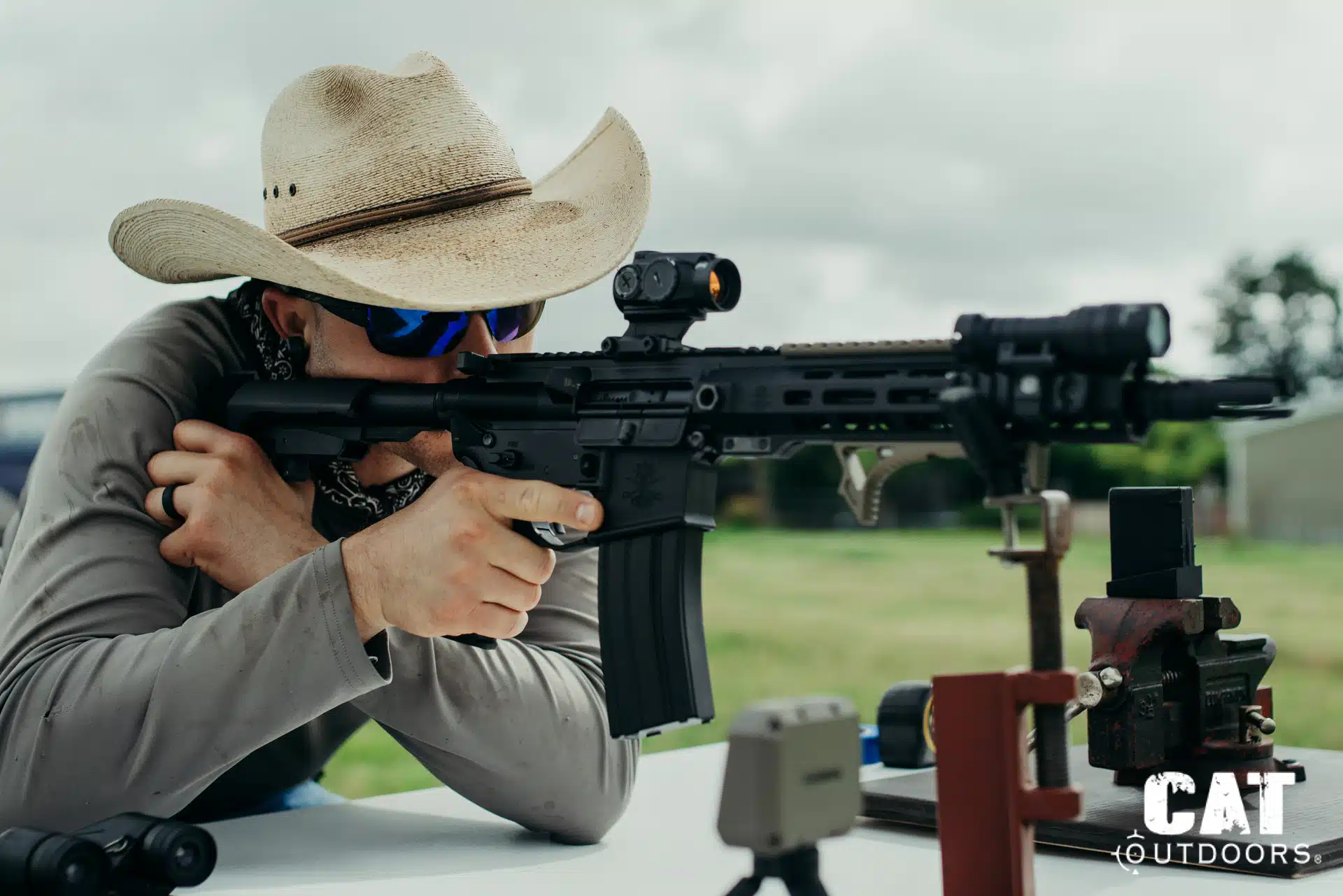
Special thanks to my friend Cowboy Jim, who let me use his private 50-yard range for this testing and helped with the photography while I was shooting.
Safety & Compliance
- Always follow manufacturer instructions and torque specs during installation and maintenance.
- Suppressors are NFA-regulated items. Complete the required federal paperwork and approval process before taking possession, and comply with all local, state, and federal laws, including current rules on pistol braces and short-barreled rifles.
- NFA rules change and vary by state. If you have questions about suppressor ownership or configuration in your area, talk to a licensed dealer or SOT before you buy.
- We do not attempt or describe illegal modifications. If any part of the job is beyond your bench, use a licensed gunsmith.
FAQ
Is .300 Blackout good for home defense?
It has real advantages: a short-barreled .300 Blackout is easier to maneuver through doorways and hallways than a full-length rifle, and running it suppressed reduces the risk of instant hearing damage from firing indoors while making communication easier afterward. A suppressor won’t eliminate the noise, though, and any defensive rifle needs to be proven reliable with your exact ammunition first. Ours needed gas tuning and an ammo change before we would have trusted it for anything serious.
Why not just shoot subsonic 5.56 instead of .300 Blackout?
Because a 55-grain 5.56 bullet is too light to do the job at 1,050 fps. Think ping pong ball versus baseball: at subsonic speeds the light bullet carries very little energy, sheds it quickly, and often won’t generate enough gas pressure to cycle an AR-15. Subsonic .300 Blackout solves this with 190-220 grain bullets, roughly four times heavier, that cycle reliably and carry significantly more energy.
Do you need a suppressor to enjoy .300 Blackout?
No, but the cartridge was engineered from the beginning with suppressed shooting in mind, and that is where it shines. Even unsuppressed, our 10.5-inch Sabre had a lighter report than a 5.56, closer to a pistol cartridge than a rifle round. Add a can and subsonic ammo, and it gets dramatically quieter still. That steel-ringing-louder-than-the-shot appeal is exactly what this cartridge was built for.
What ammo ran best in the PSA Sabre 300 Blackout?
Winchester 200-grain subsonic, by a mile. Our suppressed setup produced repeated bolt-over-brass malfunctions with both Hornady loads, and the 190-grain Sub-X kept jamming even after gas tuning. The first full magazine of the Winchester load ran flawlessly; the only hiccup after that was one unexplained jam during my son’s 20-round mag. Every suppressed build is its own ecosystem, so test before you stockpile.
Is the PSA Sabre 300 Blackout a pistol or a rifle?
It ships as a large-format pistol with an arm brace, not a stocked rifle. Configuration rules around braces and short-barreled rifles have shifted repeatedly in recent years, so verify the current federal and state rules for your setup before buying or modifying one.
What does a complete suppressed 300 Blackout setup cost?
More than the price tag on the rifle. The Sabre runs around $1,000-1,250 depending on configuration, the CMMG ZEROED 36K adds roughly $500-550 plus NFA transfer costs and the wait, our GLx optic runs about $220-260, and you’ll feed it both subsonic and supersonic ammunition at roughly $1.25 per round and up. That complete ecosystem is considerably more expensive than a comparable 5.56 build.
How hard is it to tune an adjustable gas block?
Easier than it sounds, and I say that as someone who had never done it before this project. Close the gas block completely, then open it one half-turn at a time, firing a single shot after each adjustment until the rifle ejects consistently and locks the bolt back on an empty magazine. Ours took 3 half-turns from closed. The catch: the tune is specific to the ammunition and suppressor you used, so if you change either, verify it again.
Why does a suppressed 300 Blackout jam?
In our case, too much gas rather than too little. Most .300 Blackout ARs ship intentionally over-gassed to cycle a wide variety of ammunition, and a suppressor adds back pressure on top of that. The bolt travels so fast it outruns the magazine spring and rides over the next case instead of chambering it. Gas tuning fixed the cycling, and switching ammunition fixed the rest; some loads simply don’t run well in short, suppressed guns.
Have you built a suppressed .300 Blackout, or is the tax stamp still sitting in your cart? Drop a comment below and tell us what your build ran into, and what you want tested next.
Also, be sure to check out our roundup of the Best AR-15 Suppressors if you’re still shopping for your first can!
Brad Lanphear is a professional videographer by day and a gun enthusiast by night. When he’s not behind a camera, he’s usually at the range, in the workshop, or testing gear he probably didn’t need but wanted anyway. He enjoys practical firearms setups, well-designed tools, and helping others avoid common (and expensive) mistakes.