Primary Arms GLx MD-21S Review: The ACSS CQB Micro Dot, Tested (2026)
Primary Arms GLx MD-21S review: a clean zero, a documented POI shift after an ammo change, the ACSS CQB reticle at work, and a 9.3/10 verdict.
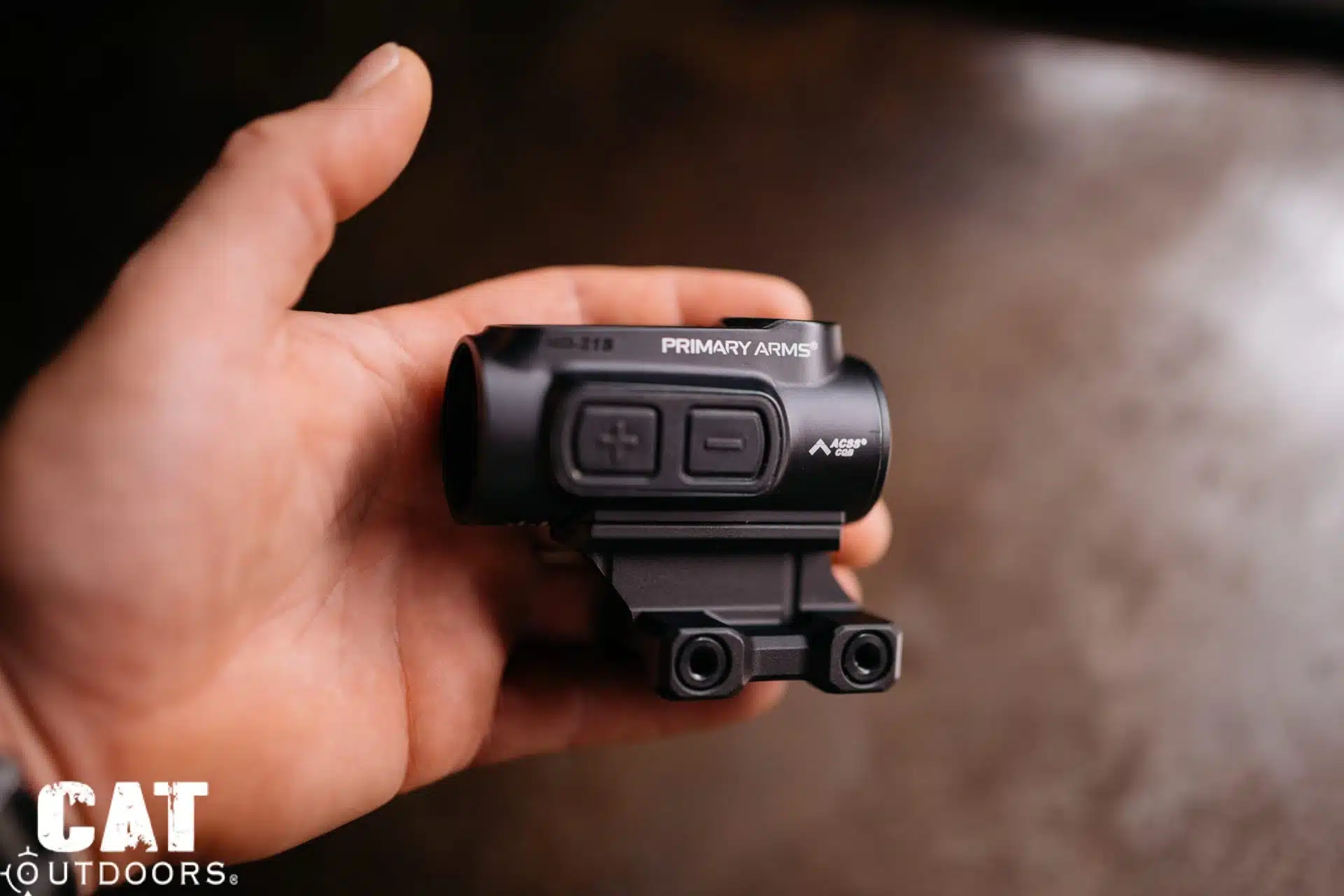
The ACSS reticle proved to be an excellent match for the .300 Blackout platform. The optic was intuitive, easy to use, and the chevron provided a very precise aiming point. I'm holding back a higher score until I validate the BDC holdovers at extended distances. Street price is $229.99 as of this writing.
Reasons to Buy
- ACSS CQB reticle is a genuine match for 300 Blackout: the BDC references earn their keep when you switch between supers and subs
- Chevron tip gives a precision aiming point a plain 2 MOA dot can't match
- Horseshoe ring is extremely quick to acquire for close-range work
- Every click adjustment tracked true on paper through two zeroes and an ammo change
- Capless recessed turrets adjust with a spent case, a coin, or a key
- Solar backup, AutoLive motion activation, up to 50,000 hours of battery life, and both mount heights in the box
Reasons to Skip
- BDC holdovers not yet validated at extended distances; the score is capped until they are
- On a plain 5.56 that never changes loads, the gap over a $100-150 Romeo5 is much smaller than the price gap
- Turrets can't be turned by fingers alone; you need a case rim, coin, or driver
- Retail naming is messy: MD-21, MD-21S, and the budget SLx MD-21 are easy to mix up
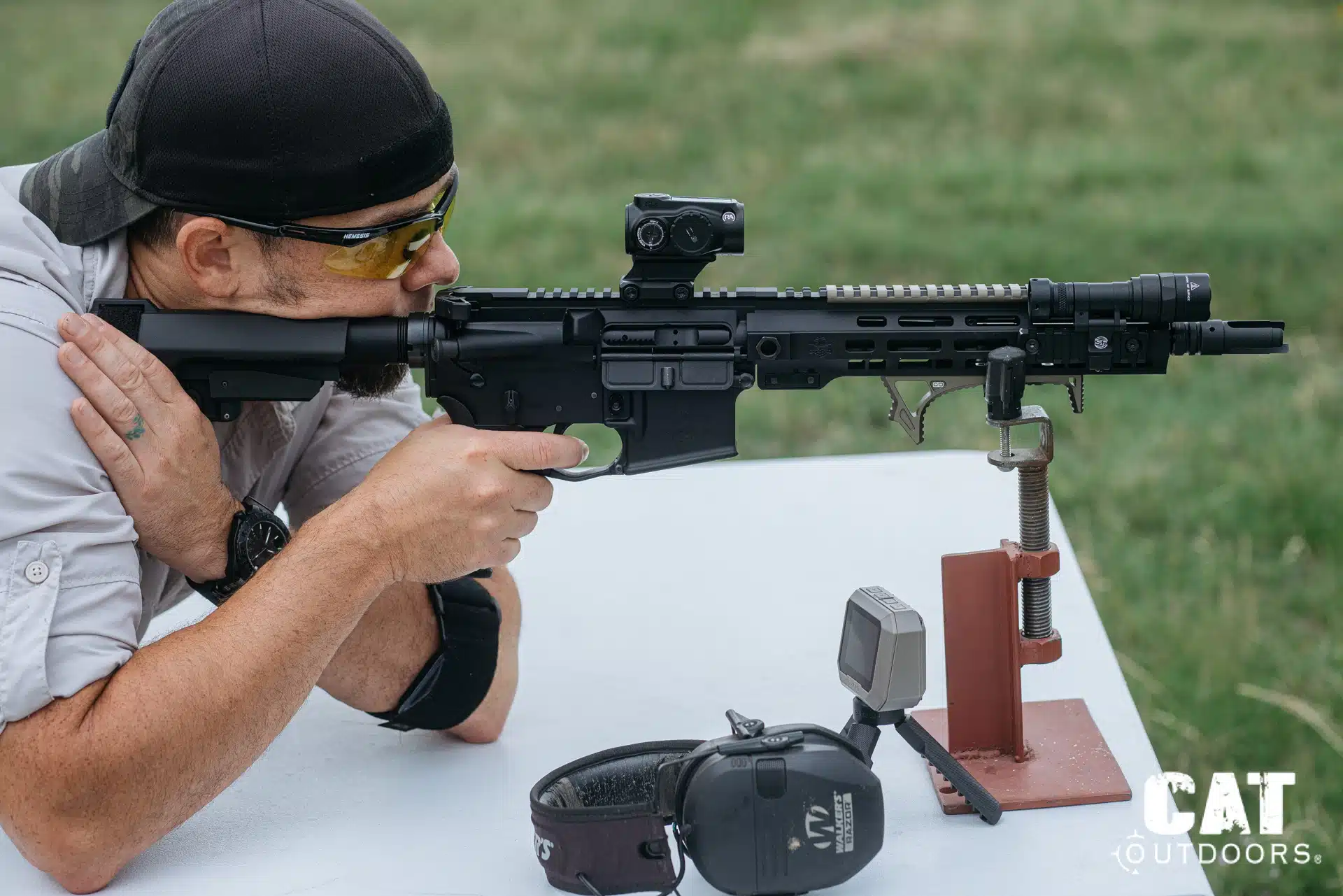
This Primary Arms GLx MD-21S review boils down to two zeroes, an ammunition change, and a pile of annotated targets: the $229.99 micro dot came through all of it with a 9.3/10 and no drama.

The test rifle was our suppressed 300 Blackout build, which matters because that cartridge swaps between supersonic and subsonic loads that refuse to share a point of impact. If any platform was going to make a BDC reticle prove itself, it was this one.
The GLx is the latest optic through our test bench, and it got the full treatment: mount it, zero it, change ammunition, and write down what happens. What follows is the long version, told in click counts and annotated targets.
Specs
- Magnification: 1x
- Objective Lens: 21mm
- Reticle: ACSS CQB Multi-Reticle System
- Reticle Options: 4 selectable configurations (chevron only, chevron + BDC, chevron + horseshoe, full ACSS CQB)
- Solar Backup: Yes
- Motion Activation: AutoLive
- Battery Life: Up to 50,000 hours
- Night Vision Compatible: Yes
- Housing: 7075-T6 aluminum
- Mount Footprint: Aimpoint Micro; low-profile and high-profile mounts included
- Warranty: Lifetime
- Street Price: $229.99 at most retailers (check current listings)
The Poll
Where does your carry gun ride?
This week's holster coverage has us curious. Tap your pick.
The Poll · Live Standings
Your vote is in.
0 votes so far. Winner announced in next week’s issue.
Want to Know the Final Results?
We tally the votes and name the winner in next week’s email. Sign up and the final standings come straight to your inbox, and you’ll be first to hear when the review goes live.
By signing up you agree to our Terms of Service and Privacy Policy. No spam, and we never sell your address. Unsubscribe anytime.
That didn’t go through. Check the address and try again.
Done. Watch your inbox.
You’re on the list. The final standings land in next week’s issue, and if your pick loses, take it up with the other voters.
Why You Can Trust This Review
Full disclosure first: our friends at Primary Arms sent this optic free of charge. They had no input on this review or any expectations about what it would say. We tested the GLx over two days at the range on our PSA Sabre, with about two hundred rounds.
This is our actual experience with the optic, both the good and bad.
- Test Platform: PSA Sabre 10.5-inch .300 Blackout, run suppressed with a CMMG ZEROED 36K
- Tested By: Brad Lanphear, across two documented range days on a private 50-yard range plus a public-range session out to 200 yards
- Mounting: Installed with Fix It Sticks and a torque limiter set to 20-25 inch pounds
- Zeroing: Zeroed at 25 yards, re-zeroed at 50 after the suppressor install and an ammunition change, with click counts logged both times
- Documentation: The annotated targets from the re-zero and the ammo-change point-of-impact shift are all shown below
Why the GLx When I Already Own a Romeo5
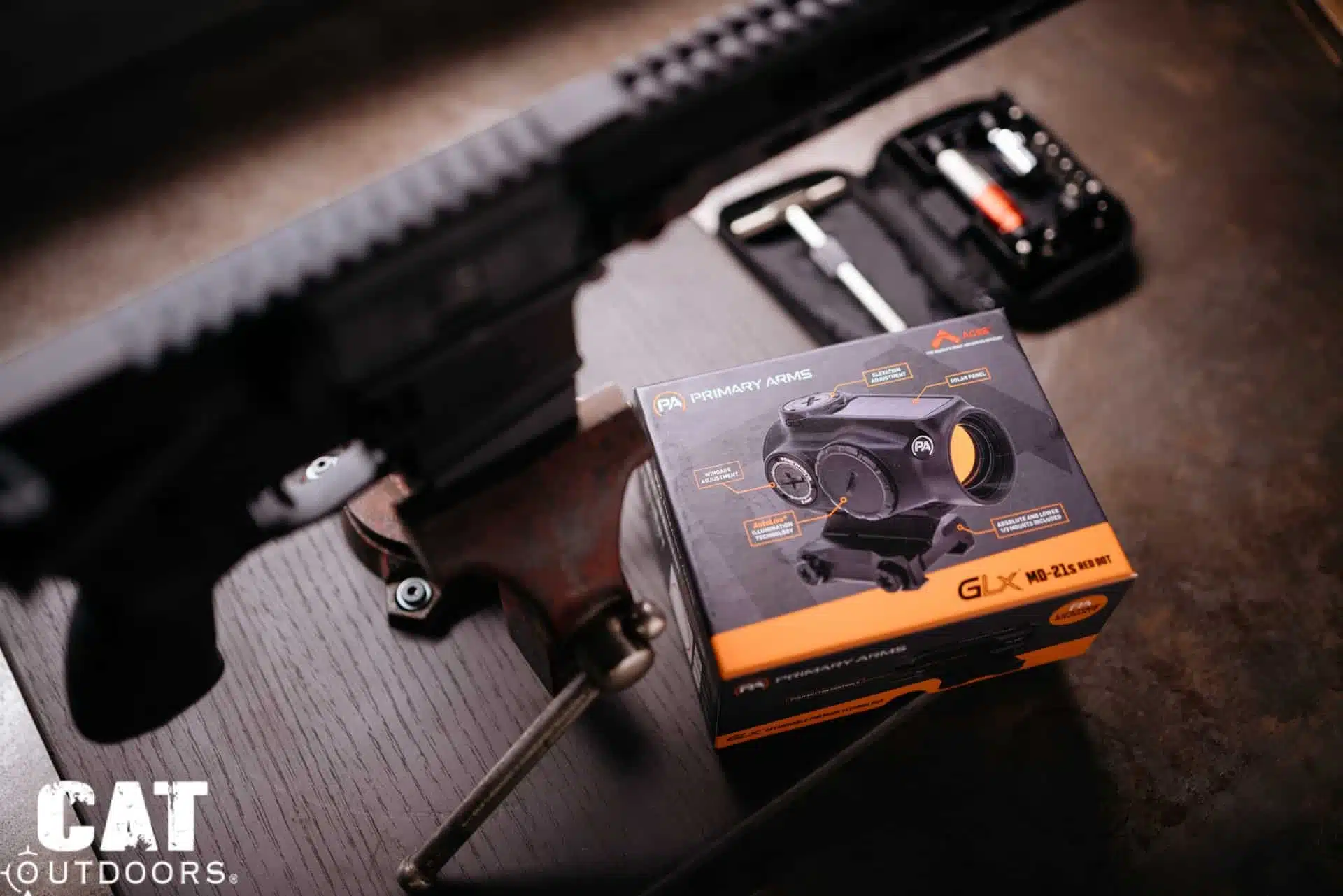
You may be asking yourself, why buy a GLx MD-21S when I already have a SIG Sauer Romeo5? Reasonable question. You can read our thoughts on that model in our SIG Romeo5 review.
You’d go with the GLx MD-21S ACSS CQB instead, because its feature set reads like it was designed by somebody who shoots 300 Blackout: a multi-reticle system with holdover references, solar backup, motion activation, and a 7075-T6 housing.
| Specification | Primary Arms GLx MD-21S ACSS CQB | SIG Sauer Romeo5 |
|---|---|---|
| Street Price | ~$220-$260 | ~$100-$150 |
| Magnification | 1x | 1x |
| Objective Lens | 21mm | 20mm |
| Reticle | ACSS CQB Multi-Reticle System | 2 MOA Dot |
| Reticle Options | 4 Selectable Modes | Single Dot Only |
| Solar Backup | Yes | No |
| Motion Activation | AutoLive | MOTAC |
| Battery Life | Up to 50,000 Hours | Up to 40,000 Hours |
| Night Vision Compatible | Yes | Yes |
| Housing Material | 7075-T6 Aluminum | Aluminum |
| Mount Footprint | Aimpoint Micro | Aimpoint Micro |
| Warranty | Lifetime | Lifetime |
Read that table one way and the Romeo5 wins: half the price, same footprint, same lifetime warranty, both night vision compatible. Read it the other way and you notice where the GLx pulls ahead: the exact features this rifle ended up needing.
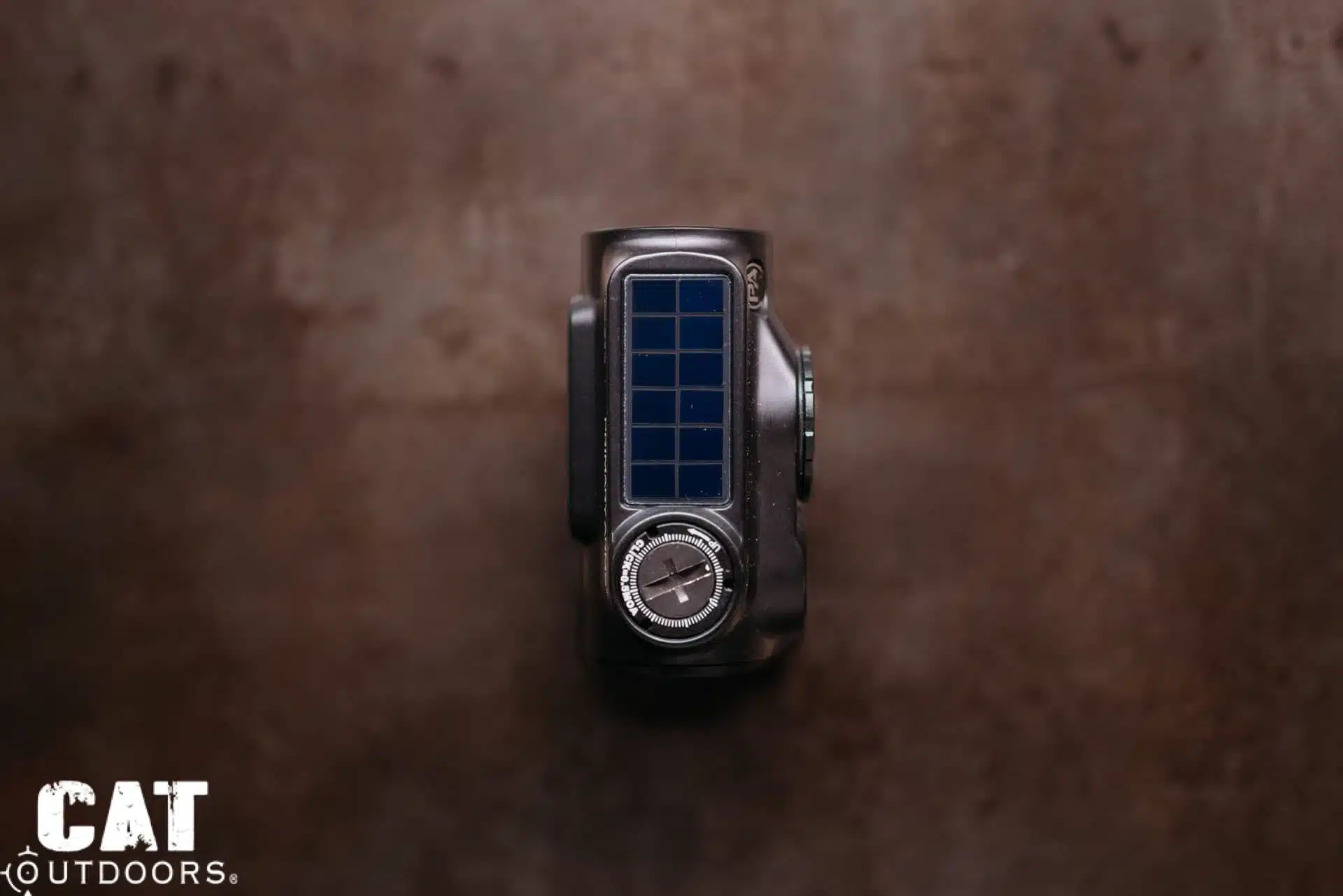
The battery math is hard to argue with. Up to 50,000 hours from the cell, AutoLive motion activation so the reticle is awake when the rifle moves, and a solar panel up top as the fallback. Belt, suspenders, and a second belt made of sunlight.
Now the caveat I’d want as a buyer: on matching 5.56 rifles, these two optics would finish a lot closer than the price gap implies. Both are durable, reliable, motion activated, and fully capable of putting rounds on target, and on a plain-vanilla carbine the Romeo5 remains some of the smartest money in red dots.
But 300 Blackout is not plain vanilla. Swapping between supersonic and subsonic ammunition is the whole reason this cartridge exists, every swap moves your point of impact, and suddenly those BDC references stop being brochure decoration and start being the reason you bought the optic.
The more this project taught me about 300 Blackout, the smarter the GLx looked.
Liking this one? Add CAT Outdoors as a preferred source on Google and stories like it show up first.
Add on GoogleWhat the ACSS CQB Reticle Does
ACSS is Primary Arms’ reticle system, and CQB is its close-quarters configuration. Instead of one dot doing one job, you get three tools stacked in a single window, and you choose how many are switched on:
- Chevron Only
- Chevron + BDC
- Chevron + Horseshoe
- Full ACSS CQB Reticle (Chevron, BDC, and Horseshoe)
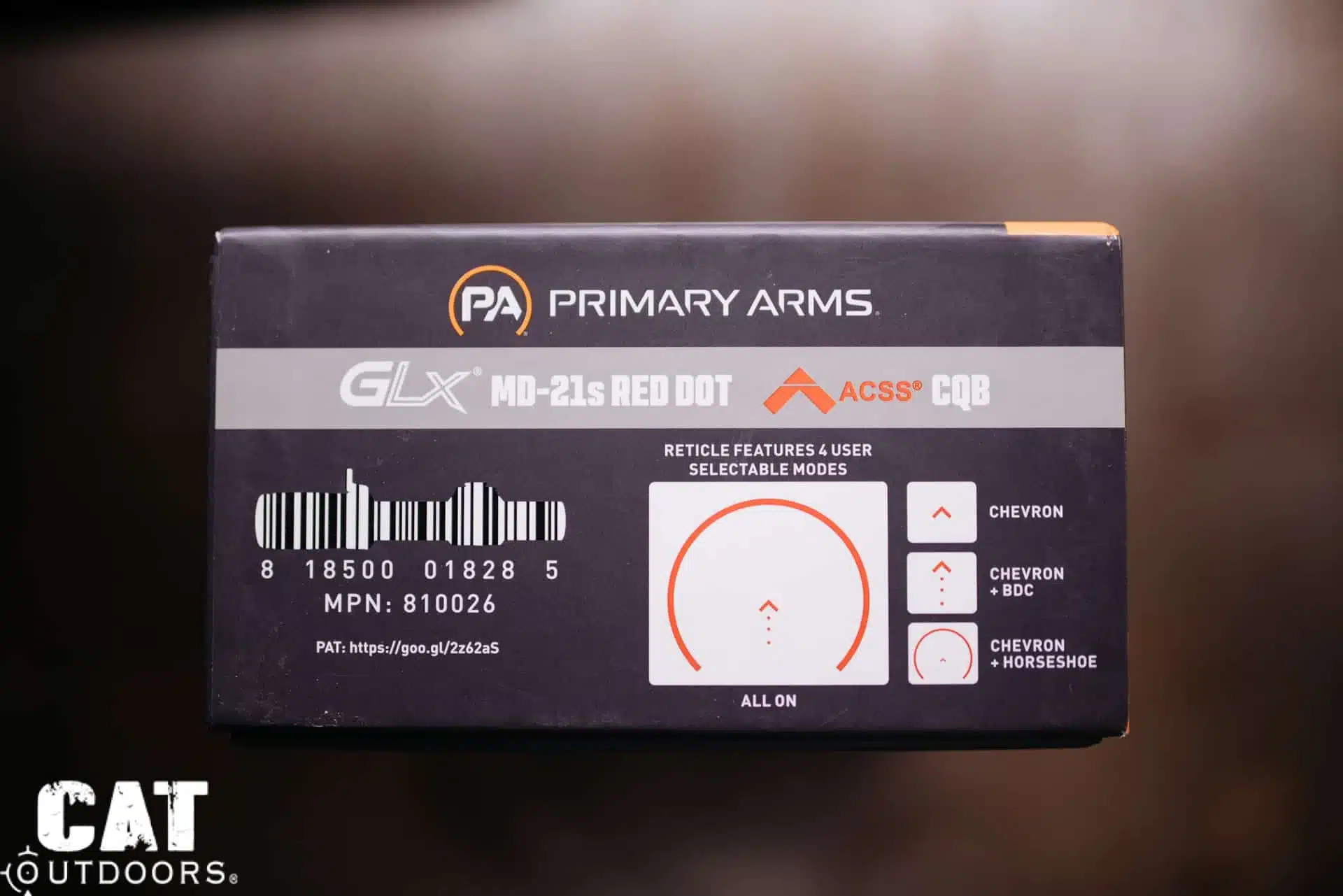
The chevron is the precision tool. It’s a small arrowhead, and you aim with the tip, which means your aiming point is an actual point instead of a glowing blob covering your target.
The horseshoe is the speed tool: a broken ring your eye snaps to without hunting. For close-range shooting I found it extremely quick to pick up.
The BDC dots hang below the chevron: bullet drop compensation, which is a fancy way of saying “aim with a lower dot at distance instead of guessing.”
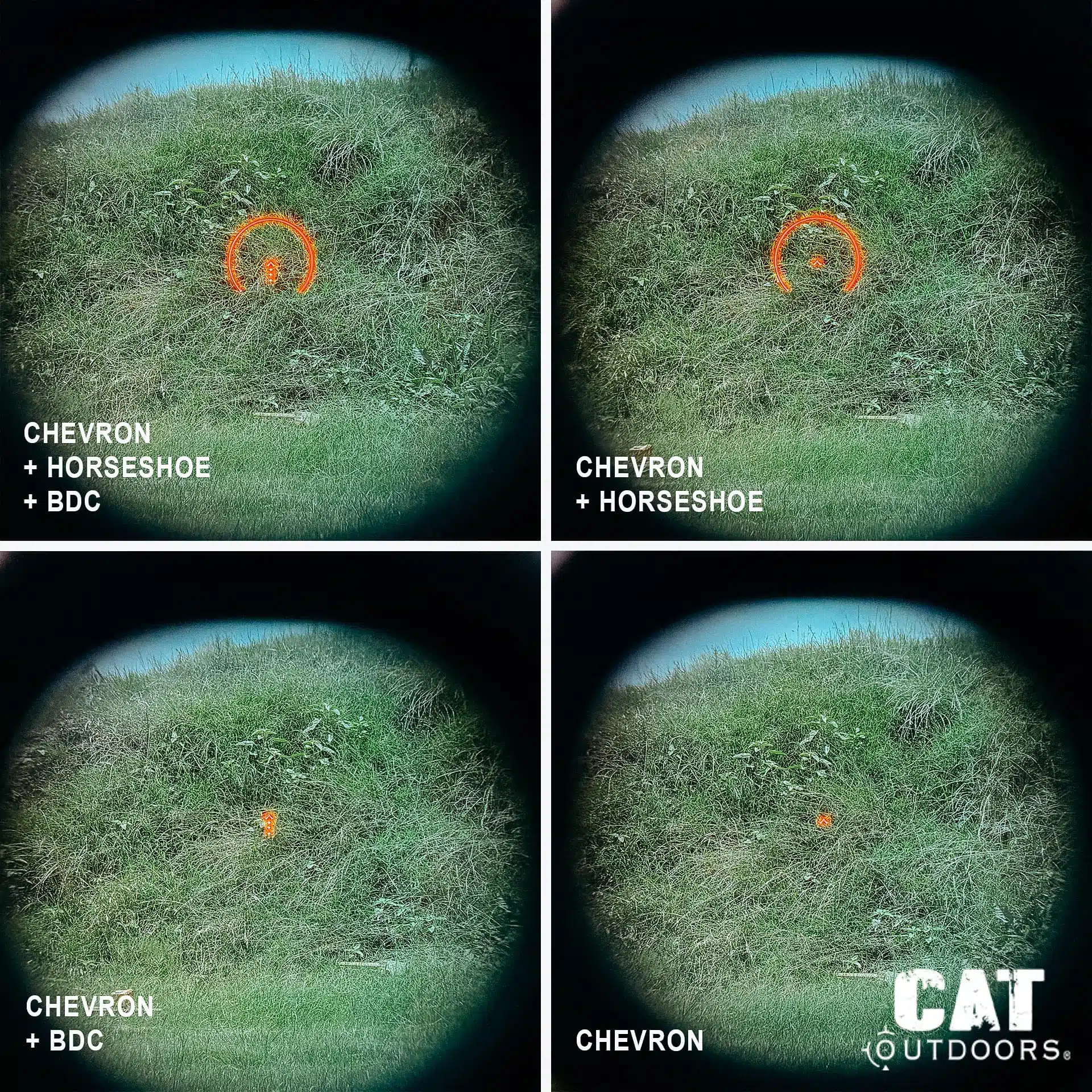
By comparison, the Romeo5 gives you one 2 MOA dot. One very good dot, to be fair. But one.
Don’t Order the Wrong One: GLx vs SLx
One warning before you shop. Primary Arms also sells an SLx MD-21 for about $199, and it is not this optic: the SLx is the budget sibling, and at least one review out there tested the SLx while talking like it’s the GLx. If the listing in your cart doesn’t say GLx (sold today as the GLx MD-21S), you’re buying a different optic than the one that earned this score.
Mounting: Two Screws and a Torque Number
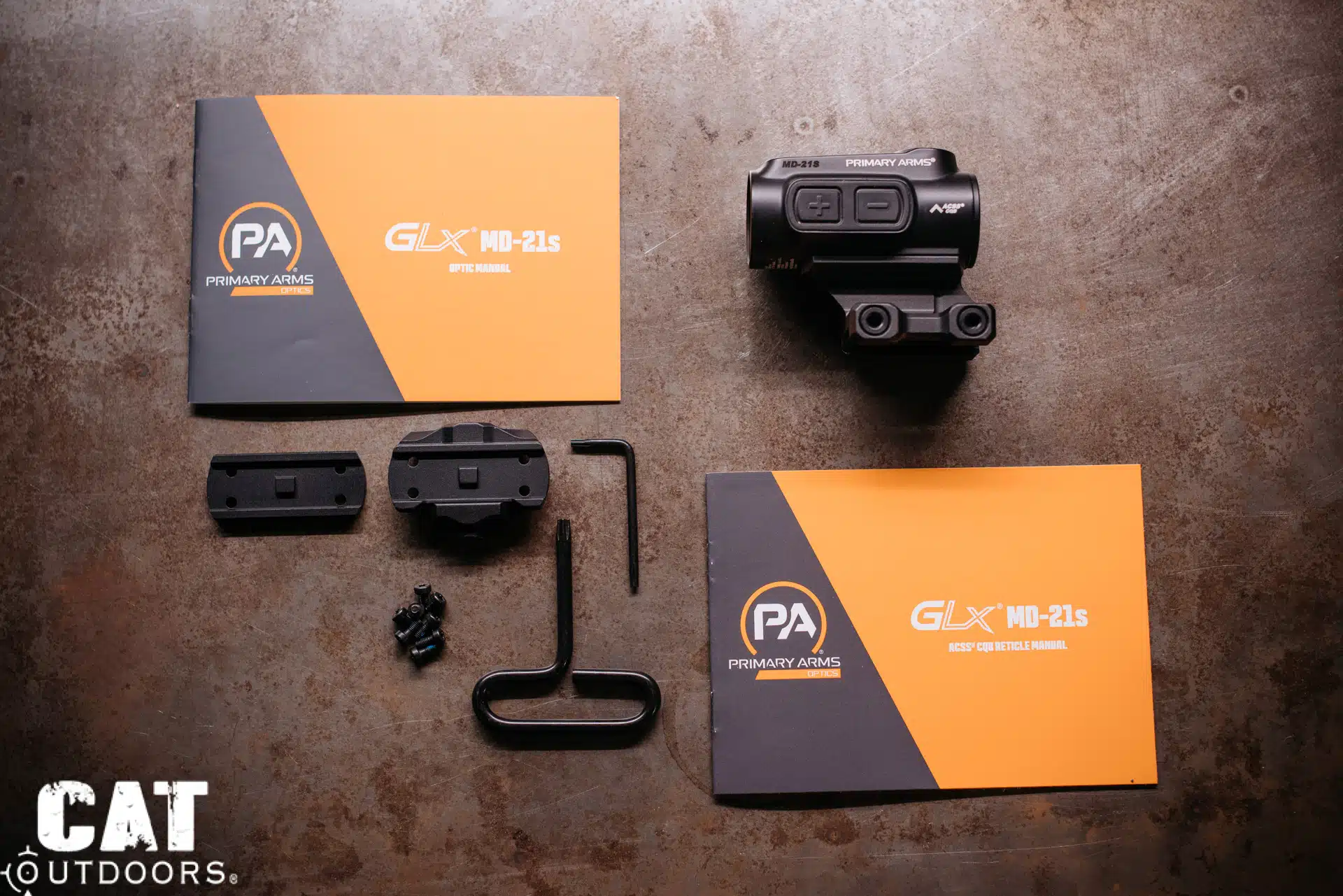
The box covers you on height either way: hardware includes both low-profile and high-profile mounts, plus screws and Torx bit drivers. You also get two manuals, a basic overview and a detailed reticle-specific manual, which tells you how seriously Primary Arms takes that reticle.
Pick your mount, attach it to the bottom of the optic, and clamp the whole assembly to the Picatinny rail.
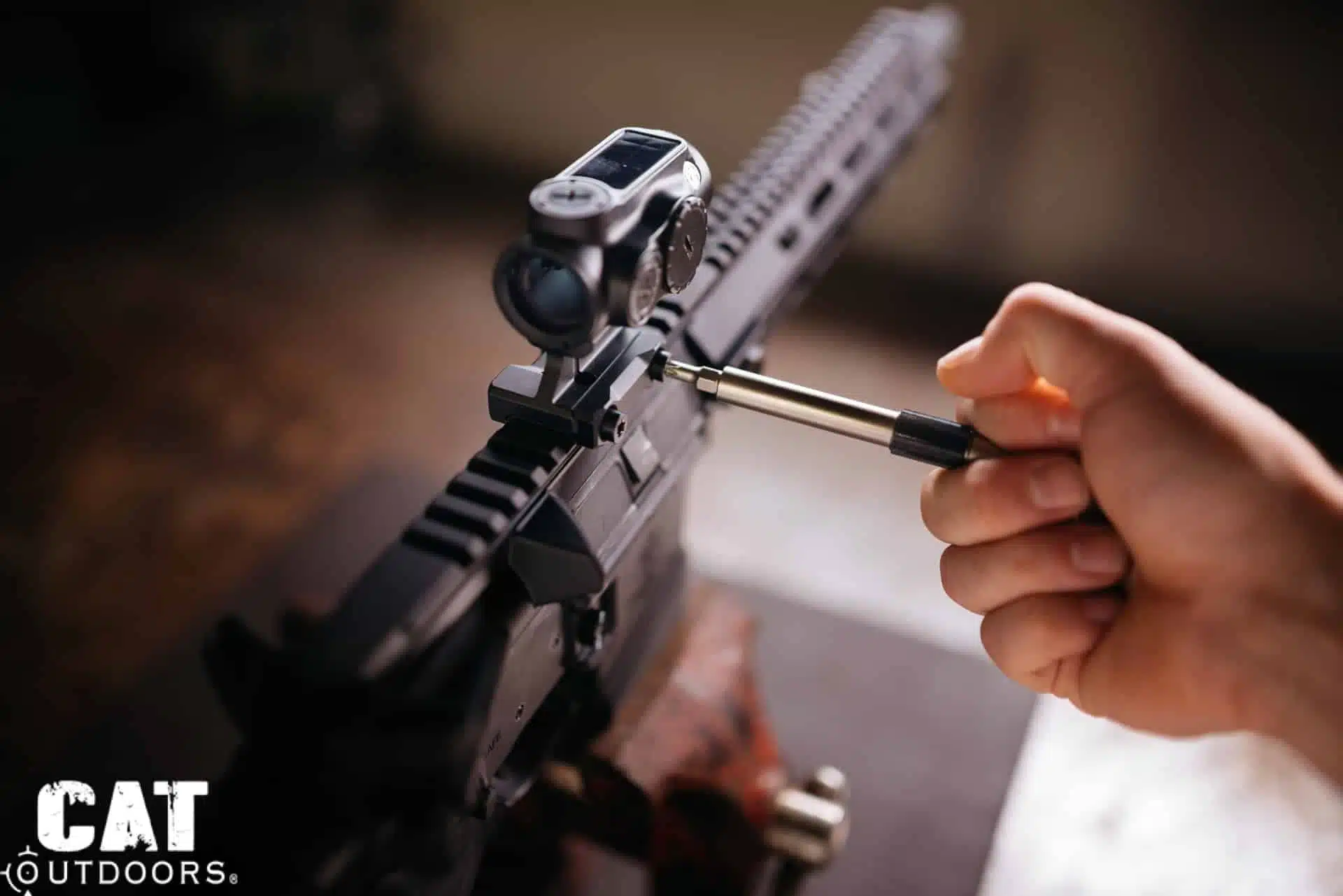
From there it’s two screws and a torque setting. Under-tighten and the mount can rattle loose; drive it too hard and you risk stripping the small screws. I set mine in the 20-25 inch pound range using the same kit from our Fix It Sticks review and its universal torque limiter.
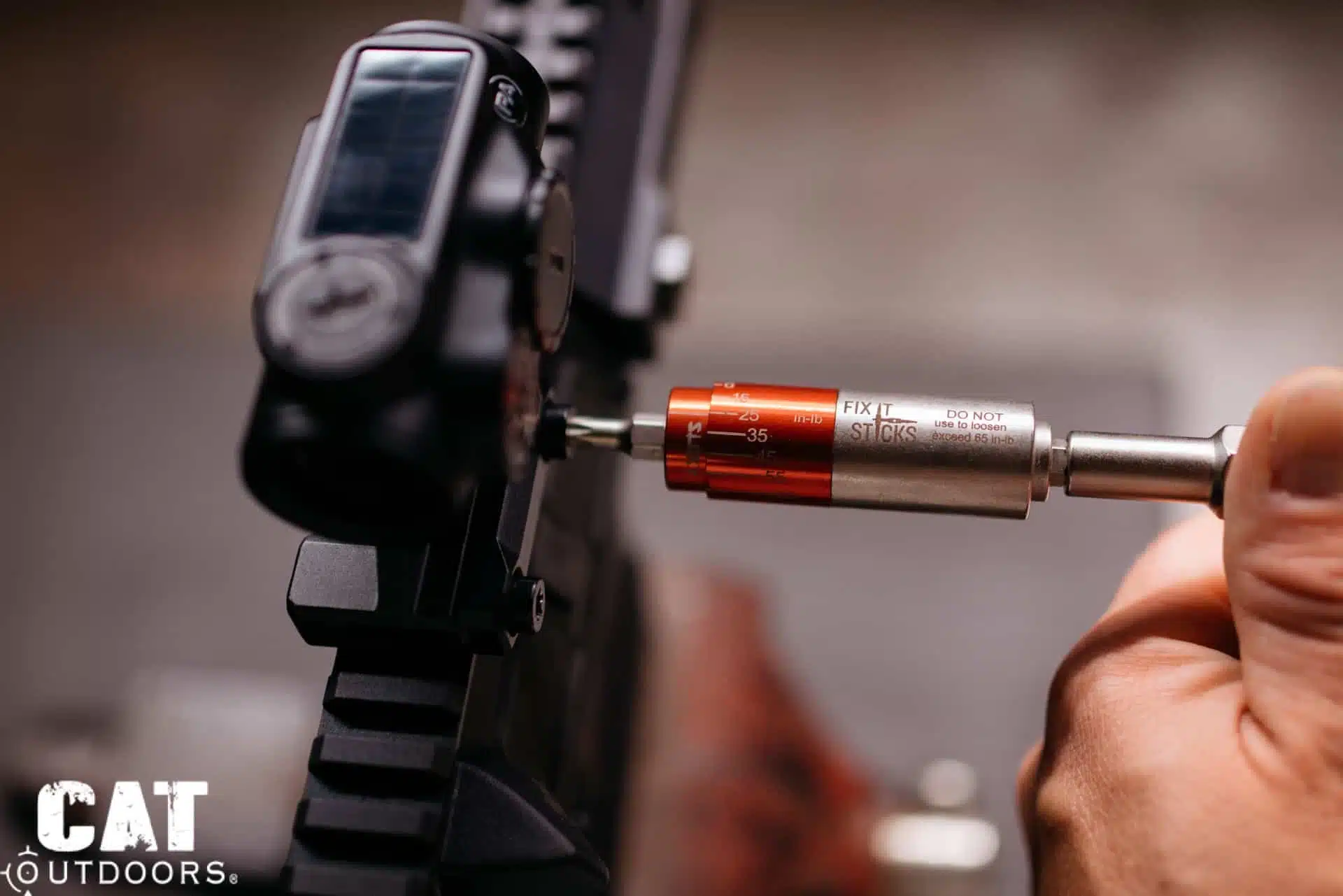
Total install drama: none.

Zeroing: Click Counts and a Spent Case
Range day one, 25 yards, Hornady BLACK 110 gr supersonic. My first three-shot group landed roughly 1.5 inches left and about 2 inches high, a few windage corrections confirmed I was headed the right direction, and a final elevation adjustment finished the job.
11 rounds. 10 clicks right. 20 clicks down.
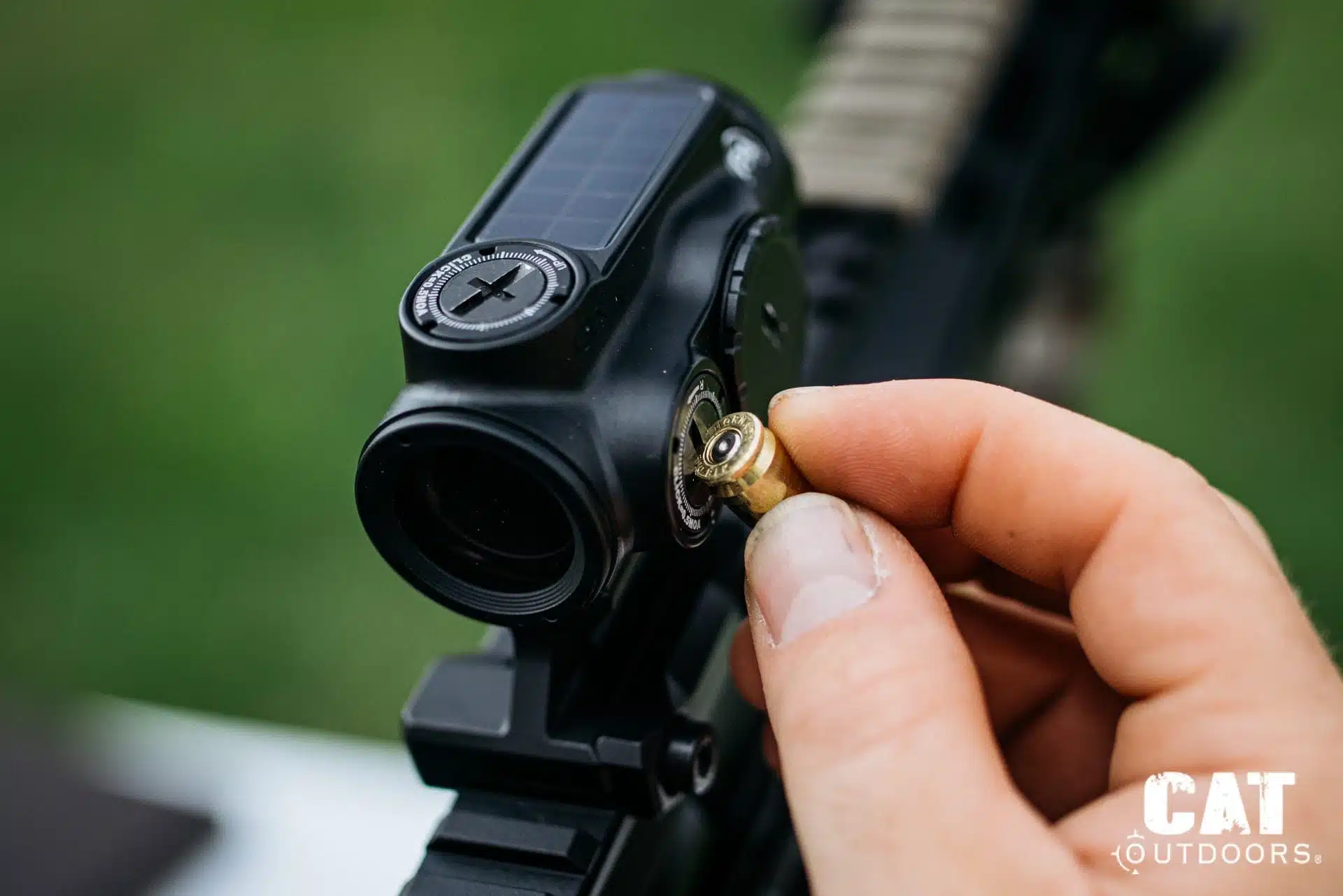
Here’s the design detail I ended up loving. The GLx skips protective turret caps entirely: the turrets sit slightly recessed in the aluminum housing and turn with a tool. Any tool. A screwdriver, a coin, a key, or the rim of a spent case, which happens to be the one adjustment tool no shooter in history has left at home.
I stopped that day at a provisional 50-yard zero on purpose. The suppressor and the ammunition experiments were still coming, and I already knew they would move my point of impact. There’s no sense perfecting a zero you’re about to change.
The full re-zero came on range day two, at 50 yards, once the rifle finally met ammunition it liked. 7 clicks left and 6 clicks up put me right where I wanted to be.
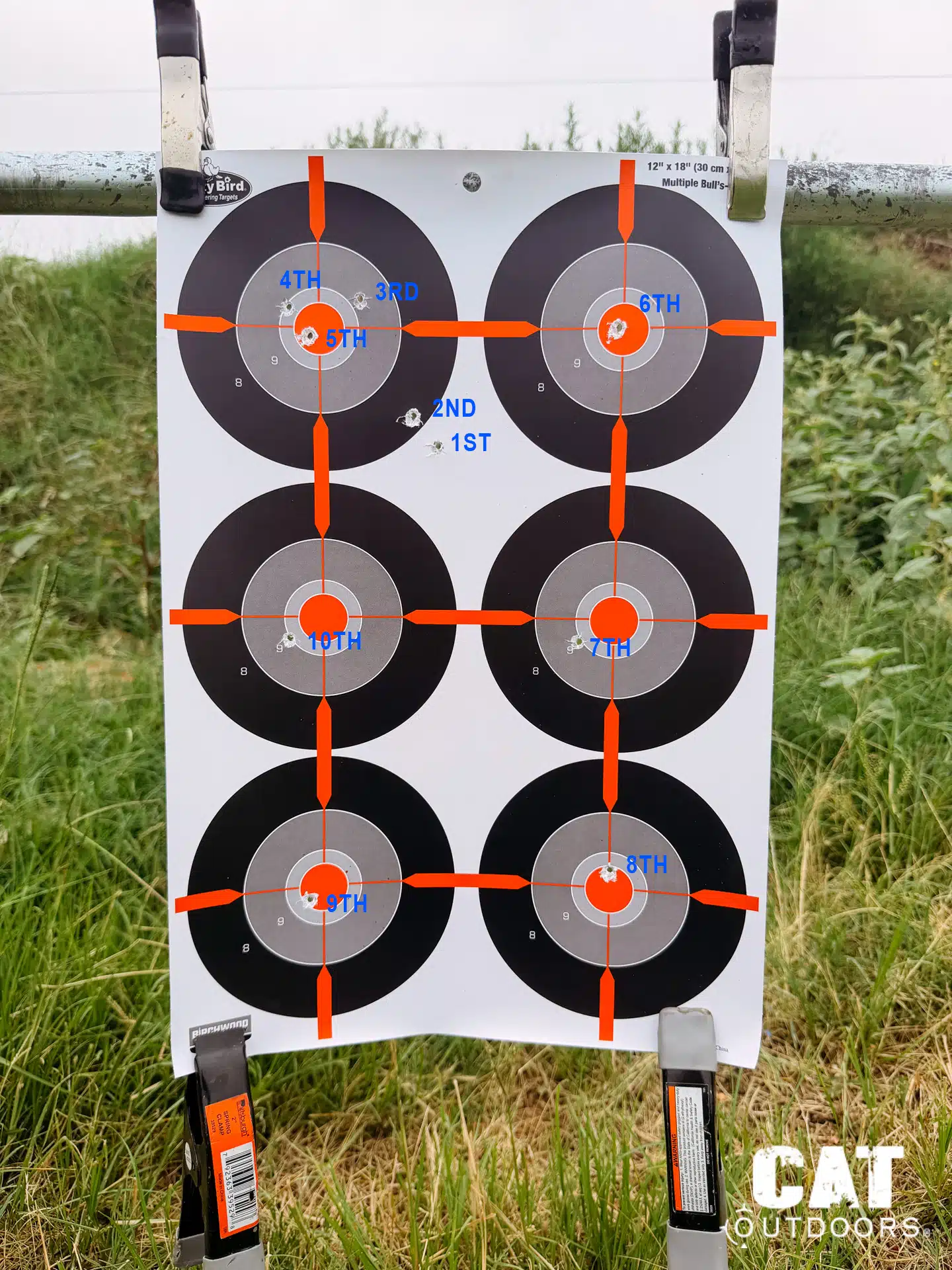
That target reads exactly how a zero should: shots 1 through 5 to dial, shots 6 through 10 to confirm. Ten rounds, no mysteries. The usual rules still apply: known backstop, eyes and ears on, and confirm your own zero with the ammunition you run.
Zero Retention and the Ammo Change
My point of impact moved three times during testing, and if you don’t understand why, you’ll blame the optic for all three. It earned exactly none of the blame.
Shift one: the suppressor. My first suppressed group landed low and left of my fresh zero, so I made the adjustments and kept shooting.
Shift two: the subs. Moving from 110-grain supersonics to 190-grain subsonics confirmed another point-of-impact shift, because a much heavier bullet at subsonic speed does not fly the same arc. Again: physics, not glass.
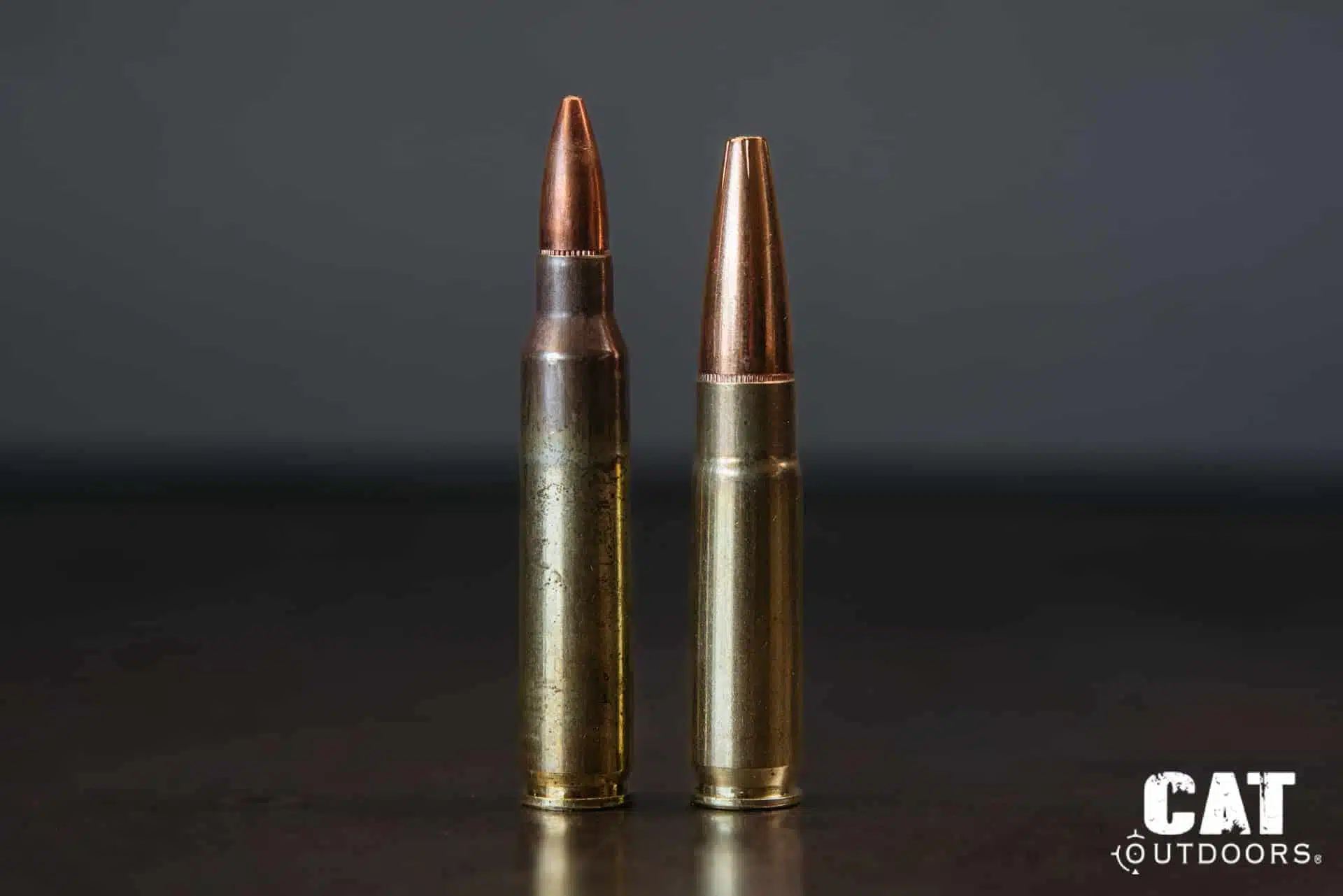
Shift three: the brand swap. When the Hornady loads kept jamming the rifle (the full saga lives in the rifle’s own review), I switched to Winchester 200-grain subsonic, the rifle immediately ran a full 30-round magazine clean, and the new load printed differently again. That’s the 7-left, 6-up re-zero you just saw.
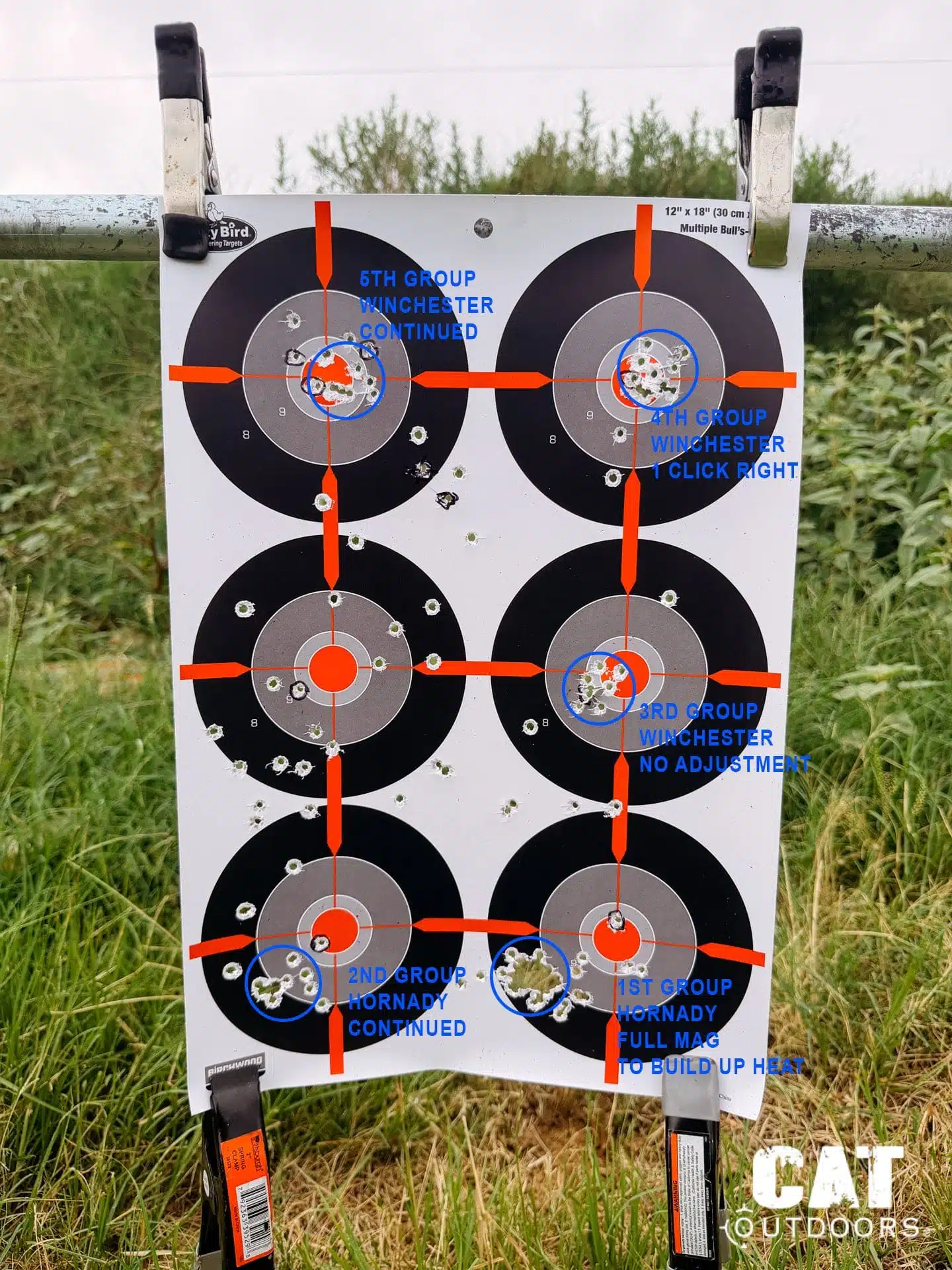
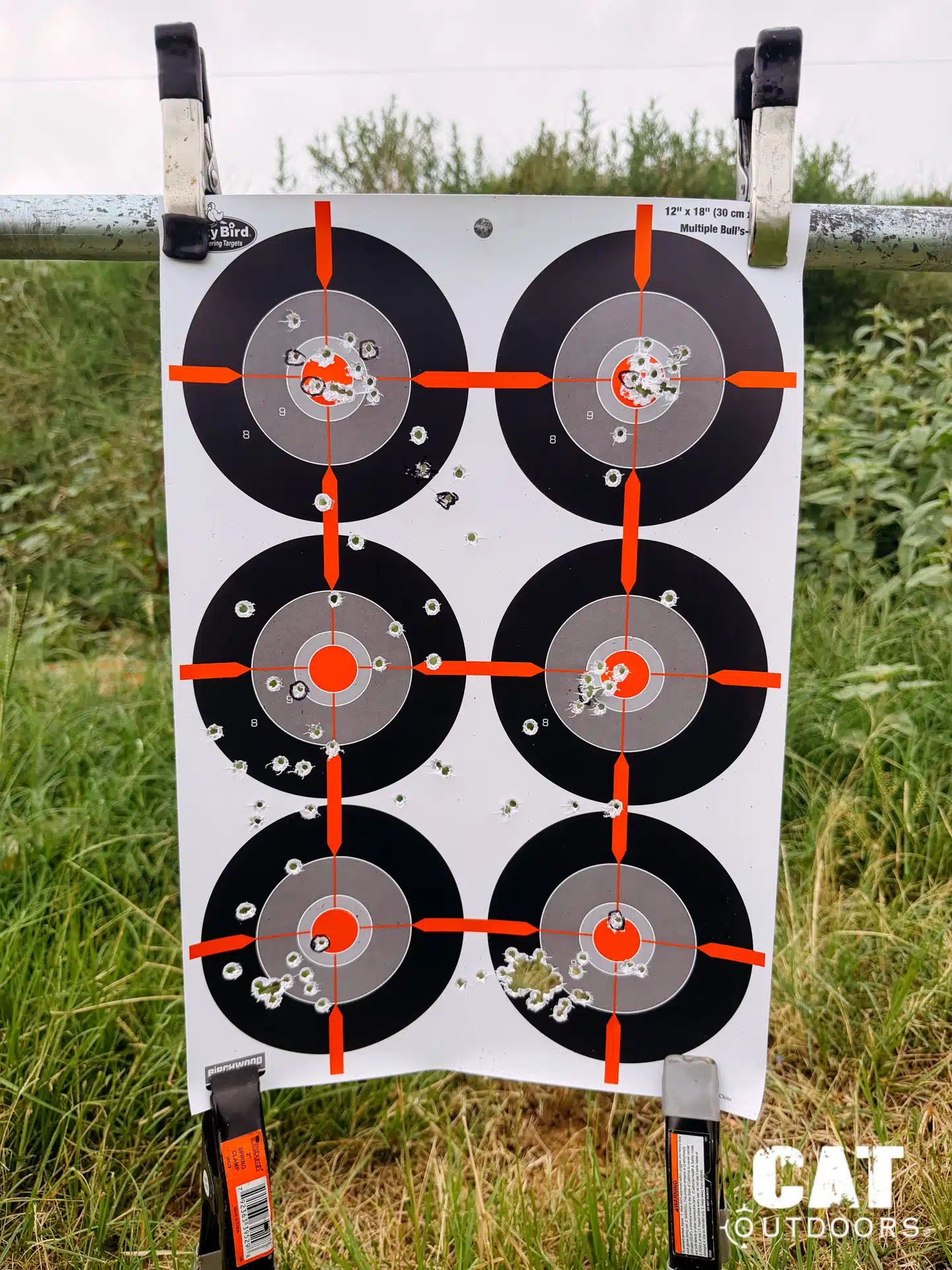
The six-bull target above is the whole day on one sheet: the Winchester re-zero sequence alongside the Hornady groups from our suppressor heat test, with the final correction down to a single click right.
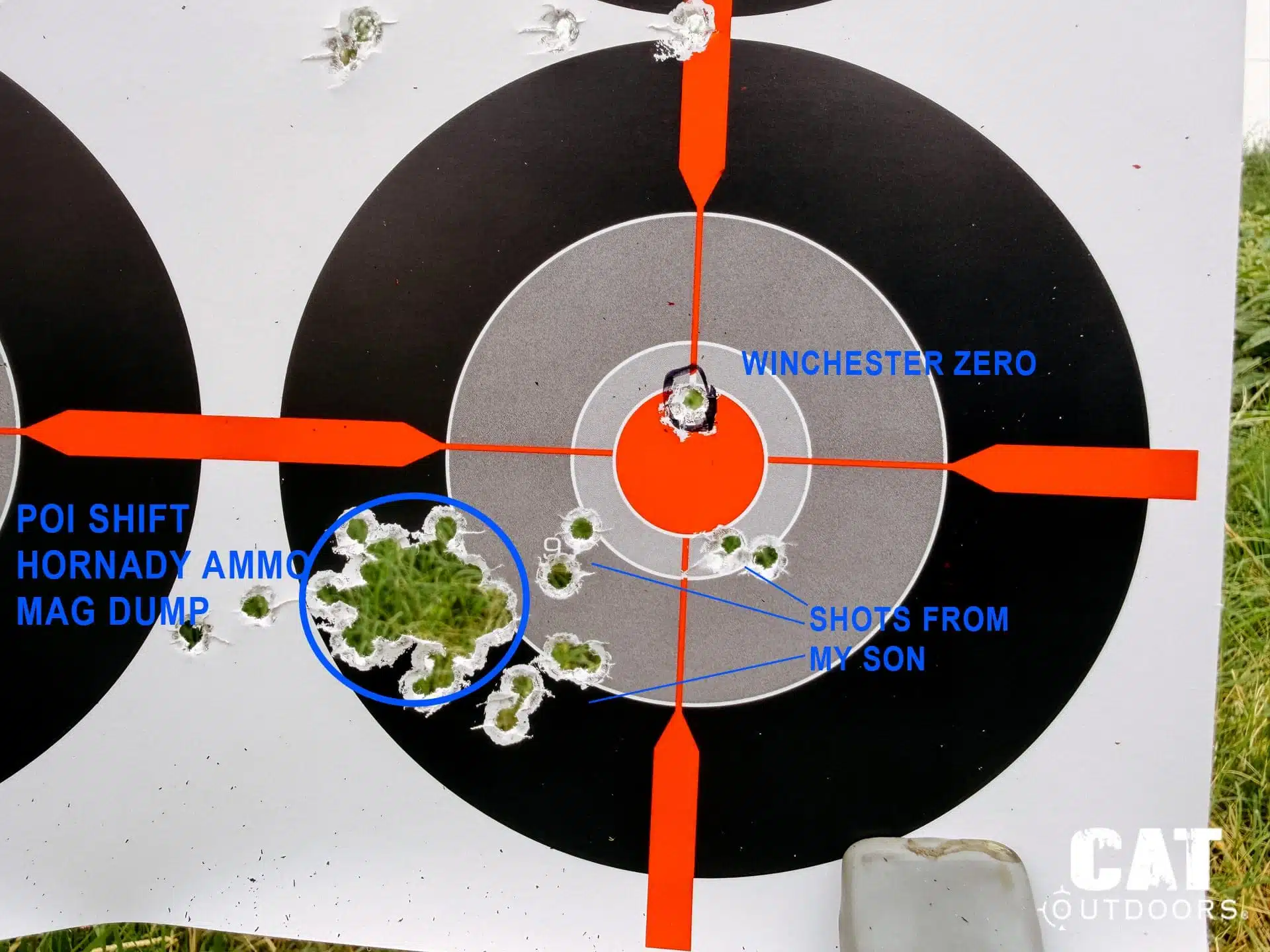
This target is the one I’d show a skeptic. Same optic, same zero, two ammunition brands: the Winchester cluster sits where the chevron promised, and the leftover Hornady prints low and left. If you’ve ever wondered whether an ammo change moves your point of impact, here’s the autopsy photo.
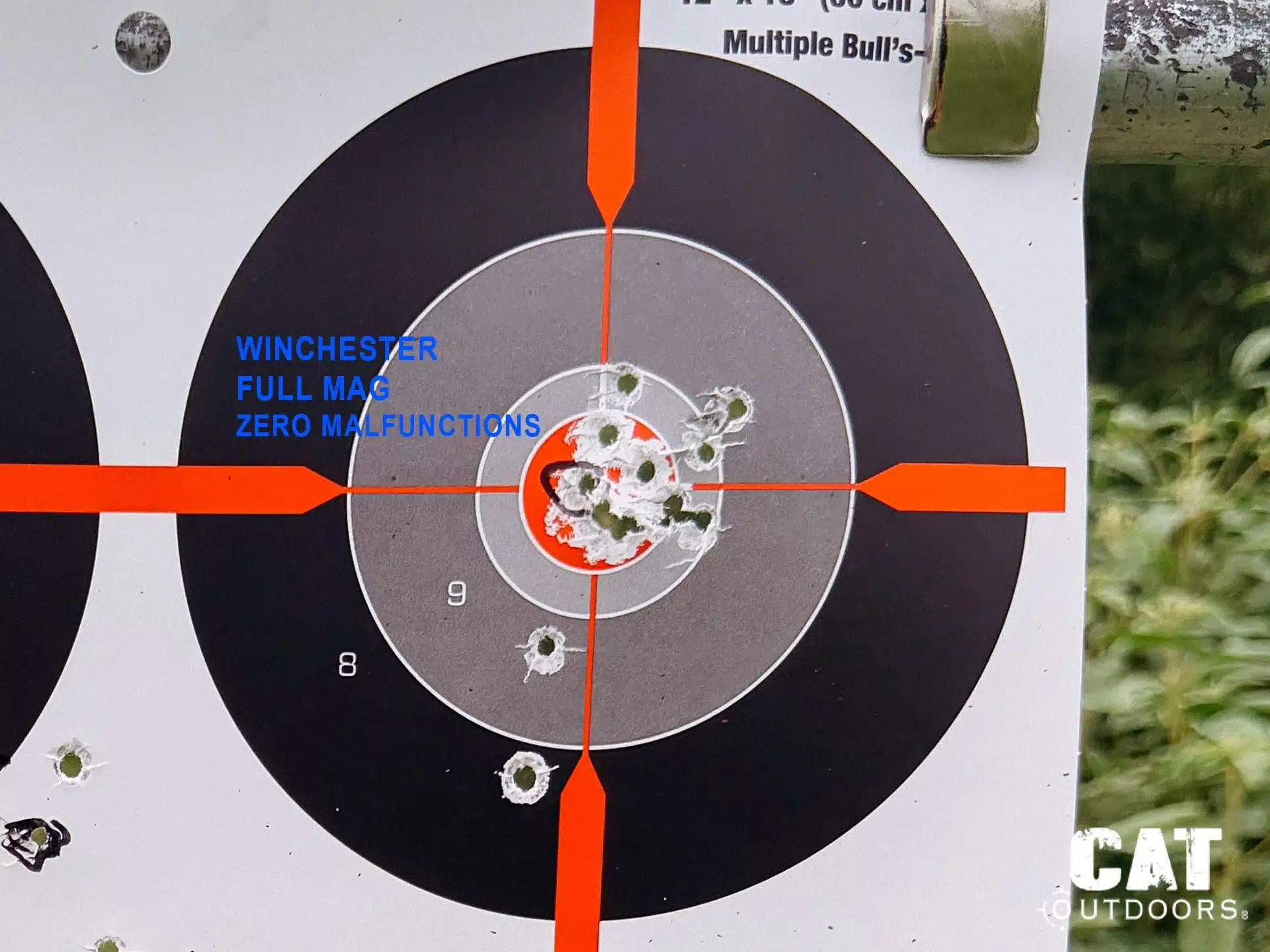
Winchester, one full magazine, zero malfunctions, one tight cluster. The lesson prints right on the paper: feed your gun the ammo it likes.
And the final 50-yard group, up close. Across three configuration changes, every click moved the group where the math said it would, and the zero stayed consistent once we set it. That’s what zero retention looks like in the real world: not a torture-test montage, a paper trail.
Range Use
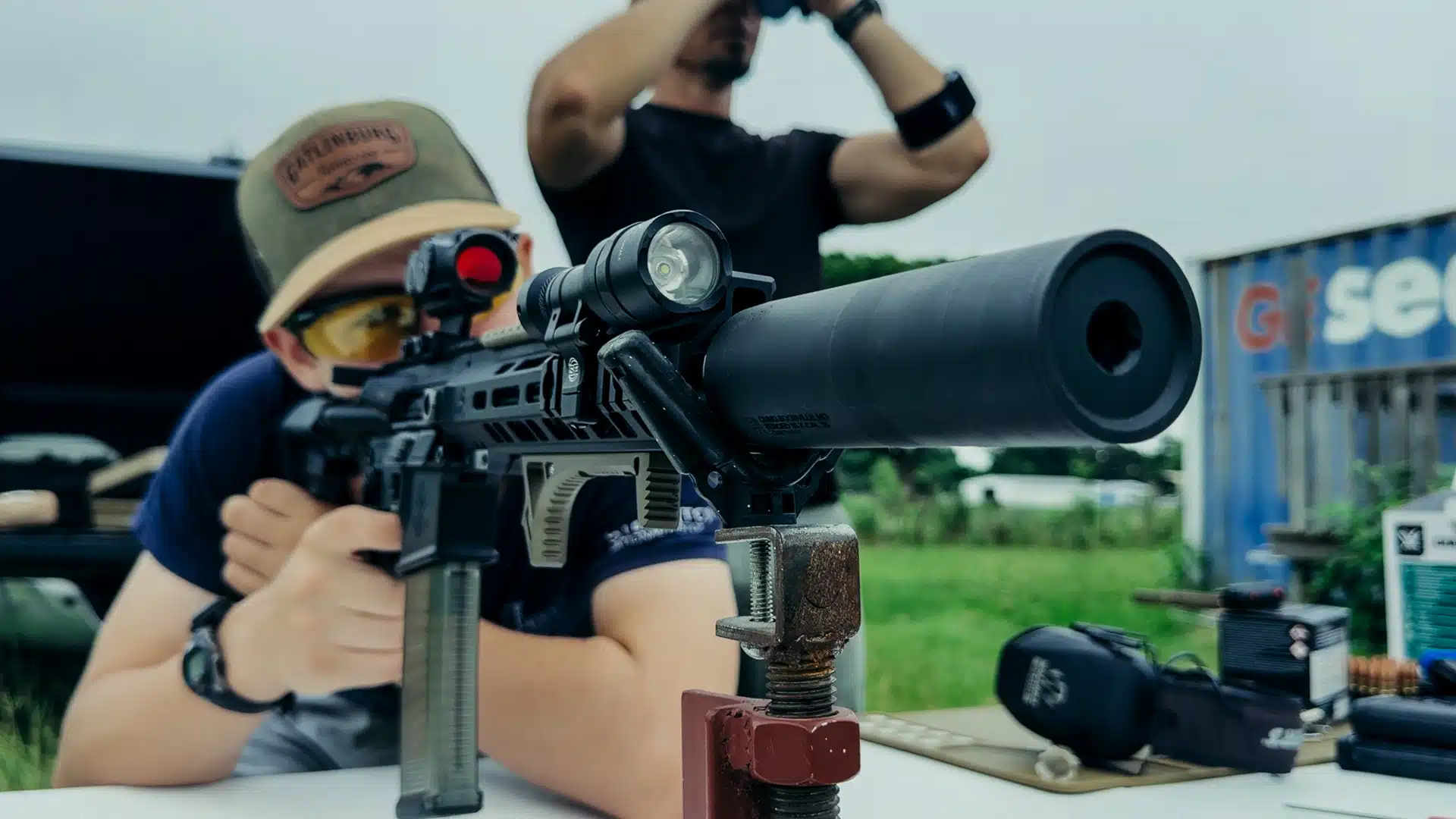
Once the rifle finally ran, the optic disappeared into the job, which is the highest compliment a red dot gets. Recoil was soft, the suppressed shots were quiet, and the chevron kept handing me the same precise aiming point every time the rifle settled.
The same session took us out to distance. At 200 yards, I compared how the supers and subs fly and put the reticle’s holdover dots to work between them. More on what that does and doesn’t prove in a minute.
The least scientific test turned out to be the best one. Back on range day two, my son ran a mag for fun at 50 yards. He had exactly one jam in 20 rounds, and I still don’t know what caused it: he called out “Jam!” and had it cleared, reloaded, and was back on target before I could even look over.
Not a perfect run, but far better than the Hornady days, and a small proud-dad moment made extra cool because it was Father’s Day weekend.
The Holdover Question
Time to say the quiet part, in the same words I used on my score sheet: The ACSS reticle proved to be an excellent match for the .300 Blackout platform. The optic was intuitive, easy to use, and the chevron provided a very precise aiming point. I’m holding back a higher score until I validate the BDC holdovers at extended distances.
Using the holdover dots at the public range and validating them are two different jobs. Validation means known distances, measured groups, both loads, and the same paper-trail treatment the zeroing data got. The honest answer is that test hasn’t happened yet.
So the BDC gets an IOU instead of a verdict. If the holdovers track at distance the way everything else on this optic tracked, the 9.3 has room to grow.
Who It’s For (and Who It’s Not For)
It’s for:
- 300 Blackout shooters who switch between supers and subs, where the BDC references earn their keep
- Anyone who wants a precision aiming point without stepping up to an LPVO
- Shooters who like options: four reticle modes, night vision compatibility, and solar backup in one micro dot
- New optic buyers who’d rather grow into a reticle than out of one
It’s not for:
- A plain 5.56 that never changes loads, where the performance gap over a $100-150 Romeo5 is much smaller than the price gap
- Single-dot purists who want zero decisions in the glass
- Anyone who needs validated long-distance BDC data today, because ours is still on the to-do list
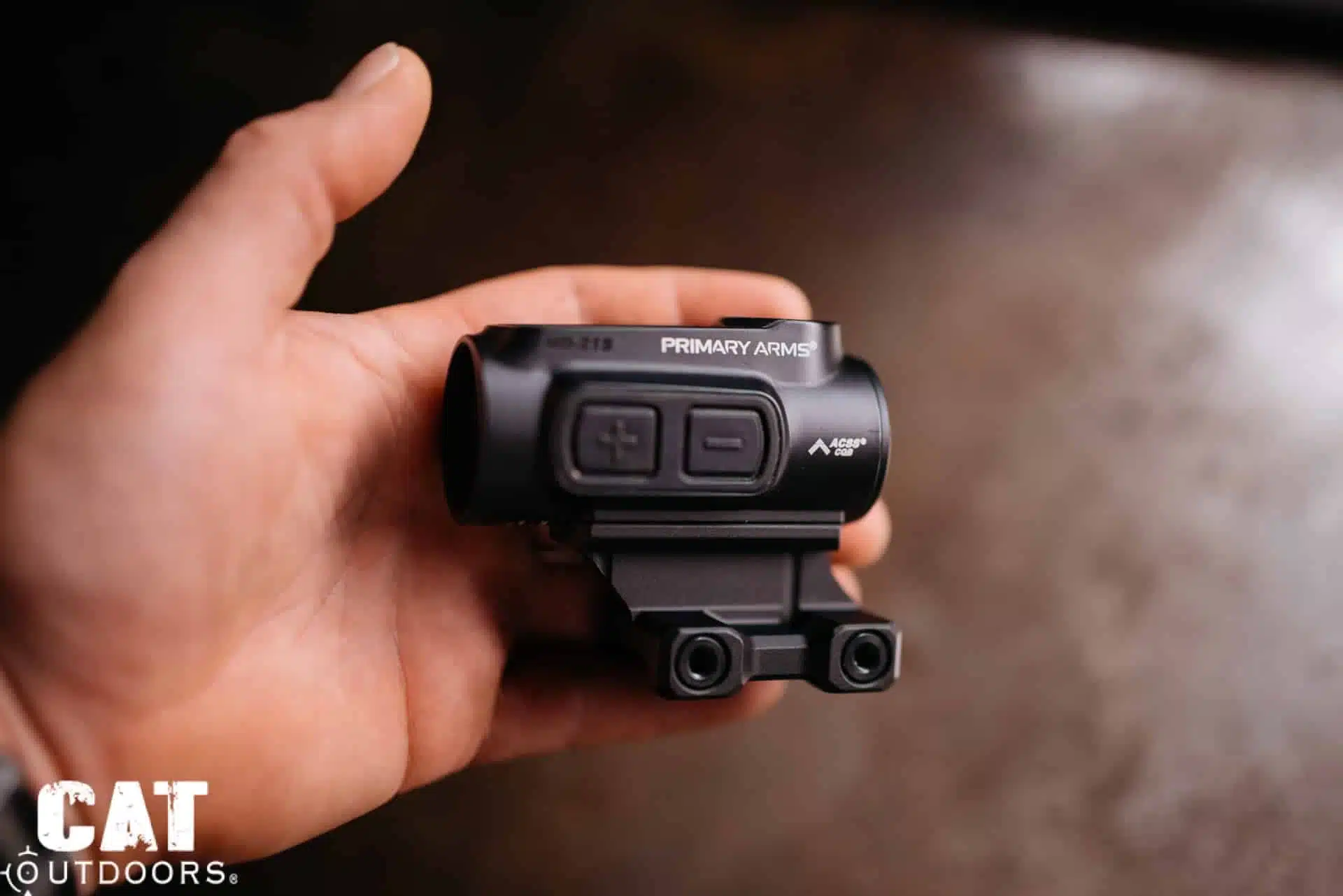
Primary Arms GLx MD-21S ACSS CQB
The ACSS reticle proved to be an excellent match for the .300 Blackout platform.
Our Verdict
The GLx MD-21S walked into a project full of troubleshooting and simply did its job. Mounted once, zeroed in 11 rounds, re-zeroed in ten when the ammunition changed, and it never gave me a reason to think about it again.
Where the score comes from: the reticle is the star of the show on this platform, the click adjustments earned my trust on paper, and the capless turrets are the rare clever idea that stays clever at the range. Where it lost ground: the BDC holdovers are still unvalidated at distance, and on a simpler rifle the premium over a Romeo5 buys you less. Neither is a dealbreaker. Both are real.
Final Score: 9.3/10
At $229.99 street at Primary Arms, the GLx costs about twice what a Romeo5 does, and for this rifle I’d make the same call twice. It was built by people who understood the platform before I did.
FAQ
Is the Primary Arms GLx MD-21S worth it over the SLx MD-21?
They’re two different optics, not two prices for the same one. The GLx MD-21S we tested ($229.99 street) is the higher-tier model; the SLx MD-21 is the roughly $199 budget sibling, and it is not the optic that earned this score. We found a competing review that conflates them, so make sure the listing says GLx before you order.
What is the ACSS CQB reticle on the GLx MD-21S?
It’s Primary Arms’ multi-reticle system with four user-selectable configurations: chevron only, chevron + BDC, chevron + horseshoe, or the full reticle with all three. The chevron tip gives a precise aiming point for zeroing and accuracy work, the horseshoe is extremely quick to acquire up close, and the BDC references provide holdover information when switching between supersonic and subsonic ammunition.
Did the GLx MD-21S hold zero?
Yes. Every point-of-impact shift we recorded traced back to a configuration change (adding the suppressor, switching ammunition), not the optic. The initial 25-yard zero took 11 rounds, the 50-yard re-zero after the Winchester switch took 7 clicks left and 6 clicks up, and the confirmed zero stayed consistent through the rest of testing, including a suppressor heat test and a 200-yard public-range session.
What’s the difference between the GLx MD-21S and the MD-21S?
Primary Arms’ own materials have used both names. The current listing is the GLx MD-21S, and that is the version we tested and scored, with push-button controls and AutoLive motion activation. Whichever name you see, make sure it says GLx and not SLx; that is the difference that changes the optic.
Is the GLx MD-21S good for 300 Blackout?
That’s where it makes the most sense. Because 300 Blackout switches between supersonic and subsonic loads, the BDC holdover references get used instead of ignored, and the selectable reticles let you match the optic to the job. It scored 9.3/10 in our testing, with the only reservation being BDC validation at longer distances.
What mount does the GLx MD-21S use?
It uses the Aimpoint Micro footprint, and both low-profile and high-profile mounts come in the box along with screws and Torx bit drivers. Installation is two screws; we torqued ours to 20-25 inch pounds with a Fix It Sticks torque limiter to avoid a rattling mount or stripped screws.
What’s riding on top of your 300 Blackout, and has it earned the spot? Drop a comment below and tell us what you want tested next.
Also, be sure to check out our roundup of the Best AR-15 Red Dots!

Brad Lanphear is a professional videographer by day and a gun enthusiast by night. When he’s not behind a camera, he’s usually at the range, in the workshop, or testing gear he probably didn’t need but wanted anyway. He enjoys practical firearms setups, well-designed tools, and helping others avoid common (and expensive) mistakes.