TriggerTech Diamond Review: AR-15 Trigger Tested on a Wheeler Gauge (2026)
The TriggerTech Diamond is a zero-creep, drop-in AR-15 trigger that feels ELITE and will not, by itself, make you a better shooter. Here’s what 18 Wheeler-gauge pulls and a ruler told us.
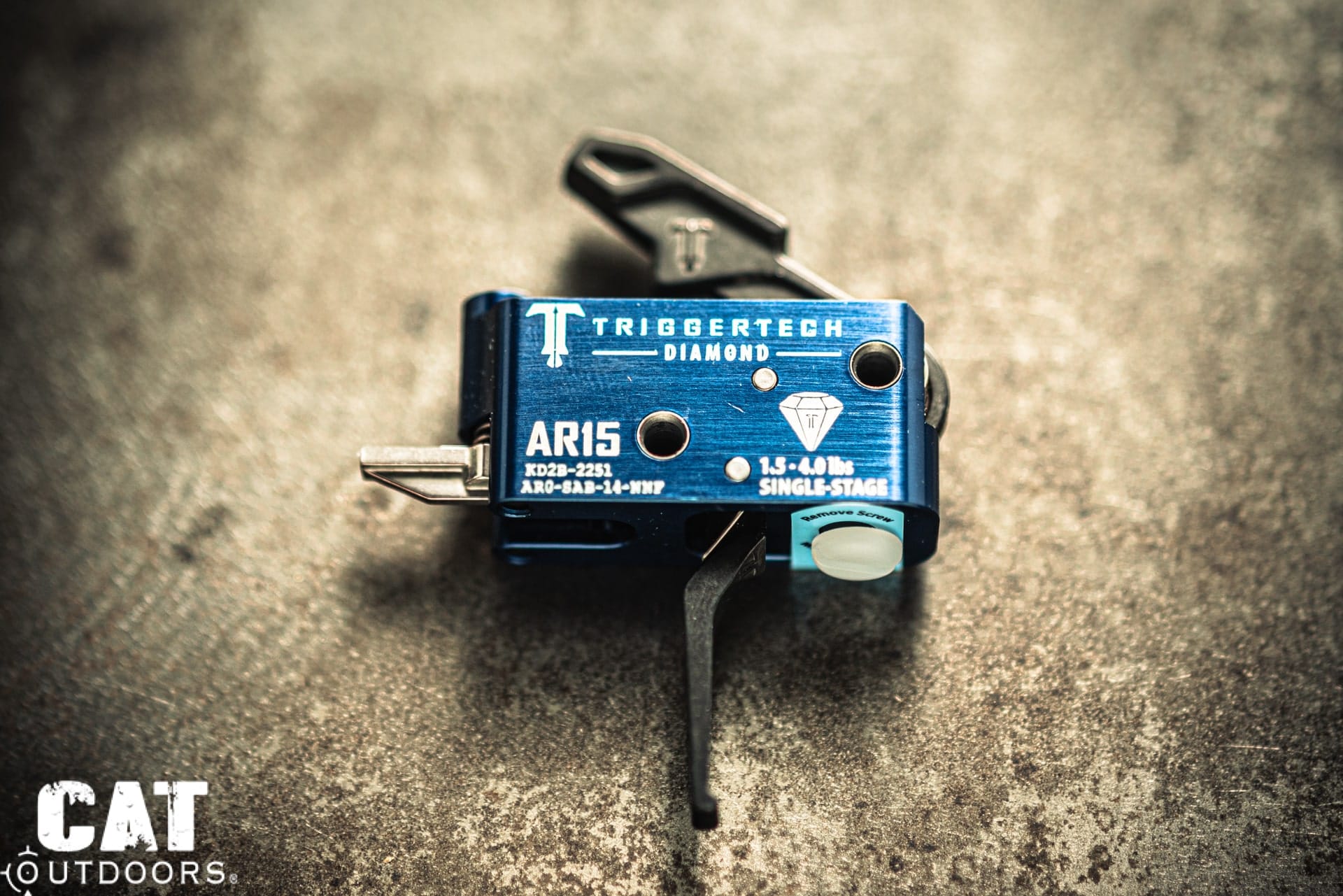
The Diamond is an amazing piece of design and engineering, but it will not make you a better shooter by itself. What it will do, immediately and on paper, is reveal your shortcomings as a shooter. Our Wheeler gauge logged averages from 1 lb 0.6 oz to 5 lb 11.4 oz across the adjustment range, with 1.5mm of total travel at every setting. MSRP is $324.99, but street prices start around $240 at the big retailers right now.
Reasons to Buy
- Zero-creep break from a genuinely different mechanism, not a tuned-up conventional trigger
- Feels ELITE from the first pull after install
- 1.5mm of total travel at every pull weight setting we measured
- Crisp, clear clicks on the pull weight adjustment screw
- Shots break exactly when you intend, the mechanism behind tighter groups and faster splits
- Simple drop-in install in a mil-spec lower
Reasons to Skip
- Too light for general-purpose or defensive use, especially at the lower settings
- Premium price without universal benefit for casual shooters
- Less forgiving: there is no take-up to prep against
- Won't fix your fundamentals; it exposes them
This TriggerTech Diamond review put a $325 drop-in AR-15 trigger on a Wheeler gauge eighteen times to find out whether a zero-creep break is worth three bills.

Here’s the short version: it’s an amazing piece of design and engineering that improves exactly nothing about your fundamentals. What it will do, immediately and without much sympathy, is reveal your shortcomings as a shooter.
That sounds like a con. Keep reading, because by the end of this review you might decide it’s the entire point.
Specs
- Type: Drop-in cassette, single-stage
- Pull Weight: 1.5-4.0 lb (manufacturer stated); 1 lb 0.6 oz to 5 lb 11.4 oz measured averages on our gauge
- Total Travel: 1.5mm at every setting we measured
- Trigger Shoe: Flat (Pro Curved also available)
- Reset: Short, tactile
- Construction: 7075 aluminum housing, hardened stainless internals
- Fitment: Mil-spec .154″ pin AR-15 lower receivers
- Warranty: Lifetime
- MSRP: $324.99 (street prices roughly $240-$326 depending on retailer)
Those top-line numbers come from TriggerTech’s official Diamond AR-15 page. The measured rows are ours, and we’ll show you exactly how we got them.
Why You Can Trust This Review
Full disclosure: our friends at Primary Arms provided this trigger free of charge, and neither they nor TriggerTech had any input on this review or any expectations about what it would say. Every number here comes off our own bench: our gauge, our rifle, our protocol, all documented below. Some links on this page (including Primary Arms links) earn us a commission; that never touches the score.
- Product Tested: TriggerTech Diamond single-stage AR-15 trigger, flat shoe (AR0-SAB-14-NNF), $324.99 MSRP
- Measurement Gear: Wheeler Digital Pull Scale, with the rifle mounted in a gunsmithing vise block
- Pull Weight Protocol: 6 measured pulls at each of 3 settings (lowest recommended, middle, and maximum), recording every individual pull plus the high, low, average, and total variance of each set
- Travel Protocol: Metal ruler clamped to the grip and buttstock, zero mark aligned with the edge of the trigger, pulls recorded on video
- Reset Protocol: Tested two ways, held through the bolt cycle and released immediately after the break
Every measurement here is out-of-the-box performance with no live-fire break-in. No cherry-picking a worn-in unit, no manufacturer-supplied numbers. This review is based on our actual experience with it, both the good and bad.
First Impressions: It Feels ELITE
My first impression on installation, in exactly the words I wrote in my notes: it feels ELITE. The capital letters were not an accident. The unit itself dresses the part: machined 7075 housing anodized in TriggerTech blue, flat black shoe, the whole mechanism self-contained in one cassette.
TriggerTech isn’t shy about who this is for, either. The package states: “This product has a distinctive lower pull weight than other TriggerTech and competitors products. It is designed for use by only expert shooters.”
That’s a bold thing to print on a box. And it definitely FEELS like an expert trigger. Even the pull weight adjustment screw clicks with a crispness that tells you somebody sweated the small stuff.
Frictionless Release Technology: What’s Under the Hood
The Diamond is positioned as a top-tier, competition-grade AR-15 trigger, built around TriggerTech’s patented “Frictionless Release Technology.” To appreciate what the Diamond does differently, you need thirty seconds on how a normal trigger breaks.
Fortunately, TriggerTech put a very helpful diagram on the back of the box.
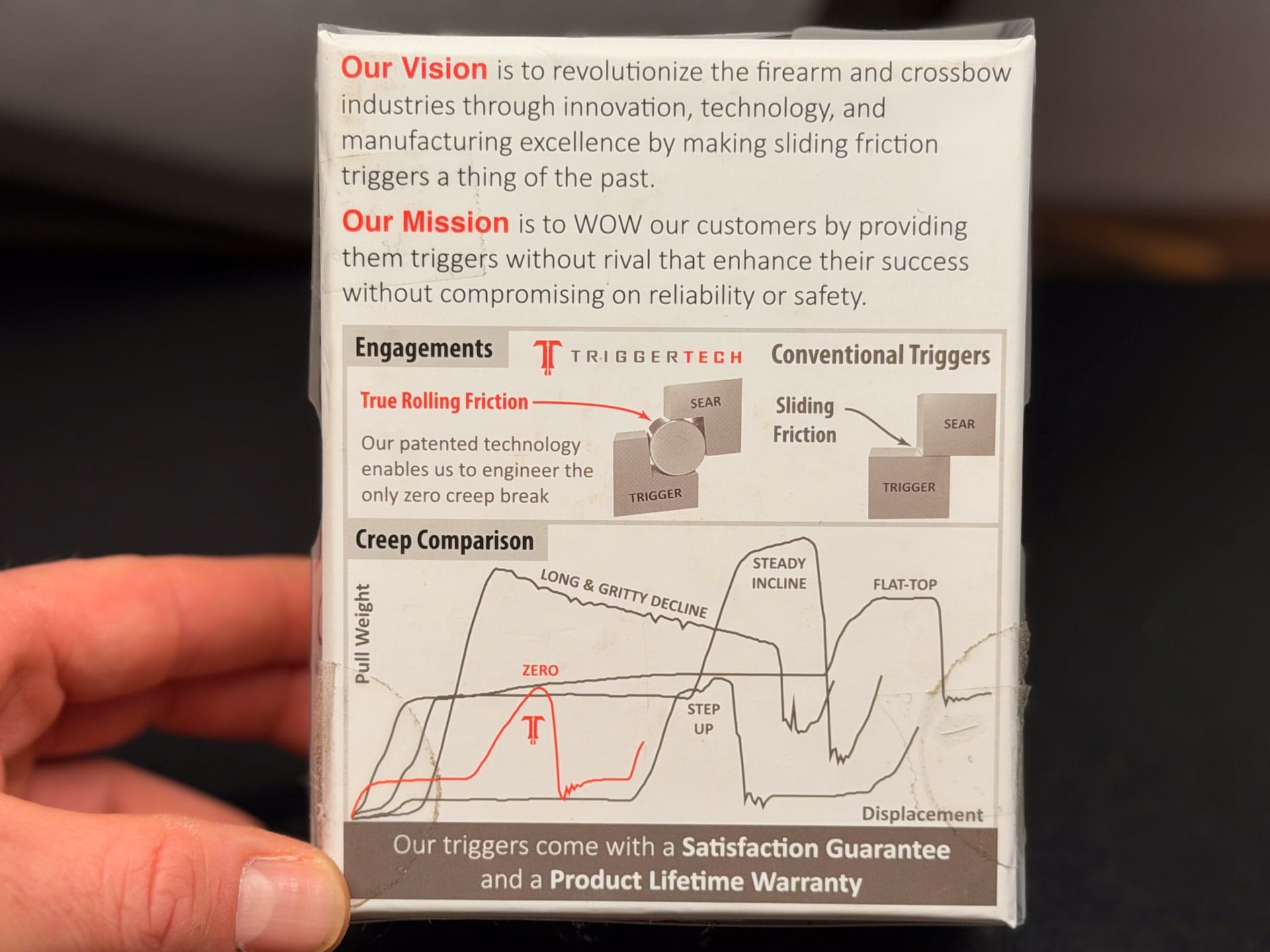
Conventional triggers rely on two key factors: friction and movement. Movement is the distance the sear, the small catch that holds the hammer back until the trigger releases it, has to slide across the trigger before it slides off, or “breaks.” That sliding distance is what’s commonly referred to as “creep.”
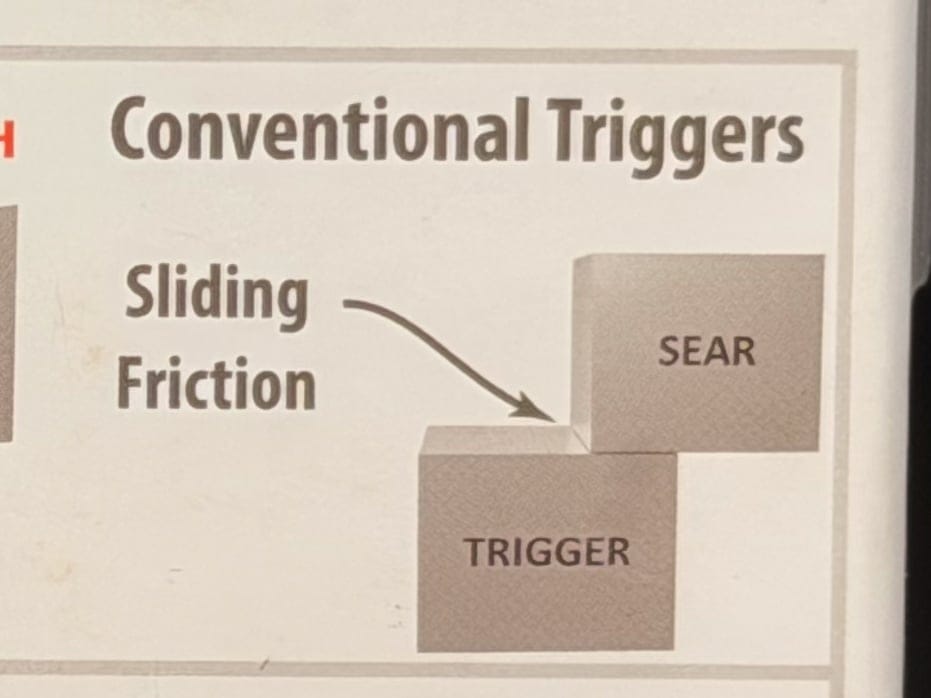
Some conventional triggers have adjustable creep distance and pull weight, but the principle is largely the same: two flat pieces of metal that slide across each other until they separate.
TriggerTech takes a completely different approach.
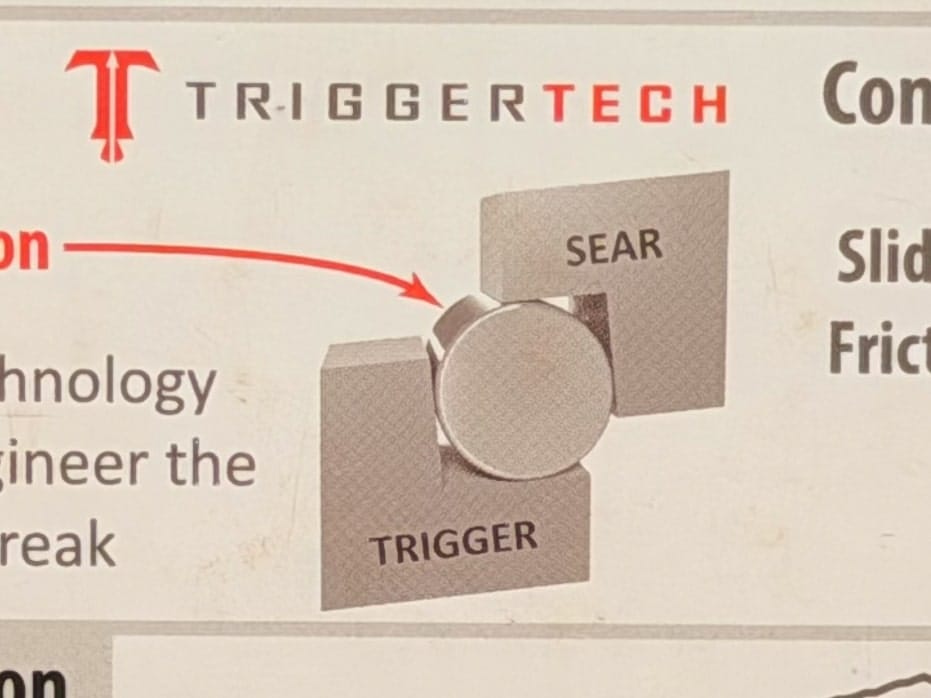
Instead of flat-on-flat surfaces, they use a roller-based design. The sear sits against a curved surface instead of a flat one, and the moment the trigger is pulled, the sear releases without any noticeable creep. It sits exactly at the breaking point, but it doesn’t break until you pull it.
The resulting zero-creep pull is incredibly instantaneous, which results in better accuracy because there’s zero delay from the moment of decision to the break. We’re obviously talking about extremely tiny fractions of a second here, hundredths or thousandths, which for casual shooters or home protection have very little meaningful effect.
But in a competition environment, where a shot timer is tracking every movement and accuracy is immediately visible on paper, those margins start to matter. A cleaner break reduces input delay and minimizes movement of the rifle at the moment of the shot, which can translate to faster splits and more consistent hits.

Installation
Like every good drop-in trigger, the Diamond is a self-contained cassette, so installation is pretty straightforward. Once your lower receiver is stripped and mounted on a vise for stability, you simply follow the instructions in the box. The fit should be snug with little or no wiggle room.
- Install the rear pin
- Install the safety
- Install the front pin
- Snug down both set screws in the bottom, which puts pressure against the pins to keep them from moving
- Reassemble the lower receiver
- Attach the upper receiver
- Check function
That’s it. No fitting, no gunsmithing. If you can detail-strip a lower, the install is exactly as straightforward as it sounds.
Pull Weight Adjustment
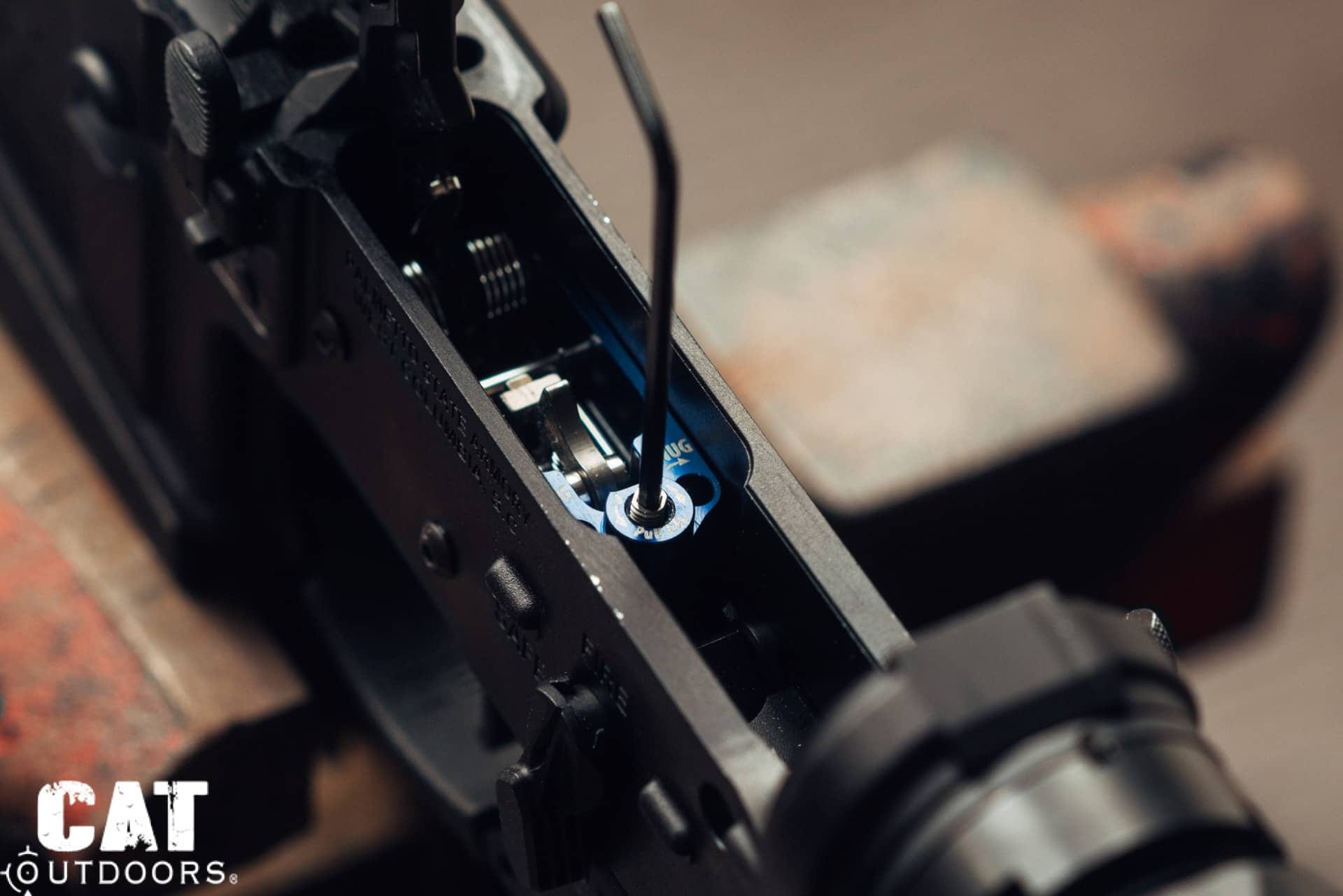
Adjusting the pull weight is very simple. Open the upper receiver and turn the set screw.
Clockwise increases pull weight. Counter-clockwise decreases pull weight.
The screw has spring-loaded detents that produce crisp and clear clicks in 1/8-turn increments. For scale: getting from the factory setting down to the minimum took 30 clicks counter-clockwise, and the instructions say to keep a minimum of 3 clicks on the adjustment screw to keep it from falling out. Running from minimum all the way to maximum took approximately 86 clicks.
How We Tested
We mounted the rifle in a gunsmithing vise block and worked the Wheeler Digital Pull Scale through 6 measured pulls at each of 3 settings: lowest recommended, middle, and maximum. For each set we logged every individual measurement plus the highest pull, the lowest pull, the average, and the total variance.
For travel, we clamped a metal ruler to the grip and buttstock, lined the zero mark up with the edge of the trigger, and filmed each pull.
We tested reset two ways, because real shooting happens two ways. First: trigger pulled and held to the rear, bolt cycled to re-cock the hammer, then the trigger slowly released forward until reset. That simulates controlled, precision shooting where the shooter maintains contact with the trigger. Second: trigger released immediately after the shot, letting the bolt cycle reset it with no finger resistance, simulating faster or less controlled strings where the trigger isn’t actively managed.
Everything below is out-of-the-box performance with no live-fire break-in.
The Poll
Where does your carry gun ride?
This week's holster coverage has us curious. Tap your pick.
The Poll · Live Standings
Your vote is in.
0 votes so far. Winner announced in next week’s issue.
Want to Know the Final Results?
We tally the votes and name the winner in next week’s email. Sign up and the final standings come straight to your inbox, and you’ll be first to hear when the review goes live.
By signing up you agree to our Terms of Service and Privacy Policy. No spam, and we never sell your address. Unsubscribe anytime.
That didn’t go through. Check the address and try again.
Done. Watch your inbox.
You’re on the list. The final standings land in next week’s issue, and if your pick loses, take it up with the other voters.
Measured Data: 18 Pulls on the Wheeler Gauge
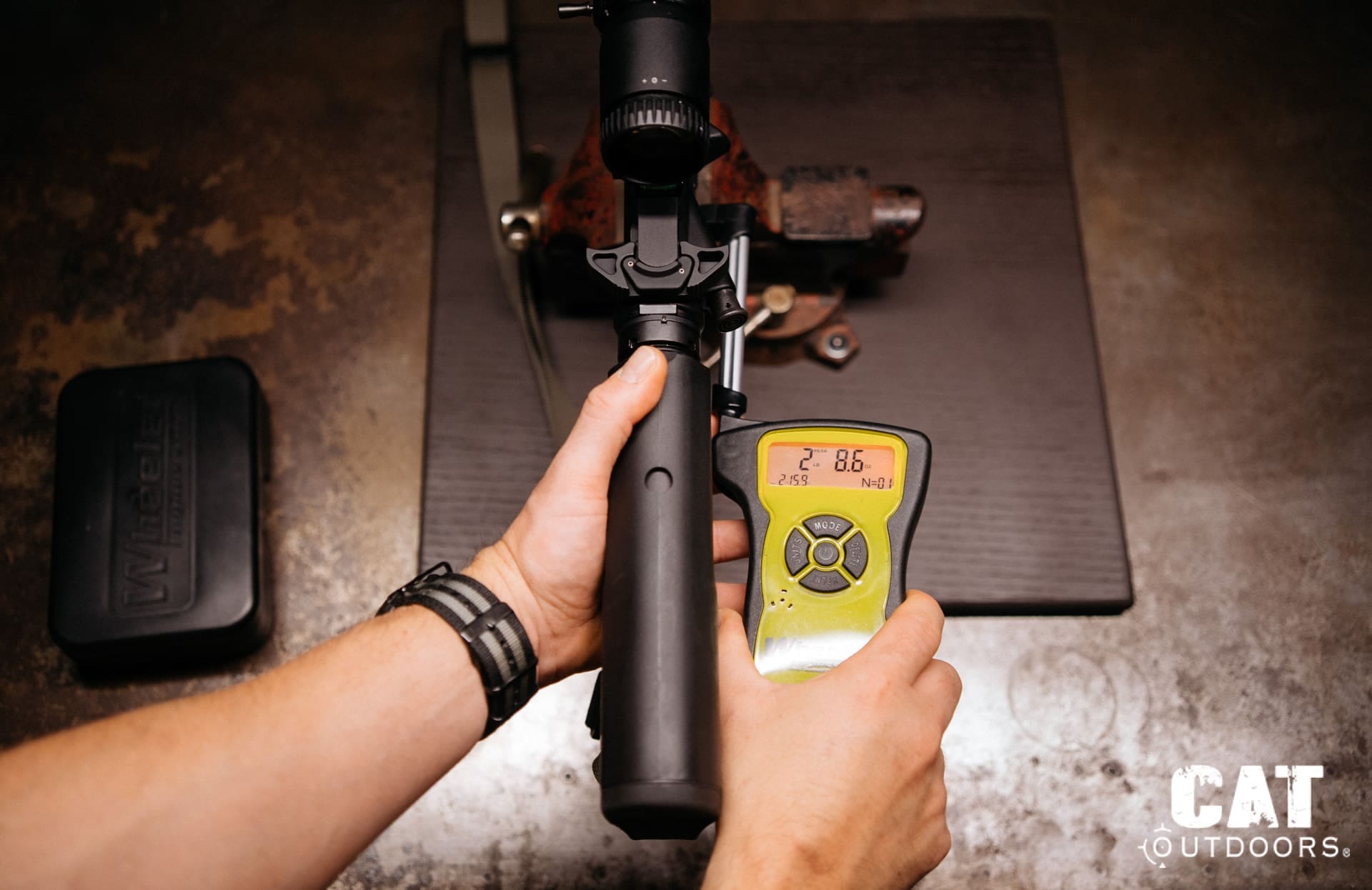
| Setting (6 pulls each) | Lowest Pull | Highest Pull | Average | Variance |
|---|---|---|---|---|
| Lowest recommended (30 clicks down from factory) | 15 oz | 1 lb 3.5 oz | 1 lb 0.6 oz | 4.5 oz |
| Middle (factory, out of the box) | 1 lb 15.1 oz | 2 lb 11.9 oz | 2 lb 7.9 oz | 12.8 oz |
| Highest possible (~86 clicks from minimum) | 5 lb 6.1 oz | 6 lb 0.4 oz | 5 lb 11.4 oz | 10.3 oz |
What jumps out is the bottom row of that low setting: the Diamond averaged a hair over one pound. That’s a pull weight most shooters have never felt on a rifle. The tightest consistency also lives down there, with just 4.5 oz of variance across six pulls.
Travel Distance: 1.5mm Is Not a Typo
Across all pull weight settings, the travel distance remained consistently the same: 1.5mm.
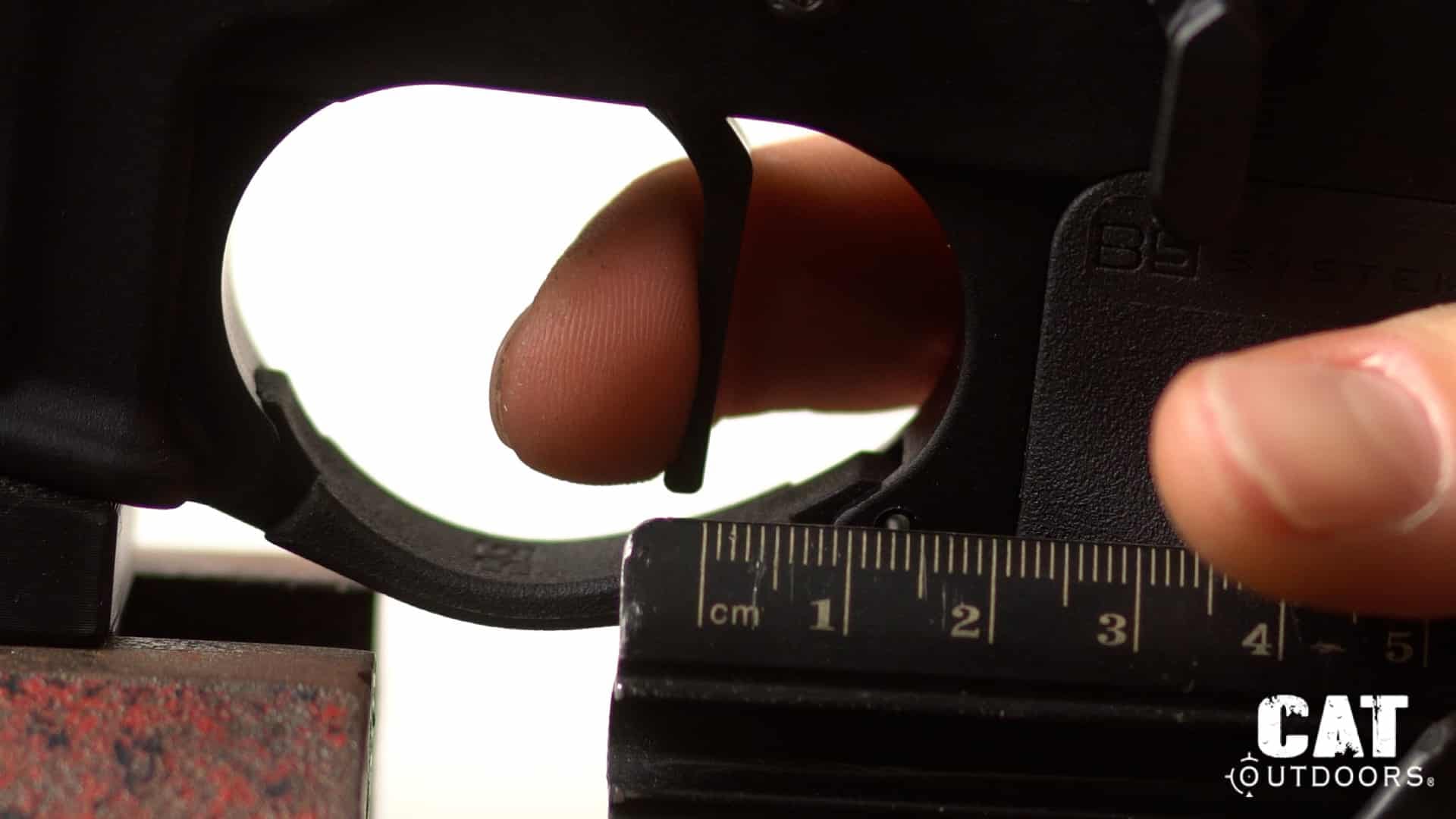
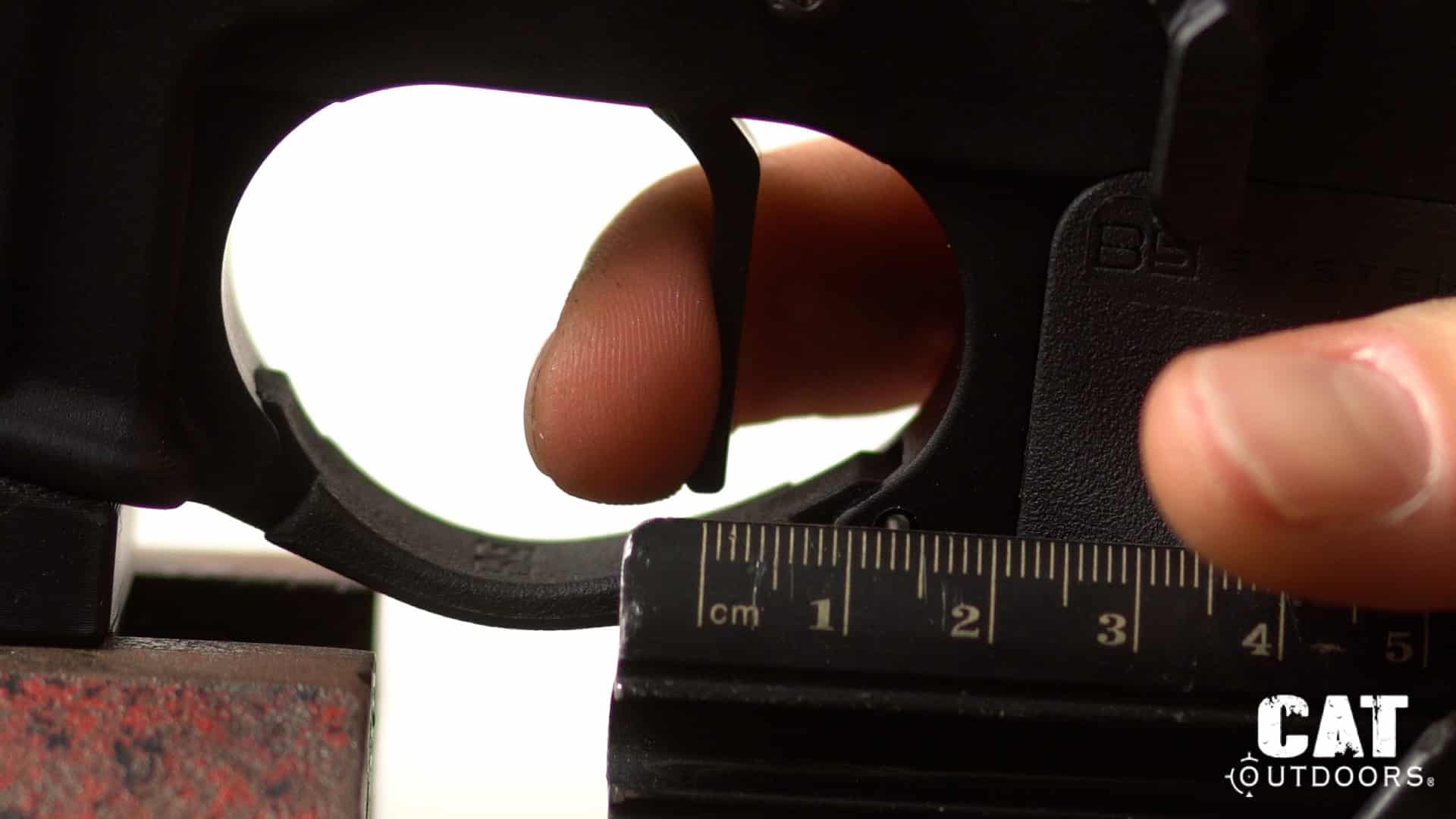
If you’re experienced with triggers, then you know what you’re looking at here. For those learning for the first time, let me explain: 1.5mm is incredibly short, which also means incredibly fast.
Compare that to a mil-spec combat trigger, which has a total travel distance (creep plus overtravel) of about 4mm. Less than half the distance is a significant reduction in pull and reset time.
Combined with the low pull weight, the experience becomes less of a conscious “pull” and more of a decision.
And that is where the TriggerTech Diamond stands out for serious shooters.
But that level of speed and sensitivity comes with a tradeoff. A trigger like this doesn’t give you anything for free. With a pull this light and a break this immediate, there’s nothing between you and the shot: no slack, no forgiveness, no margin to hide behind. Zero creep means there is no space to “prep” the trigger for the shot. It’s an instantaneous decision.
For better or worse, it exposes exactly how disciplined your trigger control really is. If your fundamentals are solid, it performs at a high level. If they’re not, it will show, clearly and consistently, on paper. This isn’t a trigger that makes you look better. It makes you honest.
Liking this one? Add CAT Outdoors as a preferred source on Google and stories like it show up first.
Add on GoogleA Believer Was Born
True story: while I was writing this review, a friend came over to visit and I started showing him what I was working on. He’s an avid gun enthusiast, but he had never experienced a precision trigger.
I handed him my rifle with the TriggerTech Diamond installed and told him to give it a dry fire. He did what any good disciplined shooter would do. Checked it for safety, racked the bolt, shouldered the rifle, settled into position and, slow and steady, pulled.
His mouth dropped and with wide eyes he said, “whoah.”
A believer was born.
Comparisons & Alternatives
| Trigger | Price | Best For |
|---|---|---|
| TriggerTech Diamond | $325 | Precision / competition |
| MimTac Drastic | $125 | Simple upgrade |
| CMC Single Stage | $190 | Simple upgrade |
| Elftmann Apex | $260 | Precision / competition |
The right way to shop this category is by what you’re actually asking the trigger to do. The MimTac Drastic and the CMC Single Stage occupy the “simple upgrade” tier, and there’s no shame in that tier. Both are conventional sliding-friction designs that have been cleaned up and tuned, and either one is a dramatic improvement over a gritty mil-spec trigger for a fraction of the Diamond’s price. If your goal is a nicer trigger on a general-purpose rifle, they deliver most of the feel-good benefit and keep an extra $135 to $200 in your pocket.
The Elftmann Apex sits closer to the Diamond in both price and intent. It’s aimed at the same precision and competition crowd, and it narrows the gap enough that shoe preference and brand loyalty become legitimate tiebreakers.
What the extra money buys with the Diamond is the mechanism itself: the rolling-friction, zero-creep break, the wide 1.5-4.0 lb adjustment range, and the pull-to-pull consistency we measured above. Whether that’s worth it depends entirely on whether you shoot for time, precision, or measurable performance. If you don’t, a mid-tier upgrade will deliver the desired benefit at a fraction of the cost. If you do, the tiers stop being interchangeable.
Who It’s For (and Who It’s Not For)
It’s for:
- Precision shooting
- Competition, especially 3-Gun and PRS-style gas gun matches
- Serious shooters who demand premium performance and train enough to use it
(Also, probably, John Wick’s preferred choice.)
It’s not for:
- Casual shooters, hunters, or home protection rifles
- Anyone wanting a set-and-forget upgrade without changing how they train
That first “not for” line isn’t a throwaway. At its lower settings this trigger gets extremely light, borderline effortless. That’s great for competition, but it leaves very little margin for error under stress. If this is going on a duty rifle, a home defense gun, or anything that sees unpredictable conditions, this might not be the right tool. That’s our position, stated plainly: leave the Diamond off defensive guns.
TriggerTech Diamond AR-15 Trigger
This isn't a trigger that makes you look better. It makes you honest.
Our Verdict
There’s a line in the movie F1 that fits: “We’re not auditioning him… he’s auditioning us.” That’s this trigger. You don’t really evaluate the Diamond; it evaluates you.
What it actually does well: It’s fast, consistent, and performs exactly how a precision trigger should. The adjustability allows you to tune it exactly to your own liking, and our gauge data backs up the consistency claim at every setting.
Where it might disappoint: It comes down to cost and usage. If you’re a shooting enthusiast who wants an upgrade over your mil-spec trigger without breaking the bank, there are plenty of other options. But if you’re thinking of competing and looking for every possible advantage to take home trophies, then you’re in the right place. If you’re competing for cash prizes, you’re buying performance that can actually pay for itself, and the street pricing helps the math: we’ve seen it as low as $239.99 at Primary Arms.
If you’re putting in the work and chasing performance, this delivers. If you’re not, it’s more trigger than you need.
Final Score: 9/10
The Diamond will not make you a better shooter. It will tell you exactly what kind of shooter you already are. Some of us needed to hear it.
Safety & Compliance
- Always follow manufacturer instructions and torque specs during installation.
- Comply with all local, state, and federal laws regarding firearms and accessories.
- We do not attempt or describe illegal modifications. If any part of the job is beyond your bench, use a licensed gunsmith.
FAQ
What is the pull weight range of the TriggerTech Diamond AR-15 trigger?
TriggerTech states 1.5 to 4.0 lb. On our Wheeler Digital Pull Scale, six pulls per setting averaged 1 lb 0.6 oz at the lowest recommended setting, 2 lb 7.9 oz at the factory middle setting, and 5 lb 11.4 oz at the maximum, all measured out of the box with no break-in. Variance stayed under 13 oz at every setting.
Is the TriggerTech Diamond a drop-in trigger?
Yes. It’s a fully self-contained drop-in cassette for mil-spec .154″ pin AR-15 lowers: install the rear pin, safety, and front pin, snug the set screws, reassemble, and function check. Pull weight adjusts afterward with a single set screw; you never have to pull the unit back out.
Is a 1.5 lb trigger safe for an AR-15?
It depends entirely on the rifle’s job. For competition and precision work in trained hands, that’s what the Diamond is built for, and the instructions still require keeping 3 clicks on the adjustment screw at minimum. For a duty rifle, home defense gun, or anything that sees unpredictable conditions, we think it’s too light: there is very little margin for error under stress.
What’s the difference between the single-stage Diamond and the two-stage AR Diamond?
They’re two different models. We tested the single-stage Diamond (AR0-SAB-14), which gives one continuous 1.5-4.0 lb pull with a zero-creep break. TriggerTech also sells a two-stage AR Diamond with deliberate take-up before the wall. Retailers often label both just “Diamond,” so check the model number before ordering.
Does the TriggerTech Diamond have a warranty?
Yes. The box states the triggers come with a satisfaction guarantee and a product lifetime warranty.
Should I get the flat or curved trigger shoe?
Personal preference; the mechanism is identical either way. We tested the flat shoe, which gives you the same geometry no matter where your finger lands. The Pro Curved version indexes your finger to the same spot every time. All of our measurements were taken on the flat-shoe model.
Will the TriggerTech Diamond make me a better shooter?
No. It’s an amazing piece of design and engineering, but the shooting is still on you. It removes creep and travel from the equation, which reveals your fundamentals instead of hiding them. Gear is only as good as the person using it; you have to train consistently to get the most out of it.
Have you run a Diamond, or are you still talking yourself into one? Drop a comment below and tell us what you want measured next.
Also, be sure to check out our roundup of the Best AR-15 Triggers, where the Diamond holds down the Best Zero Creep slot!
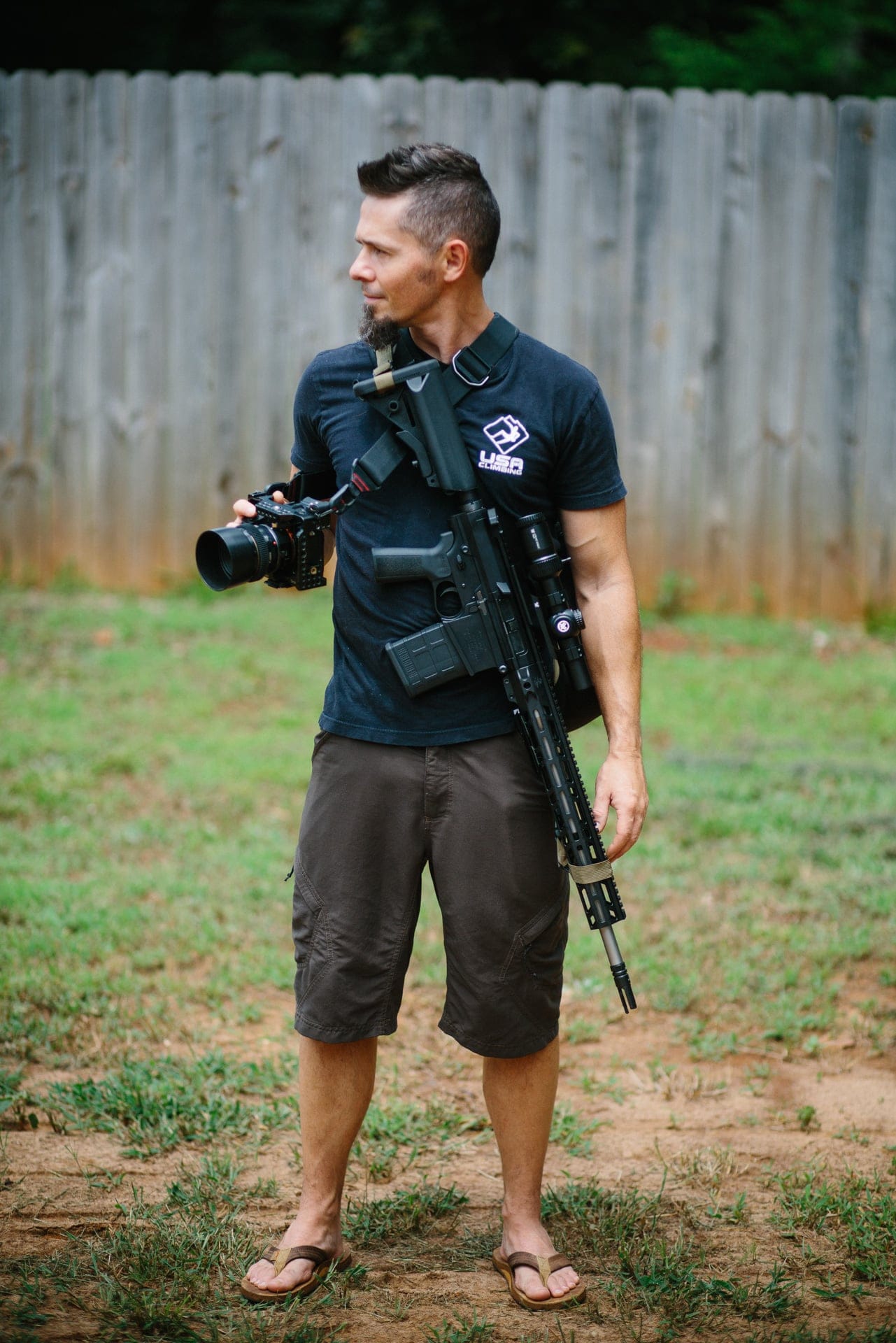
Brad Lanphear is a professional videographer by day and a gun enthusiast by night. When he’s not behind a camera, he’s usually at the range, in the workshop, or testing gear he probably didn’t need but wanted anyway. He enjoys practical firearms setups, well-designed tools, and helping others avoid common (and expensive) mistakes.