The Microphone California Makes a Home-Based Gun Dealer Run 24/7 Also Records His Kids, and Two New Briefs Ask the Full Ninth Circuit to Step In
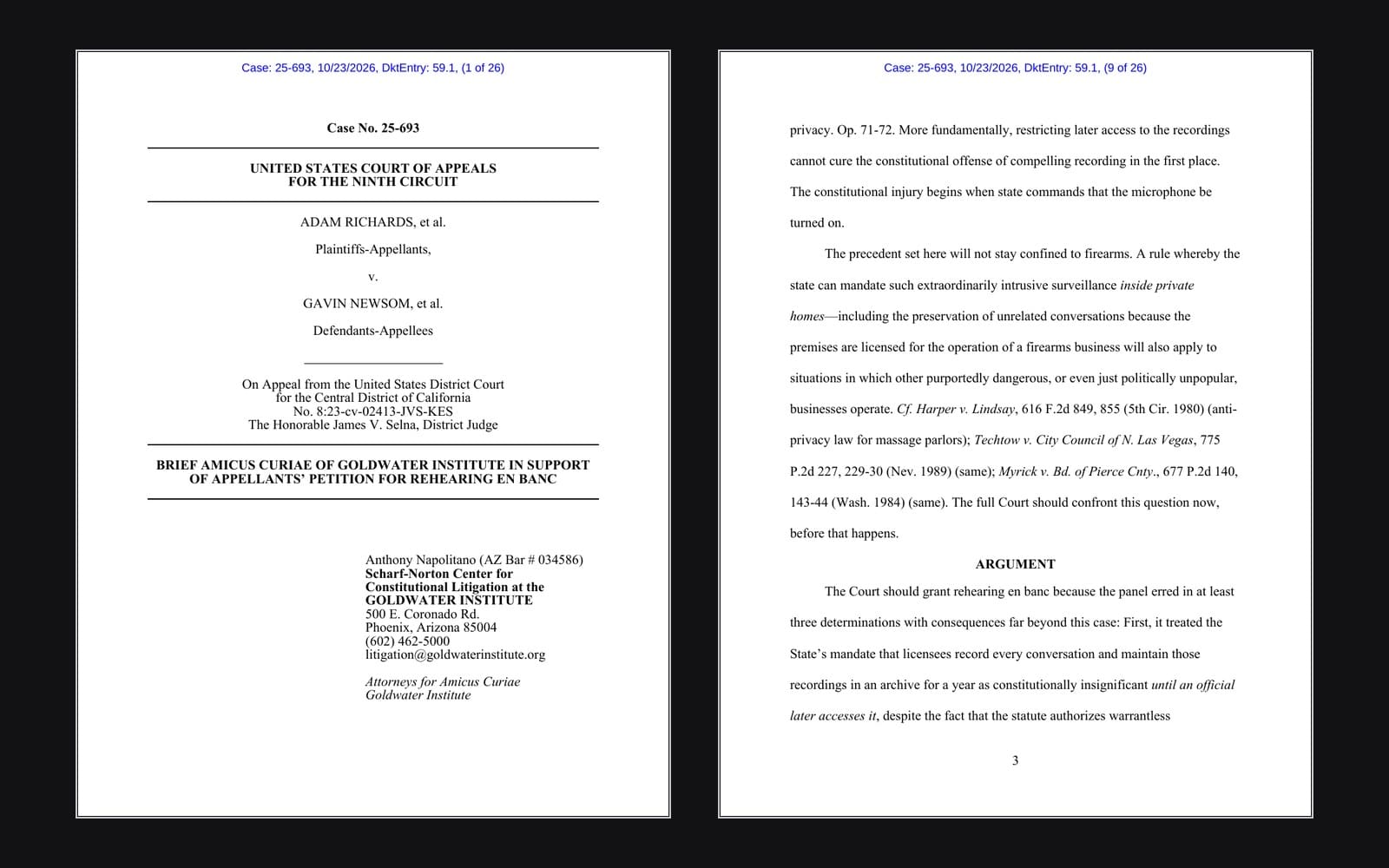
Goldwater and the NRA filed amicus briefs October 23 backing an en banc petition in Richards v. Newsom, the challenge to Penal Code 26806’s 24-hour audio and video mandate for every California gun dealer.
The California gun dealer surveillance law, Penal Code section 26806, requires every federally licensed dealer in the state to run cameras and microphones around the clock and keep a year of the recordings, whether the dealer works out of a storefront or a spare room at home. A divided Ninth Circuit panel upheld it on August 27. On October 13 the plaintiffs asked the full court to rehear the case, and on Friday, October 23, two amicus briefs landed in support: one from the Goldwater Institute, the other from the NRA, the America First Policy Institute and American Suppressor Association president Knox Williams.
The case is Richards v. Newsom, No. 25-693, filed in December 2023 by the Second Amendment Foundation, Gun Owners of America, the California Rifle & Pistol Association and allied groups, two gun stores and a handful of individual dealers and buyers. The district court dismissed it, the panel affirmed with one judge dissenting on the First and Fourth Amendment questions, and the en banc petition is the last stop before the Supreme Court.
What the law requires: Section 26806 took effect January 1, 2024, under SB 1384, which Gov. Newsom signed on September 30, 2022. The statute says the system “shall continuously record 24 hours per day at a frame rate no less than 15 frames per second,” has to cover every entrance and exit, every area where guns are displayed and every point of sale, and, for cameras inside the premises, has to capture audio. Recordings are kept for at least a year, and every entrance carries a sign in one-inch block letters: “THESE PREMISES ARE UNDER VIDEO AND AUDIO SURVEILLANCE. YOUR IMAGE AND CONVERSATIONS MAY BE RECORDED.”

Video mandates aren’t new. The panel opinion notes that Illinois, New York and Washington require dealers to run cameras, and that the ATF itself recommends recording “at all times.” The audio is what sets California apart. Judge Kenneth Lee, dissenting in part, put it plainly: “Neither the federal government nor the other 49 states have ever enacted such an intrusive audio-recording requirement for any business activity.”
Who it reaches: The lead plaintiff, Adam Richards, is an attorney who runs his FFL out of a detached office at his home. According to the complaint, he does about half his legal work there, including confidential client calls, and his family and kids come through in the mornings and in the evenings before bed. The statute doesn’t care which of those is happening when the microphone is on.
Goldwater’s brief, written by senior attorney Anthony Napolitano, builds its argument on that office. “The recording system, of course, cannot distinguish among uses. It captures a firearms transaction, a client call, and a family conversation all the same.” Its bottom line fits in one sentence: “The constitutional injury begins when state commands that the microphone be turned on.”
What the panel decided: Judge Lucy Koh’s majority opinion, joined by Judge Ana de Alba, held that no Fourth Amendment search happens when the state orders a private business to record, because no government agent enters the premises and the complaint never alleged that anyone in Sacramento had watched a frame of the footage. The plaintiffs’ theory that the search occurs the moment the camera starts rolling was, in the majority’s word, “novel,” and not cognizable. The First Amendment claims failed because the plaintiffs alleged a “subjective fear” that the state might “misuse them in some unspecified way,” not a concrete threat of retaliation. The takings claim failed too.
On the home-dealer question, the majority said section 26806 doesn’t authorize inspections at all; other statutes do, and nobody challenged those. And since neither Richards nor the other home-based dealer alleged that the state had ever inspected his house, the majority called the worry “too speculative” to support a claim. In plain terms, come back after the state shows up in your bedroom.
Lee took the opposite view on both amendments. On speech, he wrote that gun stores are “a hub of political activism” and that “the First Amendment shrivels under the constant surveillance of even a benevolent Big Brother.” On the Fourth Amendment, he pointed to the Ninth Circuit’s own 1985 decision in Rush v. Obledo, which struck down a California inspection rule for home day cares because it set no limits on time or place, and he noted that under this statute a compliance check “can occur at 2 a.m. or on Christmas Day.” And on the state’s rationale: video can identify a thief, but “audio-recording almost certainly does not.”
The fair objection: The legislative record the panel cites counts 34,339 guns stolen from licensed dealers nationwide between 2017 and 2021, about 80 percent of them in burglaries, which tend to happen after hours, and it ranks California seventh among the states for gun theft. Straw purchases are the other target, and a camera on the counter is a legitimate tool against both. The NSSF has told its own members that cameras are “essential for every FFL.”
That case is strong for cameras and empty for microphones. No burglar is identified by his voice, and no straw purchase is stopped by a year-old recording of two guys talking about the next election. The majority never offers a theft-prevention reason for the audio or the one-year archive, and those are the two parts the dissent and both amicus briefs attack.
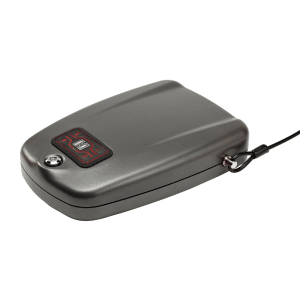
Hornady RAPiD Safe 2700KP (XL, RFID + keypad)
California’s entire case for section 26806 is after-hours theft. At home, that problem is solved with steel: the 2700KP opens by RFID, keypad or key, holds a full-size pistol with a spare mag, and keeps the gun out of the wrong hands without recording a word.
The NRA’s angle: The NRA brief, filed with AFPI and Williams and signed by NRA-ILA’s Joseph Greenlee, goes after the First Amendment holding from the buyer’s side. Because every transfer in California has to run through a licensed dealer, the brief argues, “an ordinary, law-abiding citizen in the state now has no plausible way to purchase a firearm legally without being recorded.” Goldwater adds the slippery slope: “If that is constitutional here, it is constitutional any time a license is required,” which in its telling covers home kitchens, massage parlors and “halal or kosher grocery stores.”
What happens next: An en banc petition goes to every active judge on the Ninth Circuit. If a majority votes to rehear, the case goes to an 11-judge court under the circuit’s rules, the chief judge plus ten drawn by lot, and the panel opinion stops being precedent. The court can also ask California to respond before anyone votes, and as of the docket’s last update on October 26 it hadn’t. There is no deadline.
Lee’s dissent spends a footnote on the Ninth Circuit’s “tradition and history of calling en banc decisions that vindicate the Second Amendment,” citing the magazine ban in Duncan, the ammunition background check in Rhode and the open-carry ruling in Baird. Each of those panel wins was taken en banc and erased. This time the gun-rights side is the one asking for the full court.

Our takeaway: Every justification the state and the majority offer for section 26806 is a justification for cameras, and three other states show how to mandate cameras without microphones. California chose to add audio and a year of storage, and it chose to apply that to a lawyer’s home office where his kids say goodnight. Whether that counts as a search is a question the full Ninth Circuit should answer before the panel’s answer binds nine states and two territories for good.
Should a state be able to require a business owner to record every conversation in his own home? Tell us in the comments.
Get the gun-law stories that matter, in your inbox. Sign up for the CAT Outdoors newsletter.
Sources: Ninth Circuit opinion, Richards v. Newsom, No. 25-693 (Aug. 27, 2026); Goldwater Institute amicus brief (Dkt. 59.1, Oct. 23, 2026) and Goldwater’s post on the filing; NRA, AFPI and Knox Williams amicus brief (Dkt. 60.1, Oct. 23, 2026) and NRA-ILA’s announcement; CourtListener docket and SAF case page (petition for rehearing en banc filed Oct. 13, 2026); Cal. Penal Code § 26806. Featured photo: Carol M. Highsmith, Library of Congress, public domain (Courtroom One, James R. Browning U.S. Court of Appeals Building). Camera photo: CC0 via Wikimedia Commons.

Justin Trump is the managing editor and owner of CAT Outdoors. The son of a Vietnam veteran, he’s a Certified Glock Armorer, an avid gun enthusiast and 2A advocate. He holds two firearm patents for the CAT M4 and Talon tools. When not managing CAT Outdoors, he enjoys spending time with his family and friends, rooting for Michigan sports teams, and serving his church.