The DOJ’s Letter Ending the NFA Appeal Showed Up Stapled to a Request for 10 More Days to Say Who the Ruling Covers
The Solicitor General’s no-appeal letter surfaced inside a DOJ motion asking for ten more days to answer nine states on who the NFA injunction covers. The appeal window closed Monday.

The DOJ NFA appeal is officially not happening, and for the first time the government has said so in a document with a signature on it. On September 24, Solicitor General D. John Sauer wrote Senate Judiciary Chairman Chuck Grassley that the Justice Department “has determined not to file an appeal” in Silencer Shop Foundation v. ATF, the Texas case that struck down National Firearms Act registration for suppressors, short-barreled rifles, short-barreled shotguns, and “any other weapons.” The letter became public on October 1, when DOJ lawyers attached it to a court filing, and the 60-day window to appeal Judge James Wesley Hendrix’s August 5 judgment closed Monday with nothing new on the docket.
That settles the appeal question for good. A judgment the government lets go final can’t be revived by the next attorney general, because the deadline doesn’t reset with the administration. The registration system that survived every court challenge since 1934 ended with a two-page letter and an expired calendar.
What the letter says: The notice went out under 28 U.S.C. § 530D, the statute that requires the Justice Department to tell Congress when it decides not to appeal a ruling that holds a federal law unconstitutional. Sauer spends most of it restating the court’s reasoning without pushing back on any of it. He writes that for most of its history the NFA “imposed a $200 tax on the making or transfer of an NFA firearm,” that Congress and President Trump “amended the NFA to eliminate the transfer and making taxes” on these items in 2025, and that Congress “left in place the ‘web of regulation’ that was originally meant to ‘aid enforcement’ of the NFA’s now-extinct taxes.”

He then summarizes the holding: the challenged provisions “can no longer be sustained under Congress’s taxing power” and “also could not be sustained under Congress’s power to regulate interstate commerce.” Nowhere does the letter say the department disagrees. The government’s top appellate lawyer put the plaintiffs’ theory on Justice Department letterhead and attached the opinion as the enclosure.
What it fences off: Sauer is just as careful about the edges. He notes the court “did not enjoin the enforcement of other NFA provisions,” and that the ruling does not reach “the provisions’ application to machineguns and destructive devices (to which the transfer and making taxes still apply)” or “the special occupational tax for importers, manufacturers, and dealers of NFA firearms.” The injunction itself runs to “the plaintiffs and, where applicable, the plaintiffs’ agencies, political subdivisions, members, and customers.” Machine guns stay where they were, dealers keep paying the SOT, and the relief still belongs to the plaintiff states and to the members and customers of the plaintiff groups, not to everyone who can pass a 4473.
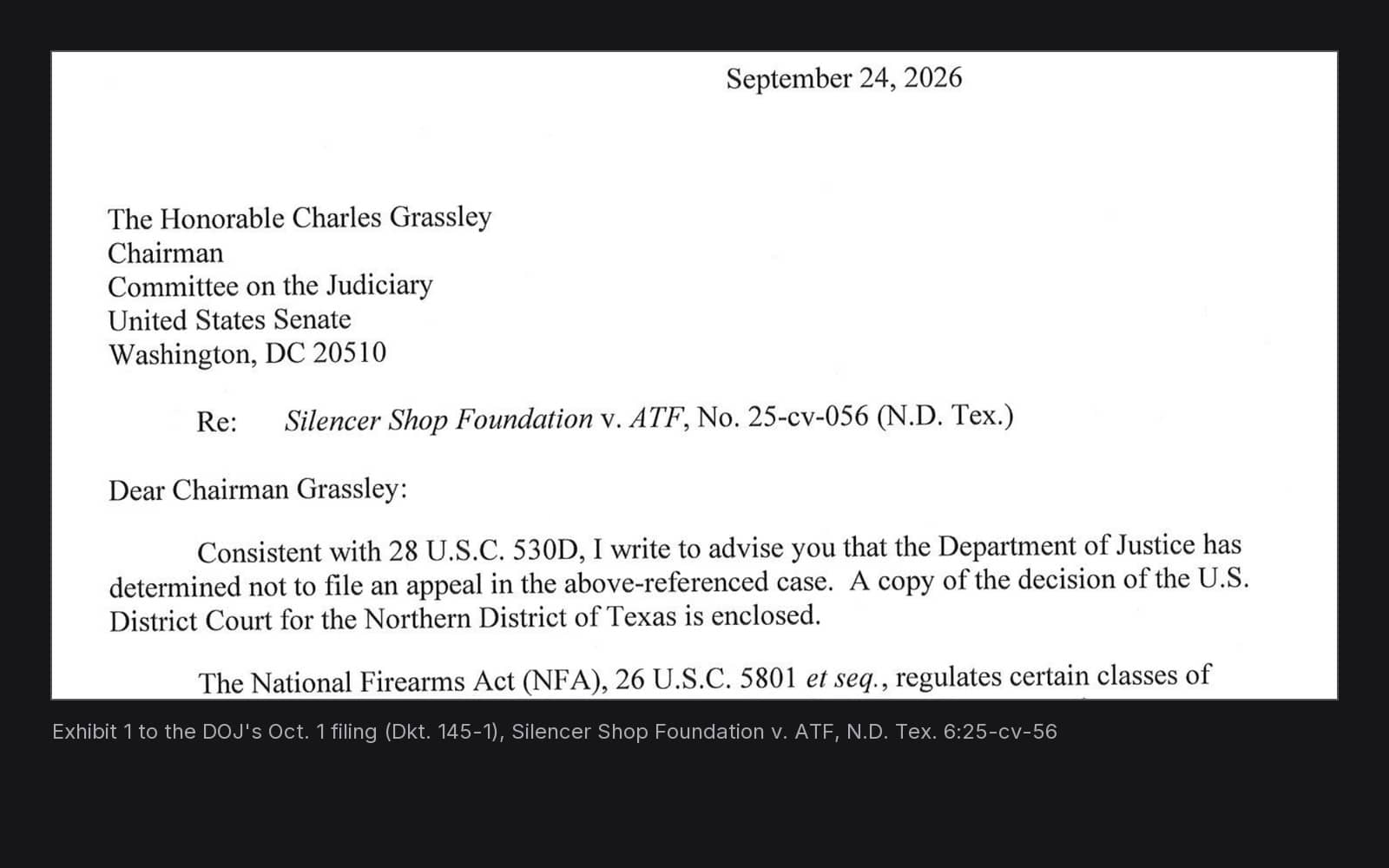
The motion it rode in on: The letter didn’t arrive as an announcement. It was Exhibit 1 to a four-page motion in which the DOJ asked Hendrix for ten more days to answer the nine plaintiff states’ motion for clarification, filed September 11 by Kansas, Texas, Alaska, Indiana, Louisiana, North Dakota, Oklahoma, South Dakota, and Utah. Those states want two things spelled out: whether the injunction “applies statewide to all relevant transfers within the Plaintiff States,” and whether ATF “must take any action to notify or identify individuals covered by the injunction.”
The states’ filing describes attorney general offices “deluged with inquiries from licensed dealers and prospective firearms purchasers,” and dealers who call ATF and get told to consult an attorney. In conference, the states say, “ATF stated its belief that it is not required to determine whether any individual is covered by the Court’s injunction.” We covered that motion when it landed. What’s new is the government’s answer, and the answer is a request for more time.
The DOJ’s reason for the delay: Two developments, the motion says. The first is the Sauer letter. The second is that ATF “is currently working to finalize public guidance regarding the NFA,” and that guidance “will likely inform defendants’ position on and the Court’s resolution of the states’ motion for clarification, and also may obviate the need for the Court to resolve certain issues that the motion raises (e.g., whether ATF is required to provide certain guidance to federal firearms licensees).” In plain terms, the government would rather ATF write the rules of the road than have a federal judge write them.
Then the motion turns on the states for objecting. The states “waited 37 days before seeking this clarification,” DOJ writes, so their claim that residents would be prejudiced by a ten-day delay doesn’t hold: “The states’ own delay in seeking clarification thus refutes their assertion of prejudice.” Hendrix granted the extension the next morning, per the docket, and set October 12 as the deadline for the government’s response.
Liking this one? Add CAT Outdoors as a preferred source on Google and stories like it show up first.
Add on GoogleWhere that leaves a buyer: Suppressors have been clearing gun-shop counters on a 4473 for covered buyers since the injunction took effect in mid-August, and ATF Director Robert Cekada told a Dallas dealer summit in late September that written guidance was weeks away. The gap today is still the one the states described: the same transfer can be paperwork-free for a buyer in Texas or a member of a plaintiff group, and a Form 4 wait for the customer behind him, and ATF’s position in conference was that sorting out who is who isn’t its job. That gap is what the October 12 filing has to address, either with guidance in hand or with an explanation for why it’s still coming.

SilencerCo Omega 300 (.30 cal, multi-caliber)
The Omega 300 is the do-everything .30-caliber can we point first-time buyers at. With the stamp at $0 and the judgment final for covered buyers, the only wait left is whatever paperwork your dealer still asks for.
The objection worth answering: The fair criticism of all this is that a government that agrees with the ruling should have wanted it appealed, because only the Fifth Circuit or the Supreme Court could turn a party-limited injunction into a national rule. Letting the deadline expire locks in a judgment that covers some buyers and not others, and leaves the rest hoping ATF’s guidance is generous. That’s a real cost, and it’s why repeal legislation is still the only route to a clean national answer.
But the trade cuts the other way, too. An appeal is a chance to lose, and a Fifth Circuit panel could have narrowed the injunction or reversed on the Commerce Clause holding, the one with less precedent behind it. By declining, the DOJ made the judgment permanent for every plaintiff state, every member of the plaintiff groups, and every future member who joins, and it kept the power to extend the practical effect further through ATF’s own enforcement choices. Cekada has already said publicly that talk of the agency seeking “revenge” for the ruling is “misinformation,” and that ATF will honor the order. Whether the guidance matches that promise is the October question.

The takeaway: NFA registration for suppressors and short-barreled guns is finished as a matter of federal litigation, and nobody in a future administration can undo that in court. What’s left is administrative: who’s covered, what a dealer has to do at the counter, and when ATF says so in writing. Watch October 12 for the DOJ’s response, the ATF guidance it keeps pointing to, and Hendrix’s ruling on whether an injunction “against” the states means every transfer inside their borders. State law is untouched by any of it; a state suppressor or SBR ban is still a state crime.
Do you think ATF’s guidance will cover everyone, or just the plaintiffs? Tell us in the comments.
Shopping your first can now that the stamp is $0 and the appeal is dead? Start with our best AR-15 suppressors guide, and sign up below to get the October 12 filing the day it drops.
Sources: Solicitor General letter to Sen. Grassley under 28 U.S.C. § 530D, Sept. 24, 2026 (Dkt. 145-1); Defendants’ Motion to Extend Briefing Deadline, Oct. 1, 2026 (Dkt. 145); Plaintiff States’ Motion for Clarification of Scope of Injunctive Relief, Sept. 11, 2026 (Dkt. 144); Docket, Silencer Shop Foundation v. ATF, N.D. Tex. No. 6:25-cv-56 (order of Oct. 2, 2026, Dkt. 146); Memorandum Opinion and Order, Aug. 5, 2026 (Dkt. 136); Final Judgment (Dkt. 137); 28 U.S.C. § 530D; Outdoor Life, Oct. 5, 2026.

Justin Trump is the managing editor and owner of CAT Outdoors. The son of a Vietnam veteran, he’s a Certified Glock Armorer, an avid gun enthusiast and 2A advocate. He holds two firearm patents for the CAT M4 and Talon tools. When not managing CAT Outdoors, he enjoys spending time with his family and friends, rooting for Michigan sports teams, and serving his church.