NFA Registration Just Lost in Federal Court to Its Own $0 Tax Stamp
A Texas federal judge permanently enjoined NFA registration for suppressors, SBRs, short-barreled shotguns, and AOWs after Congress zeroed the tax. Who is covered comes down to membership and where you buy.
NFA registration is unconstitutional for suppressors, short-barreled rifles, short-barreled shotguns, and AOWs, a federal judge in Texas ruled Wednesday. In a 66-page opinion in Silencer Shop Foundation v. ATF, US District Judge James Wesley Hendrix permanently enjoined the ATF and the Justice Department from enforcing the registration and transfer requirements against the plaintiffs, their members, and their customers.
Machine guns and destructive devices still carry the $200 tax and are untouched. Everything else on the NFA’s list just watched its legal foundation get repossessed.
Think of the old $200 stamp as a toll, and the Form 4s, fingerprint cards, photographs, and registry as the booth built to collect it. Congress dropped the toll to zero dollars; Judge Hendrix spent 66 pages asking why the booth is still staffed.

The math: The NFA lives in the tax code. Congress passed it in 1934 under its taxing power, and for nine decades the paperwork survived judicial review because it helped collect a real tax.
Then the One Big Beautiful Bill Act zeroed the transfer and making taxes for those four categories, effective January 1, 2026. No tax means no revenue, and no revenue means the taxing power no longer holds up the Form 1s, Form 4s, fingerprints, photographs, or the National Firearms Registration and Transfer Record itself.
The government offered two fallbacks. It argued that the occupational tax dealers and manufacturers still pay could prop up the buyer-side rules, and when that did not land, it reached for the Commerce Clause.
Judge Hendrix rejected both, because Congress never invoked the commerce power in the NFA at all. The Federal Firearms Act of 1938, written four years later, anchored itself to interstate commerce explicitly; the NFA never did, and a court cannot retrofit a statute onto a power its authors never claimed. “Efforts to render the NFA constitutional must come from Congress, not this Court,” he wrote.
The Second Amendment never took the field. At the parties’ urging, the court decided the whole case on the enumerated-powers question and left the 2A claims untouched. The NFA did not lose a gunfight. It failed a civics quiz.
Want the next one the day it lands? Add CAT Outdoors as a preferred source on Google and our coverage shows up first.
Add on Google
Who’s covered: This is not a nationwide injunction. Citing the Supreme Court’s decision in Trump v. CASA, Judge Hendrix held NFA registration unconstitutional but limited relief to the parties in front of him: the plaintiffs, their members, and their current and future customers.
The tent is still enormous. The lead case covers Silencer Shop Foundation, Gun Owners of America, Gun Owners Foundation, the Firearms Regulatory Accountability Coalition, B&T USA, Palmetto State Armory, and SilencerCo; the consolidated Jensen case adds the Texas State Rifle Association, the Citizens Committee for the Right to Keep and Bear Arms, and FPC Action Foundation.
Fifteen states signed on too: Alaska, Georgia, Idaho, Indiana, Kansas, Louisiana, Montana, North Dakota, Oklahoma, South Carolina, South Dakota, Texas, Utah, West Virginia, and Wyoming. Read the fine print before celebrating, though: for the states, the ruling covers their agencies and political subdivisions, not every resident holding one of their driver’s licenses.
One more wrinkle. The Jensen plaintiffs never established standing on AOWs, so their slice of the injunction skips that category; AOW relief flows only through the lead-case plaintiffs.
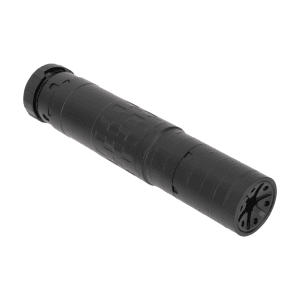
SilencerCo Omega 36M Multi-Caliber Suppressor
SilencerCo is a named plaintiff and so is Palmetto State Armory, which puts an Omega 36M bought there about as far inside this ruling's tent as a can can get. Modular enough to run short on a 9mm carbine and full-length behind a .338.
What happens next: Judge Hendrix stayed his own order for seven days, until August 12, to give the government a chance to seek emergency relief at the Fifth Circuit. If the DOJ files, this fight moves to New Orleans. If it does not, enforcement stops for everyone inside the tent when the stay lifts.
The Second Amendment track is still running elsewhere, including a challenge to the SBR registry we covered at the Sixth Circuit. This ruling hands every one of those plaintiffs a second template.
Your move: Coverage runs through membership and purchase path, not geography. If you belong to Gun Owners of America, the Texas State Rifle Association, or the Citizens Committee, or you buy from Palmetto State Armory, SilencerCo, B&T, or through Silencer Shop, you are inside the injunction once the stay lifts.
State law still gets a vote: a suppressor or SBR that is illegal in your state stays illegal, injunction or not. And if you have been waiting on a can, the smart first question is now who you are buying from, not how long the ATF’s queue is. Our best 9mm suppressors guide is the place to start narrowing.
Does the DOJ sprint to the Fifth Circuit inside its seven days, or does the booth come down on August 12? Call it in the comments.
For rulings like this one the moment they drop, sign up for the CAT Outdoors newsletter below.
Sources: Judge Hendrix’s memorandum opinion and order in Silencer Shop Foundation v. ATF, N.D. Tex. No. 6:25-cv-00056 (Aug. 5, 2026); the case docket via CourtListener; 26 U.S.C. § 5811; Gun Owners of America.

Justin Trump is the managing editor and owner of CAT Outdoors. The son of a Vietnam veteran, he’s a Certified Glock Armorer, an avid gun enthusiast and 2A advocate. He holds two firearm patents for the CAT M4 and Talon tools. When not managing CAT Outdoors, he enjoys spending time with his family and friends, rooting for Michigan sports teams, and serving his church.