Congress Defunded Gun-Rights Restoration in 1992. The DOJ Just Reopened It With a $30 Fee and a Start Date.
DOJ’s final rule revives the 925(c) relief process Congress defunded in 1992: who qualifies, who’s presumptively denied, what the application costs, and when the window opens.
Federal gun rights restoration just went from dead letter to a dated, numbered federal process. The Justice Department on Thursday published a 40-page final rule, 91 FR 54054, reopening relief under 18 U.S.C. 925(c), and the first applications get invited starting September 21, 2026.
The statute has said the same thing since 1968: a person barred from firearms “may make application to the Attorney General for relief from the disabilities imposed by federal laws.” Then in 1992, Congress barred ATF from spending a dollar to process those applications, and the program went dark.
So for 34 years the law kept saying you may apply. There was just nobody allowed to open the envelope.

What changed: the Department pulled the job away from ATF entirely (a March 2025 interim rule withdrew that delegation) and handed it to the Office of the Pardon Attorney, with published criteria instead of the old ad hoc guesswork. Attorney General Todd Blanche signed the rule as one of his first acts in the job.
“The Second Amendment is not a second-class right, and the federal government should not permanently deprive Americans of a constitutional right without regard to whether they pose a danger to public safety,” Blanche said in the Department’s announcement.
Who this touches: anyone prohibited under 18 U.S.C. 922(g), most prominently the felony-conviction prohibition in 922(g)(1). The scale is not small: the rule cites more than 31 million active federal-prohibitor records in the NICS Indices as of May 31, 2026, and the Department expects around 330,000 applications in year one.
Big pool. Narrow gate. Every applicant has to convince the Attorney General they are “not likely to act in a manner dangerous to public safety” and that relief serves the public interest, and nothing about a grant is automatic.
Who’s presumptively out: the rule draws hard lines. Convictions for violent felonies (homicide, sexual offenses, kidnapping, robbery, burglary, arson, domestic violence, stalking, terrorism) mean denial “absent extraordinary circumstances,” as does any felony where the applicant brandished or fired a gun. A denial on that list also presumptively bars you from ever applying again.
Below that sit waiting periods: 10 years for drug-trafficking felonies, threats of violence, explosives offenses, and misdemeanor domestic violence, and 5 years for any other felony. Fugitives, people under active protective orders, current unlawful drug users, and registered sex offenders are presumptively denied for as long as that status holds.
One detail worth reading twice: for this program, the rule’s definition of “controlled substance” explicitly excludes marijuana. Cannabis use alone does not park an applicant on the presumptive-denial list.
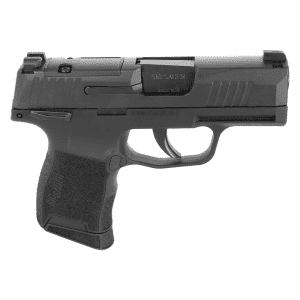
Sig Sauer P365 9mm (3.1-inch barrel, 10+1, optics ready)
The default first pistol in America for a reason: micro-compact, easy to live with, and every major retailer keeps it in stock. If a restored right ever turns into a first purchase, start your comparison here.
What an application takes: a $30 fee (raised from the proposed $20 after commenters argued that was too low; waivable for indigency), electronic fingerprints, certified court records, and a criminal-record check from every state you’ve lived in since turning 18, capped at 25 years. You also need sworn statements from three references who’ve known you at least three years, aren’t family, and aren’t prohibited persons themselves.
Your gun rights, in other words, get vetted harder than most job applicants. The Department’s own math puts a representative applicant’s total out-of-pocket cost near $105 once fingerprints and records are counted.
Local law enforcement gets notified of your application, and the chief law enforcement officer where you live can weigh in either direction. Every grant of relief gets published in the Federal Register, with reasons, so a restored right arrives with its own government paper trail.
Want the next one the day it lands? Add CAT Outdoors as a preferred source on Google and our coverage shows up first.
Add on GoogleThe fine print: relief is federal only. If your state imposes its own prohibition, that stays, and lying anywhere in the application makes any relief void from day one. Applicants prohibited over a mental-health adjudication must first try their state’s relief program where one exists.
The calendar: the program’s site at justice.gov/ffrr lays out a staged launch. September 21 opens invitations; 75 days after publication (early November) the application opens to the public, capped at the first 5,000; at 120 days (mid-December) more applicants come in, and only then does the fee start. Per the Department’s page, the earliest applicants file before the fee begins.
The online form, OMB Form 1123-0017, is listed as coming soon. If someone you know has waited decades for this, the drawer-safe purchase can wait five more minutes: read the rule first, then the FAQ, then start gathering paperwork.
One thing to watch: the appropriations rider that killed the old program targeted ATF’s budget, and the first working federal gun rights restoration process since 1992 now lives at Main Justice instead. Whether Congress lets that arrangement stand in the next funding cycle is an open question.
For now, the desk is staffed and the envelopes get opened starting September 21. Thirty-four years is a long time to hold the government’s mail.
Would you file under this process, or does the paperwork stack read like a deterrent? Let us know in the comments.
Want regulatory shifts like this explained before they hit your feed? Sign up for the CAT Outdoors newsletter below.
Sources: Final rule, 91 FR 54054 (Aug. 20, 2026); DOJ press release 26-934 (Aug. 17, 2026); DOJ Federal Firearm Rights Restoration program page; 18 U.S.C. 925(c); 90 FR 13080; 90 FR 34394.

Justin Trump is the managing editor and owner of CAT Outdoors. The son of a Vietnam veteran, he’s a Certified Glock Armorer, an avid gun enthusiast and 2A advocate. He holds two firearm patents for the CAT M4 and Talon tools. When not managing CAT Outdoors, he enjoys spending time with his family and friends, rooting for Michigan sports teams, and serving his church.