The Lawsuit Blaming Gun Ads for a D.C. School Shooting Now Has the Supreme Court’s Attention
The Supreme Court wants to hear from the families suing Daniel Defense and 12 other gun companies over their ads. Here’s the liability theory the NRA and SAF want the justices to shut down, and why it reaches every AR brand.

The Daniel Defense lawsuit over the 2022 shooting at a Washington, D.C. school asks a question that reaches every gun company in America: can a manufacturer be sued over a stranger’s crime when the lawsuit never alleges the criminal saw any of the ads it blames? On September 24, the National Rifle Association and the Second Amendment Foundation filed a joint brief urging the Supreme Court to take the case and answer no.
The justices are already interested. The families suing waived their right to respond to Daniel Defense’s petition in August, and on August 26 the Court requested a response anyway, a step any single justice can trigger when a petition deserves a closer look. That response is now due October 26.
What happened in 2022: On the afternoon of April 22, 2022, a 23-year-old man fired roughly 239 rounds from an apartment across the street from the Edmund Burke School in Washington. Karen Lowy, who was waiting in her car to pick up her 13-year-old daughter, was shot and had to be resuscitated twice at the hospital. Antonio Harris, a school security guard and 26-year veteran of the Metropolitan Police Department, was shot in the abdomen while shouting for students to get back inside.

The shooter died by suicide. Lowy and Harris both survived with serious, lasting injuries, which the appeals court’s opinion describes in detail.
Who got sued: In 2023, Lowy and Harris sued the companies behind the shooter’s gear in federal court in Alexandria, Virginia. The list starts with Daniel Defense, which made his DDM4 V7 rifle, and keeps going: Bravo Company USA, Magpul, SureFire, FAB Defense, Centurion Arms, Loyal 9 Manufacturing, Fostech, Hearing Protection LLC (Griffin Armament), TorkMag, and ammunition makers Federal and Fiocchi. It reads like the parts list for a typical AR-15 build.
The claims run under Virginia’s false advertising and consumer protection laws, on the theory that marketing caused the attack. The complaints accuse the companies of setting out to “advertise, market, promote, and sell a warrior mentality” to impulsive young men.
The ad nobody can place: The complaints catalog the companies’ social media posts at length. What they never allege is that the shooter saw any particular one of them. The closest they come is a single sentence pleaded “upon information and belief,” the legal phrase for an allegation made on belief rather than firsthand knowledge, claiming he “was exposed to and influenced by” the companies’ marketing “while researching and planning the Shooting.”
That gap is why Senior U.S. District Judge Claude M. Hilton threw the cases out in July 2024. The complaint, he wrote, “does no more than speculate that Shooter, like other young men in Virginia, observed defendants’ advertisements,” so the families lacked standing, the constitutional requirement that an injury be “fairly traceable” to the defendant’s conduct. He also ruled, in the alternative, that the Protection of Lawful Commerce in Arms Act, the 2005 federal law that shields gun makers from most lawsuits over crimes committed with their products, barred the claims.
How the Fourth Circuit revived it: On February 11, 2026, a divided panel of the U.S. Court of Appeals for the Fourth Circuit reversed. Judge Robert King, joined by Judge James Wynn, held that plaintiffs clear the standing bar if they plausibly allege a company’s conduct had a “predictable effect” on a third party’s decisions, and called the families’ burden at this stage “relatively modest.” In a footnote, the majority “readily” rejected the argument that the families had to allege the shooter “saw each example” of the challenged ads, because that information is held by the companies and law enforcement, not the plaintiffs.
The panel then erased the PLCAA ruling as “advisory” without deciding it, reasoning that a court that finds no standing has no jurisdiction to rule on anything else. That leaves the gun industry’s main federal shield set aside in this case, not rejected, while the case heads back to the trial court.
Judge A. Marvin Quattlebaum dissented. “Speculation or guesswork will not do. But that is all plaintiffs in this case have,” he wrote. “They do not allege the disturbed individual even saw defendants’ advertisements.”
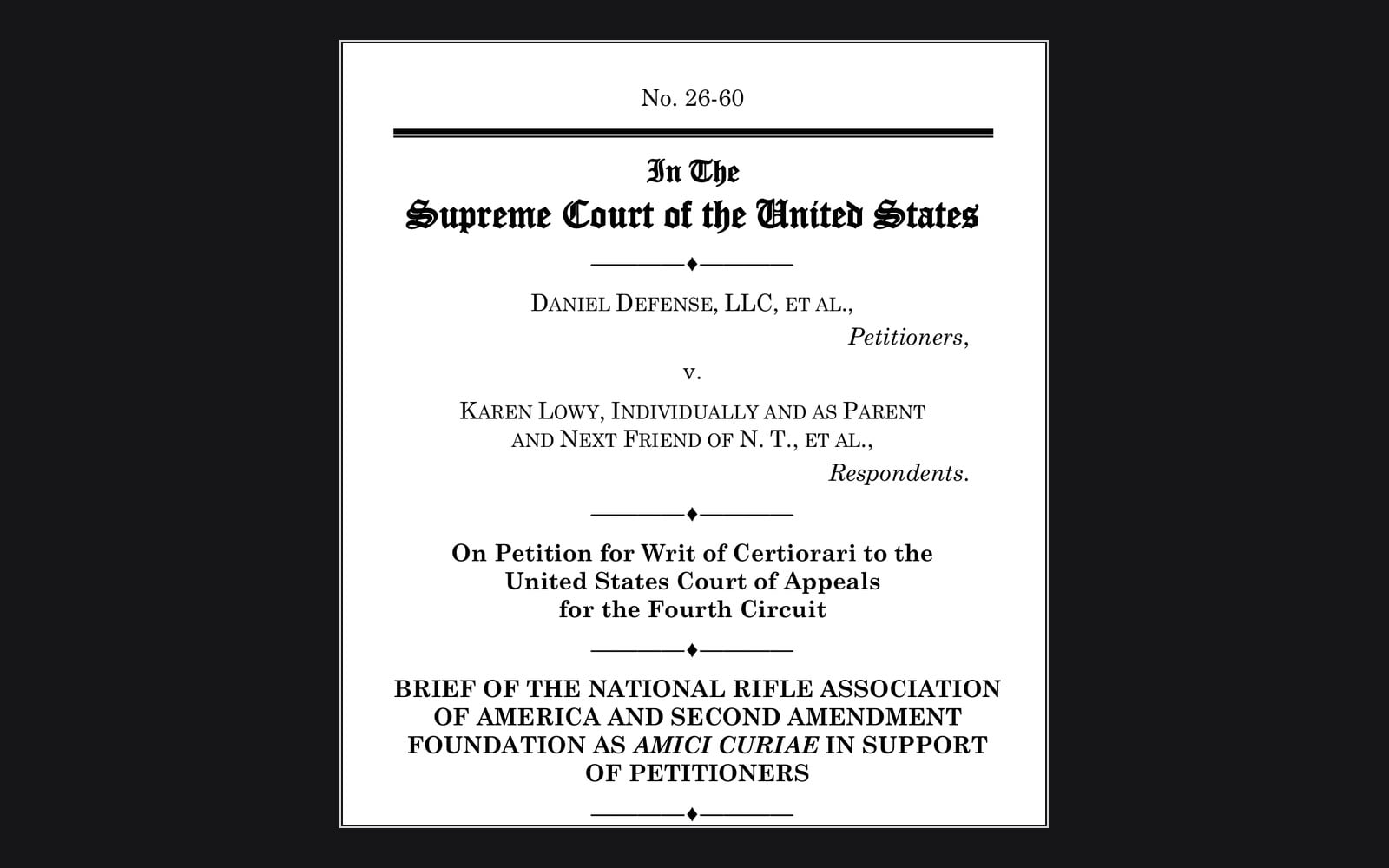
What the NRA and SAF are telling the Court: The joint brief argues that military themes have sold civilian guns since before the country existed: colonial fowling pieces sold with bayonets for militia duty, Colt revolvers engraved with battle scenes, Colt’s Single Action Army sold as “The Peacemaker,” and the Henry rifle advertised as “ALWAYS LOADED AND ALWAYS READY.” If the Fourth Circuit’s rule stands, the brief warns, “every manufacturer whose ads use historically ordinary military, patriotic, or law-enforcement themes could be hauled into court after a third party commits a crime with a similar product.”
“This is not a new kind of speech. It is how Americans have sold and described arms since the Founding,” Kostas Moros, SAF’s director of legal research and education and a co-author of the brief, said in SAF’s September 28 release announcing the brief.
The gun groups are not alone. West Virginia and 21 other states filed a brief backing the companies in August, as did the National Shooting Sports Foundation, and no amicus brief has been filed on the families’ side.
Why this reaches past one company: If the Fourth Circuit’s standard holds, the recipe for the next lawsuit is short: find a crime committed with lawful products, collect the makers’ social media posts with military imagery, and plead on information and belief that the criminal was exposed to them. Almost every company in the AR-15 market advertises that way, from rifle makers to the brands behind the magazines, lights and ammunition on a typical build. These are mainstream companies: Magpul, SureFire, BCM and Federal are standard names on an ordinary AR-15 build, not fringe suppliers.
Want the next one the day it lands? Add CAT Outdoors as a preferred source on Google and our coverage shows up first.
Add on GoogleThe petition also lands while the industry is fighting on several courtroom fronts at once, from the Supreme Court’s AR-15 ban case set for argument December 2 to the forced reset trigger patent lawsuits the Justice Department recently weighed in on.
The cost lands even if the companies win in the end. A case that survives the standing stage moves toward discovery, where companies can be ordered to hand over marketing files and internal communications, and that expense alone can change how an industry advertises. Congress wrote the PLCAA to stop suits over third parties’ crimes before they reach that point, and in this case the Fourth Circuit’s ruling means the question hasn’t been answered.
The families’ best argument: Standing is a threshold check, not a trial, and at the pleading stage no plaintiff can know exactly what a shooter looked at online before an attack. The Supreme Court has also held that standing can rest on the “predictable effect” of a defendant’s conduct on third parties, which is the precedent the majority leaned on.
The problem is where that phrase comes from. In Department of Commerce v. New York, the 2019 census case, the “predictable effect” was how households across the country would respond to a citizenship question, a mass behavior backed by the Census Bureau’s own data. One man’s decision to open fire on a school is not that kind of prediction, and in 2024 the Court said plaintiffs “generally cannot ‘rely on speculation about the unfettered choices made by independent actors not before the courts.'”
The Court applied the same instinct last year, when it unanimously ruled that federal law barred Mexico’s lawsuit blaming American gun makers’ production and marketing for cartel violence. The NRA and SAF brief argues the Fourth Circuit’s decision would turn that same remote-harm theory into a standing rule, letting a case proceed without any ruling on the PLCAA.
Bottom line: What happened outside the Burke School was a crime, and the people it hurt deserve every sympathy. A rule that lets a lawsuit against gun makers proceed without alleging the shooter saw a single one of their ads isn’t about this shooting, though; it makes routine gun marketing grounds for a lawsuit after any crime, and the Supreme Court should take this case and say so.
What to watch: With the families’ response due October 26 and a reply to follow, the earliest the justices could vote on the petition is a conference in late November or December. If they grant review, argument could come as soon as spring 2027. If they deny it, the Daniel Defense lawsuit heads back to federal court in Alexandria, with the PLCAA defense still undecided.
Should gun companies answer in court for a crime when nobody can say the shooter saw their ads? Let us know in the comments.
Want the next ruling in this case in your inbox? Sign up for the CAT Outdoors newsletter below.
Sources: Supreme Court docket No. 26-60; NRA and SAF amicus brief (Sept. 24, 2026); Daniel Defense petition for certiorari (July 10, 2026); Lowy v. Daniel Defense, No. 24-1822 (4th Cir. Feb. 11, 2026); Second Amendment Foundation release (Sept. 28, 2026). Featured photo: the Fourth Circuit’s courthouse in Richmond, Virginia, by Acroterion, CC BY-SA 4.0.

Justin Trump is the managing editor and owner of CAT Outdoors. The son of a Vietnam veteran, he’s a Certified Glock Armorer, an avid gun enthusiast and 2A advocate. He holds two firearm patents for the CAT M4 and Talon tools. When not managing CAT Outdoors, he enjoys spending time with his family and friends, rooting for Michigan sports teams, and serving his church.