The Fine Print in the ATF’s NFA Walkback Is a Section Titled ‘Future Risk’
The ATF’s October 9 guidance drops Form 1 and Form 4 approval and NFRTR registration for suppressors, SBRs, SBSs and AOWs nationwide. Here are the five limits, the Form 20 catch, and the no-grandfather warning.
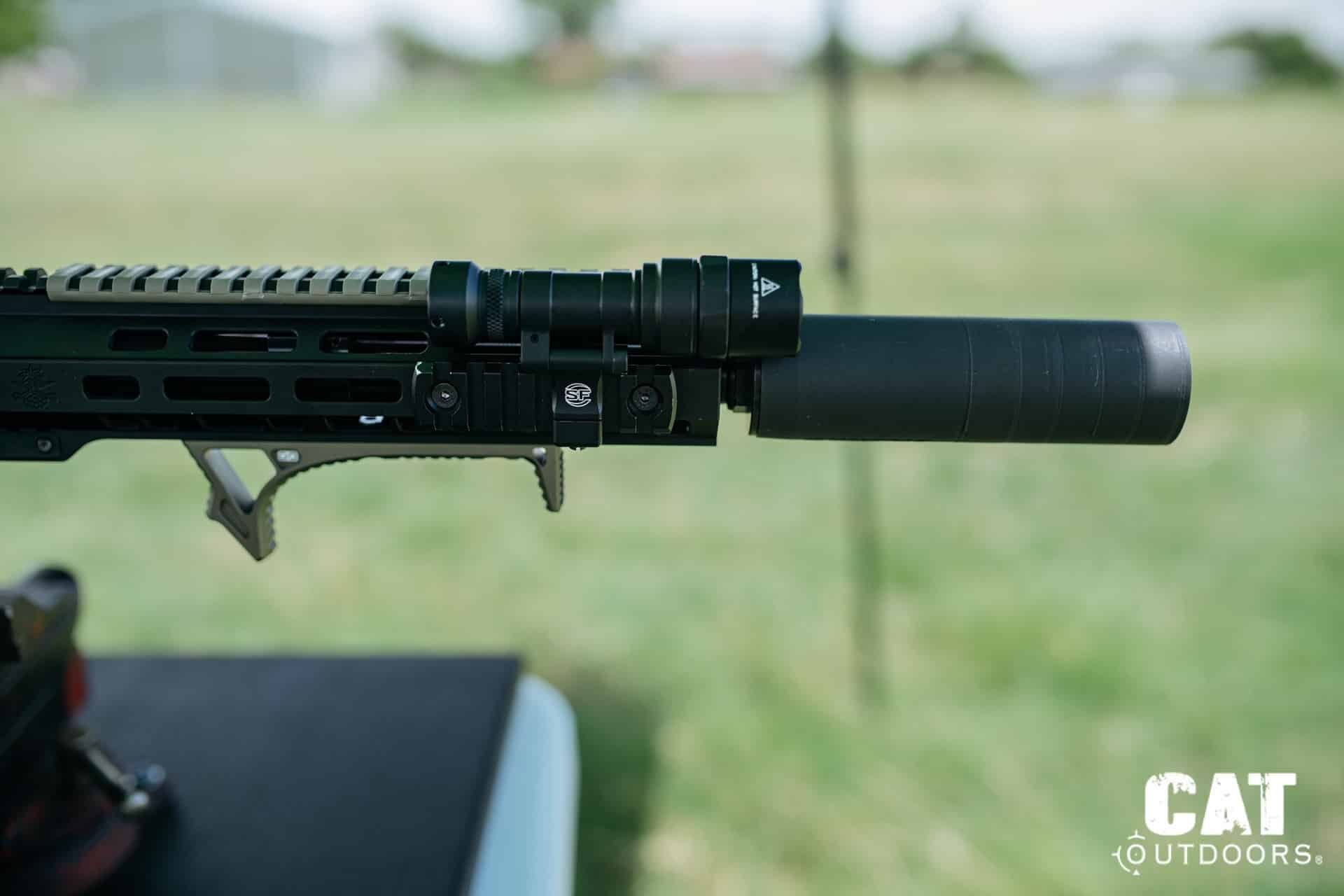
On October 9 the ATF said it will no longer require approval or registration for suppressors, short-barreled rifles, short-barreled shotguns, and AOWs, for anyone, not only the plaintiffs in the Texas case. A suppressor is a 4473 and a NICS check now.
The open letter says the ATF “will no longer require individuals to seek ATF approval under the NFA before making or transferring” suppressors, short-barreled rifles, short-barreled shotguns and “any other weapons,” and it “will also no longer require such items to be registered in the National Firearms Registration and Transfer Record.”
There are catches, and the ATF wrote them down.

The ATF spelled out five limitations, there is a Form 20 catch if you own a short-barreled rifle, and one line in the FAQ says none of this is permanent.
What came out October 9: Three things went up on atf.gov: an Open Letter to every FFL and the public, signed by Director Robert Cekada, a press release, and a pretty long Frequently Asked Questions page. The letter essentially spells out the policy. The FAQ breaks down the details. If you’re a dealer or about to buy a can, it is the document that matters.
Just a quick refresher on how we got here.
Back on August 5, Judge James Wesley Hendrix ruled in Silencer Shop Foundation v. ATF that once Congress zeroed out the making and transfer tax on these items in last year’s budget bill, the NFA’s registration scheme for them couldn’t stand on the taxing power anymore. To the cheers of the 2A community, the DOJ let the appeal deadline come and go on October 5.
The problem with the injunction, however, is that it “applies only to the plaintiffs and to NFA firearms for which the One Big Beautiful Bill Act eliminated existing taxes.” Which means two guys standing at the same counter could be under two different sets of federal law depending on whether they’d joined the right organization or not. That’s kind of a mess.
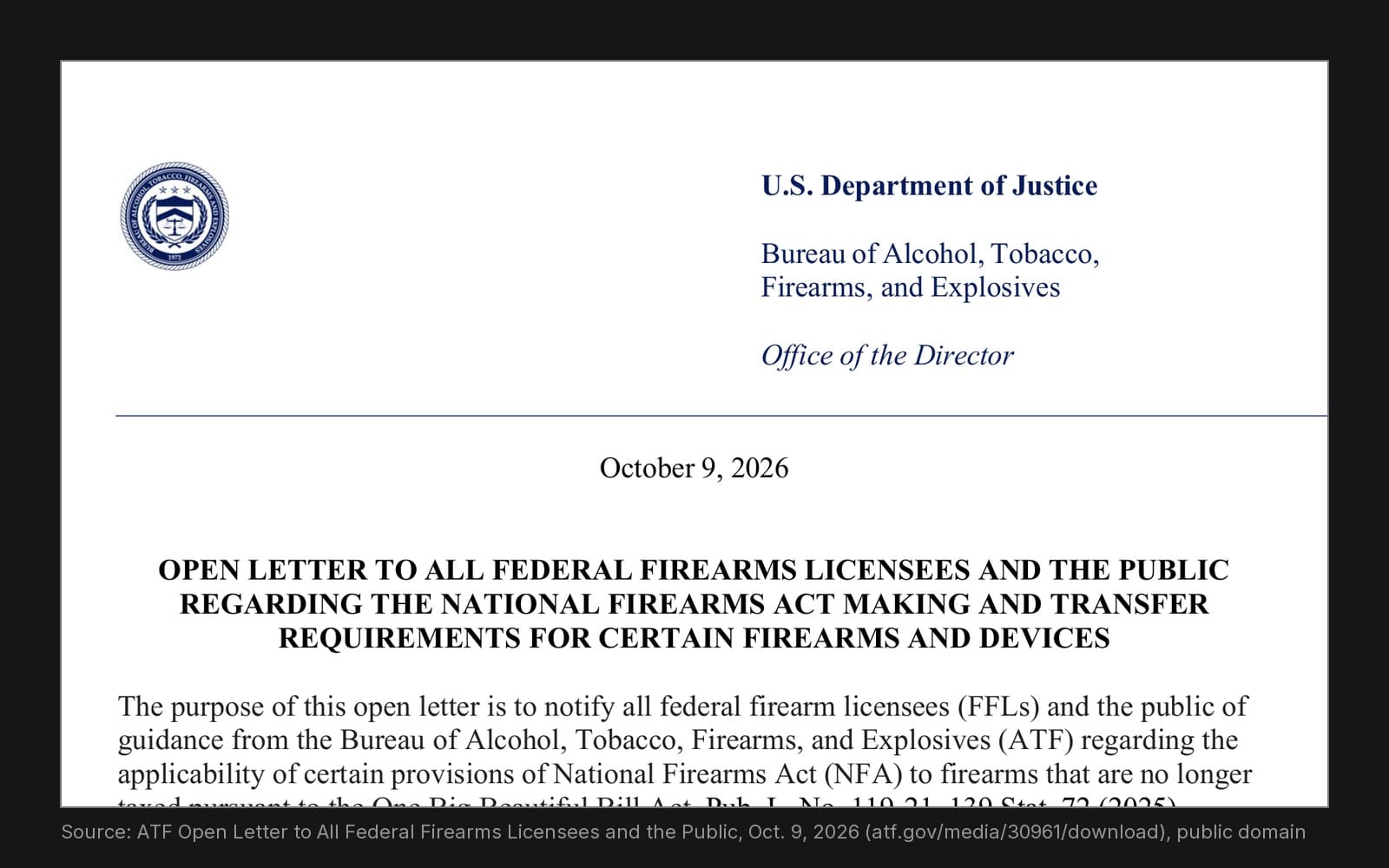
The letter is upfront that this is a policy decision, not a court order. “Although the district court’s injunction applies only to plaintiffs and certain other specified persons, the Department has determined to exercise its enforcement discretion to create greater uniformity, consistent with the Attorney General’s statement today.”
The FAQ says it more plainly: the policy “is designed to eliminate the inequity and disuniformity created by the district court’s injunction, which is limited only to certain parties.” Forty-seven members of the House and Senate asked for exactly this in an August 11 letter led by Rep. Andrew Clyde, and the Open Letter cites it in its one footnote.
Something to pay attention to…that “Attorney General’s statement” doesn’t exist anywhere we could find. Nothing on justice.gov as of October 10, and still nothing we could find a week later. So the three ATF documents are the only written record of this policy, and the signature on the letter is Cekada’s, not Blanche’s.
What stops on October 9: The FAQ lists out what the ATF “will cease enforcement” of, and it only applies to the $0-tax items: getting prior approval to make one, the 24-hour registration rule for manufacturers, getting prior approval to transfer one, registering it in the NFRTR, the criminal prohibitions on making, receiving, transferring and possessing unregistered items, the ban on taking unregistered items across state lines in 26 U.S.C. § 5861(j), and the NFA marking requirement.
Basically, no more Form 1, no more Form 4, and no more Form 3 between dealers. “FFLs should process transactions involving these items as they would any other statutory ‘firearms’ under the GCA,” the FAQ says. That’s a 4473, a NICS check, and the bound book. Same as buying a pistol. If you want to build your own can or cut a barrel under 16 inches, you “no longer need[] to file a Form 1 and receive ATF approval before making or transferring such items.”
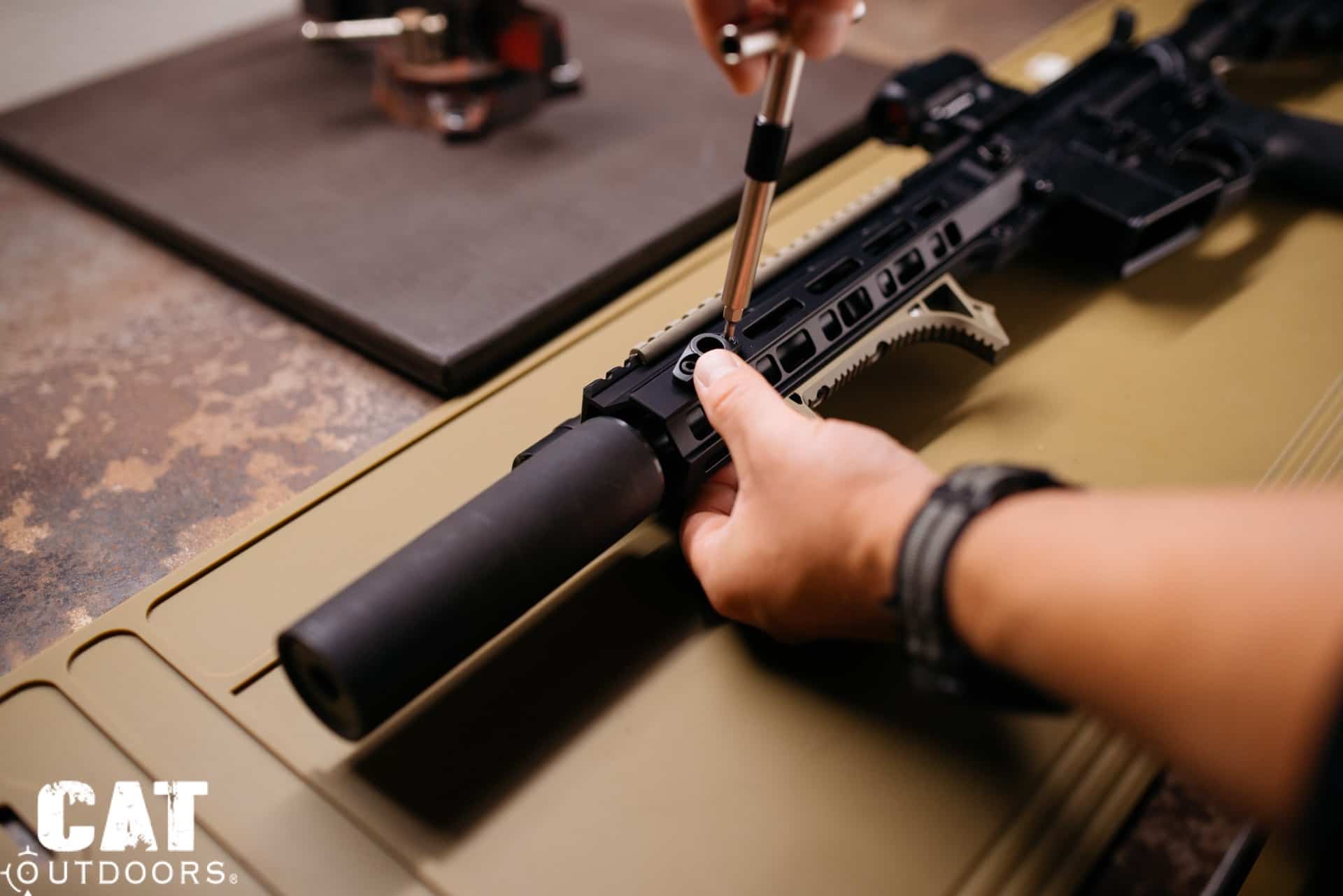
The registry isn’t going away, though. “ATF will continue to administer the NFA on a voluntary basis,” the letter says, and the FAQ confirms the bureau “will continue to maintain the National Firearms Registration and Transfer Record and approve all NFA forms for those who voluntarily wish to submit them.”
Why keep it? The press release answers that one: “many state laws require individuals to register NFA firearms.” So if your state statute is written around federal registration, a Form 4 is still how you check that box. The queue the ATF spent all of 2026 clearing doesn’t disappear. It just becomes optional.
The five limits, in the ATF’s order: First, the special occupational tax stays. If you’re “engaged in the business of manufacturing, importing, or dealing” in these, you still pay it. So a non-SOT shop can’t just start stocking suppressors on Monday. Second, machine guns and destructive devices aren’t touched at all. The $200 tax survived the budget bill on those, so “all NFA provisions still apply.”
Third, the Gun Control Act is untouched. Suppressors and short-barreled guns are still “firearms” under the GCA, so prohibited persons still can’t have them and every transfer still goes through a 4473 and NICS.
Fourth, the GCA’s own rules on SBRs and SBSs are still on the books, and that’s where the Form 20 catch comes in. Fifth, “the district court’s injunction and the enforcement policy announced by this Open Letter do not affect state or local laws that govern NFA weapons.”
Liking this one? Add CAT Outdoors as a preferred source on Google and stories like it show up first.
Add on GoogleThe Form 20 catch: Here is where it gets a little annoying if you own a short-barreled rifle. The court enjoined the NFA. It didn’t touch 18 U.S.C. § 922(a)(4), the Gun Control Act section that makes it a crime to take an SBR or SBS across state lines without the Attorney General’s approval.
So when the FAQ asks whether you can transport an unregistered SBR across state lines, the answer is “Yes, but individuals must continue to file a Form 20 before engaging in interstate transportation of a short-barreled rifle or short-barreled shotgun, even if it is unregistered.”
Suppressors and AOWs are a different story. The FAQ says the ATF “will not enforce § 5861(j) as applied to unregistered NFA items,” so a can crosses state lines with no paperwork at all.
There’s a second snag, and this one is for dealers. Section 922(b)(4) says an FFL can’t sell an SBR or SBS “except as specifically authorized by the Attorney General,” and the Form 4 used to be that authorization.
The ATF admits it: “At this time, no regulatory mechanism exists to authorize FFLs to transfer short-barreled rifles or short-barreled shotguns outside the NFA process.”
Their fix is to write new forms and regulations “as quickly as possible” and, in the meantime, “not enforce 18 U.S.C. § 922(b)(4).” So an SBR leaves the counter on a 4473 today on a promise not to prosecute, with the actual paperwork still being written. Not ideal, but that’s where it stands.
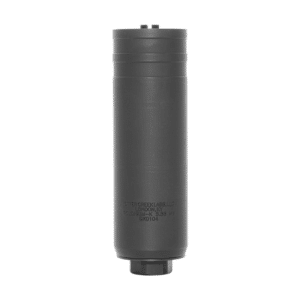
Otter Creek Labs Polonium K (5.56, 4.8-inch)
The Polonium K is the budget pick in our Best AR-15 Suppressors guide, and as of Friday the paperwork between you and it is a 4473 in most states. Short, 5.56-rated, and $522 at the retailers below.
Where it can still bite you: This whole thing is enforcement discretion, and the ATF says so in a section it literally titled Future Risk. “Material changes in legal or factual circumstances could cause NFA enforcement to resume.
For example, Congress could impose a new tax on NFA firearms, the district court’s injunction could be dissolved or overturned, or the Department could rescind the enforcement guidelines.” Then comes the next sentence, which is the one I’d write down: “The NFA treats unregistered firearms as contraband. Individuals who make, possess, transfer, or receive unregistered NFA firearms are subject to felony penalties and forfeitures.”
So, what happens to your unregistered can if the policy goes away? The FAQ doesn’t dodge it. “Federal law does not generally permit subsequent registration of unregistered NFA items nor are there provisions that would automatically grandfather unregistered NFA firearms.” The Attorney General can call a 90-day amnesty, but “is not required” to. And if you write the NFA Division to pull a registered item off the record, it stays off “unless the Attorney General declares an amnesty.” That’s a one-way door.
That’s the honest shape of this. A future attorney general can undo an enforcement memo with another memo. The one group that doesn’t have to worry about that is the plaintiffs’ members and customers, because the injunction protects them no matter what the memo says. Which, truth be told, makes a Gun Owners of America or Silencer Shop Foundation membership worth something it wasn’t worth last week.
The pushback: The fair argument against this is that the ATF didn’t have to go this far, and that enforcement discretion this broad is really an agency repealing a law Congress left on the books. The ATF’s answer is right there in the letter: the court already struck the registration scheme for these items, the government chose not to appeal, and the only question left was whether federal law would mean one thing for GOA members and something else for everybody else. They picked uniformity. The cost is that it rests on a signature instead of a ruling, and the FAQ says that out loud.
And there’s a reason it had to be a memo. Two days earlier, on October 7, the same DOJ lawyers filed a brief in Brown v. ATF, a separate NFA case in Missouri, telling that court the states’ request for a universal injunction “is foreclosed by Trump v. CASA,” the 2025 Supreme Court decision that limited nationwide injunctions. So the government’s own position is that no court can give everyone what the ATF just gave everyone with a letter. Which is exactly why a letter can be taken back.
The state problem is now the whole problem: The ATF spends more words on state law than anything else, and it refuses to answer the one question dealers actually want answered. Asked whether holding an unregistered item under this policy counts as lawful possession in a state whose statute requires compliance with federal law, the bureau says it “cannot opine.” The letter adds that “it is unclear whether state courts will apply the safe harbor created by 18 U.S.C. § 926A to interstate transportation of unregistered NFA items,” and tells you to “exercise caution before transporting unregistered NFA items through states in which such items are prohibited by law.” Translation: don’t drive an unregistered can through a state that bans them and assume the feds have your back.
Dealers get it the bluntest. “FFLs willfully transferring firearms in violation of state and local law face federal criminal penalties and license revocation.” If you run a shop in a state whose SBR statute says “registered under federal law,” you’ve got a decision to make, and the ATF just told you to call a lawyer.
What everyone said: Kansas Attorney General Kris Kobach, whose state led the nine states that joined the suit, called it “a huge victory for firearm owners” in a release Friday. The ability to buy suppressors and short-barreled guns “without seeking special permission from the government,” he said, now belongs to “citizens of all 50 states,” and “Kansas led the way in delivering this win.” The Firearms Policy Coalition spent the same day sending letters to the attorneys general of 15 states whose statutes lean on federal registration, Michigan, Ohio, Pennsylvania and Washington among them. “The states that require compliance with this unconstitutional and now-defunct federal scheme should immediately end enforcement and repeal their laws as soon as possible,” FPC President Brandon Combs said.
The most useful read, to me, came from the Second Amendment Foundation, which is a plaintiff in the consolidated case. They took the win and named its limit in the same breath. The guidance, SAF Executive Director Adam Kraut said in the group’s statement, “by its very nature purely as ‘guidance’ it cannot, and does not, provide a permanent fix for many remaining elements of the NFA. For that reason, our other two NFA cases, Brown v. ATF and Roberts v. ATF, will continue.”

Update, October 12: The DOJ filed its answer to the states’ motion, and it asked Judge Hendrix to do nothing. The response says the October 9 open letter and FAQ already give dealers the guidance the states wanted, and that because the ATF “is not enforcing the challenged NFA provisions in any state,” deciding whether the injunction covers everyone inside the plaintiff states “would have no real world impact.” Then it goes a step further: the injunction “cannot be fairly read” to cover every person in those states, because the judgment names “the plaintiffs” and their agencies, not the states as places, and the states only ever claimed standing over their own guns. The DOJ also points out that several of the same states are asking a Missouri court for statewide relief, which it says is trying to have it both ways. So the takeaway is the one the FAQ already gave you: for everyone outside the plaintiff groups, this is enforcement discretion, and the government just told a judge it would rather keep it that way than have the injunction widened.
What to watch: Hendrix’s ruling on the states’ motion, the new SBR transfer forms under § 922(b)(4), and the first state attorney general to answer FPC.
Bottom line: If you’re in a free state, October 9 changed the whole transaction. A suppressor is a 4473 and a NICS check now, same as a pistol, and the wait is over. If you own an SBR, the Form 20 still applies the second it crosses a state line. If your state law leans on federal registration, the Form 4 is still the safe play, and the ATF will still approve it. And for everybody, the FAQ’s own words are the deal: no grandfather clause, felony penalties still on the books, and a policy that lasts exactly as long as the Department wants it to. If the wait was the only thing keeping you from a can, our Best AR-15 Suppressors guide is where I’d start, and the Polonium K above is the budget pick in it.
Will you still file a voluntary Form 4, or is the 4473 enough for you? Let us know in the comments.
The new SBR transfer forms and the state responses are next. Sign up for the CAT Outdoors newsletter below so they don’t slip past you.
Sources: ATF, Update to NFA Transfer Guidance and Frequently Asked Questions (Oct. 9, 2026); ATF Open Letter to All Federal Firearms Licensees and the Public (Oct. 9, 2026); ATF press release (Oct. 9, 2026); Silencer Shop Foundation v. ATF, No. 6:25-cv-00056 (N.D. Tex. Aug. 5, 2026), opinion and docket; Rep. Clyde et al. letter to Attorney General Blanche (Aug. 11, 2026); 26 U.S.C. § 5861; 18 U.S.C. § 922; 18 U.S.C. § 926A; Defendants’ Third Supplemental Brief, Brown v. ATF, No. 4:25-cv-01162 (E.D. Mo. Oct. 7, 2026); Kansas Attorney General release (Oct. 9, 2026); Firearms Policy Coalition release (Oct. 9, 2026); Second Amendment Foundation statement (Oct. 9, 2026). Defendants’ Response to State Plaintiffs’ Motion to Clarify, Dkt. 147 (Oct. 12, 2026). Photos: CAT Outdoors.

Justin Trump is the managing editor and owner of CAT Outdoors. The son of a Vietnam veteran, he’s a Certified Glock Armorer, an avid gun enthusiast and 2A advocate. He holds two firearm patents for the CAT M4 and Talon tools. When not managing CAT Outdoors, he enjoys spending time with his family and friends, rooting for Michigan sports teams, and serving his church.