The Gun Industry Says September Sales Fell 2.3 Percent. The FBI Counted 157,000 More Checks Than the Industry Did.
The FBI logged 2,000,629 NICS checks in September, up 3.6 percent, while NSSF’s adjusted retail count fell 2.3 percent. The 149,614 NFA checks sitting between the two numbers are the story.
September 2026 NICS background checks came in at 2,000,629 on the FBI’s count, up 3.6 percent from the 1,931,173 the system ran in September 2025. NSSF, the firearm industry’s trade association, then published its adjusted count for the same month, and that one came in down 2.3 percent.
So, two numbers and two directions in one month. How did we get this discrepancy and what story does it tell?
Here’s what each of them measures, where the difference comes from, and what we think it means for anyone watching the gun market this fall.

The two counts: The FBI’s number is the raw total: every background check a licensed dealer, a state permit office, or a pawn counter ran through NICS in September. NSSF’s adjusted figure subtracts permit checks and permit rechecks, the ones states run on carry-permit applicants and on their existing permit holders, because those aren’t guns crossing a counter. The adjusted number is the industry’s working proxy for retail sales, and for September it was 1,152,077, down from 1,179,424 a year earlier.
That 2.3 percent dip ends a run. From February through August the adjusted count beat the prior year every month, including an 11.7 percent gain in June and 8.5 percent in July. The third quarter as a whole still finished up 2.5 percent at 3,329,270 adjusted checks, so the quarter was fine. September is the first month in a while where the retail side didn’t grow.
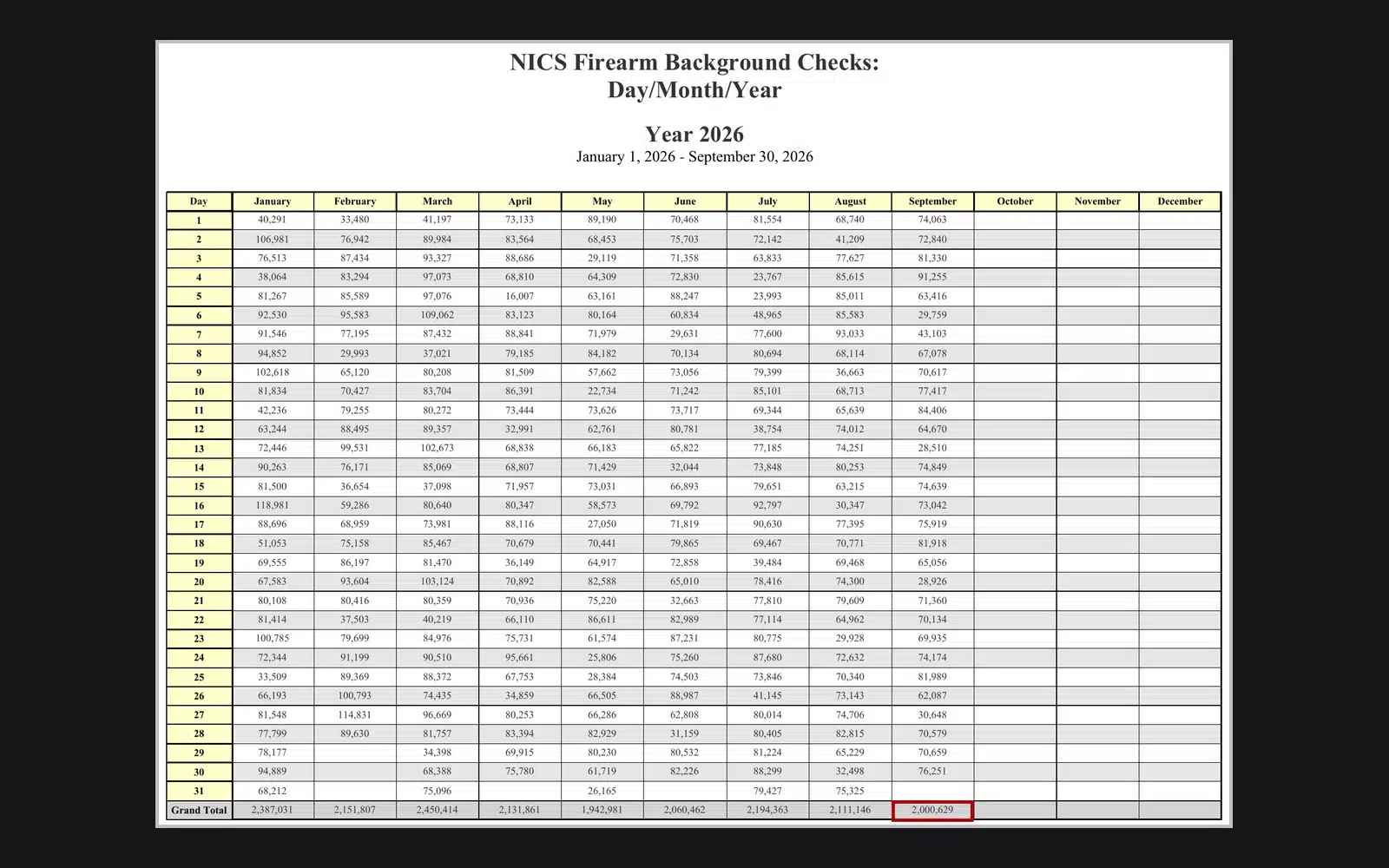
Where the gap comes from: The two reports don’t start from the same number, and that’s the detail worth knowing. NSSF’s release lists the “unadjusted” FBI figure it works from as 1,843,700. The FBI’s own grand total for September is 2,000,629. That leaves 156,929 checks in the FBI’s table that aren’t in the industry’s starting point. In the same release, NSSF reports 149,614 NFA checks for September, the background checks that run on Form 1 and Form 4 applications for suppressors, short-barreled rifles, short-barreled shotguns, and AOWs. The gap and the NFA count land within 7,315 of each other.
August lines up the same way. NSSF’s starting figure for August was 1,917,379 against an FBI total of 2,111,146, a difference of 193,767, and August’s NFA count was 185,744. NSSF doesn’t walk through the reconciliation in its releases, so we’ll stick to what the numbers show: in both months, the checks that sit outside the industry’s retail count match the NFA checks to within a few thousand.
Put plainly, the retail gun counter was flat to slightly down in September, and the NFA counter was running at more than double last year’s pace. Add the NFA checks and the month grew. Set them aside and it shrank. Neither reading is wrong. They’re answering different questions, and the one that gets quoted as “gun sales” is the narrower one.
The NFA side: 149,614 NFA checks in September, against 65,273 in September 2025, is a 129.2 percent increase. Texas ran 18,852 of them, followed by Florida at 11,771, Georgia at 7,337, North Carolina at 7,336, and Pennsylvania at 6,102. Since February, NSSF’s monthly NFA count hasn’t dropped below 130,000, and it topped 200,000 in both February and March. September’s figure is the third-lowest of the eight months we checked, which reads less like a spike cooling off and more like a market settling in at roughly twice its old size.
Why it’s happening: The $200 transfer tax that sat on every suppressor and short-barreled firearm since 1934 went to $0 on January 1 under last year’s budget law. 26 U.S.C. § 5811 now reserves the $200 rate for machine guns and destructive devices and lists $0 for everything else. Then on August 5 a federal judge in Texas permanently enjoined the NFA’s registration requirement for those items as to the plaintiffs in Silencer Shop Foundation v. ATF, and last week the Justice Department told Congress it won’t appeal. A suppressor that cost $200 in tax and months of waiting a few years ago now costs $0 in tax and clears in days. Lower the cost of entry on a product and more people buy it. The September table is that principle in a spreadsheet.
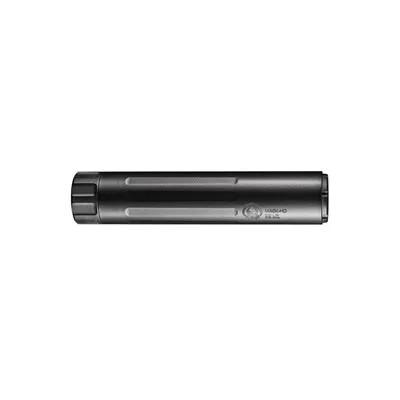
Dead Air Mask HD (.22 LR rimfire, direct thread)
The classic first can: rimfire, user-serviceable, and the cheapest way to find out why NFA checks ran 149,614 deep in September. The transfer tax is $0, and the Form 4 wait that used to eat months now clears in days. All three listings below are the black version.
The pushback: The fair objection is that the industry’s adjusted number is the better gauge of retail gun sales, and by that gauge September was down. That’s right, and it shouldn’t be waved away. The comparison base wasn’t soft, either: September 2025’s adjusted figure of 1,179,424 was an ordinary month, unlike the weak August 2025 base that made this August’s 2.2 percent gain look easier than it was. Handguns and long guns moving across 4473s did cool a little in September.
Where we’d push back on the pushback is the idea that the retail number tells the whole market story anymore. An NFA check is a buyer, a dealer, a background check, and a sale, and until this year the segment was small enough that leaving it out of the retail proxy didn’t change much. It changes a lot now. NSSF seems to see the same thing. Its September release announces that beginning with the November report, the one covering October data, “the Monthly NFA checks (Form 1 and 4) will be reported via separate email communication and will provide a higher level of detail.”
On the FBI’s raw count, the third quarter ran 6,306,138 checks against 5,749,412 in the third quarter of 2025, a 9.7 percent gain. Through nine months, 2026 stands at 19,430,694 checks against 19,389,065 at the same point last year, a difference of 0.2 percent. So the year is flat on the raw count, up on the quarter, and the NFA line is the one segment that has doubled. The FBI prints the same caveat on every table, that a check is not a sale, and it cuts both ways: the 2,000,629 overstates September’s sales, and the 1,152,077 leaves the suppressor and SBR buyers out entirely.

Our read: September wasn’t a bad month for the gun business. It was a flat month for the traditional retail side and a strong month for the NFA side, measured with a tool that was built before the NFA side mattered. For a dealer, that means the growth is at the suppressor case, not the handgun case. For a buyer, it means the line you’re standing in ran 149,614 deep last month, and that line is why the two headline numbers disagree.
What to watch: The Justice Department’s October 12 response on how far the NFA injunction reaches, the ATF’s promised public guidance, and the October tables in early November, when NSSF reports NFA checks separately for the first time. If the NFA line holds above 130,000 with the retail count flat, the pattern is a shift in where the money goes, not a one-time spike.
Are you one of September’s 149,614? Tell us what you bought and how long the wait was in the comments.
Shopping your first can? Start with our best AR-15 suppressors guide, built from cans we’ve run ourselves.
Sources: FBI NICS day-by-month and month-by-year tables; NSSF-adjusted NICS releases for September 2026 and August 2026, plus NSSF’s February through July 2026 releases for the streak; 26 U.S.C. § 5811. All retrieved October 7, 2026. The FBI table image is a U.S. government work in the public domain.

Justin Trump is the managing editor and owner of CAT Outdoors. The son of a Vietnam veteran, he’s a Certified Glock Armorer, an avid gun enthusiast and 2A advocate. He holds two firearm patents for the CAT M4 and Talon tools. When not managing CAT Outdoors, he enjoys spending time with his family and friends, rooting for Michigan sports teams, and serving his church.