San Diego County Is Suing a Filament Maker on the Theory That Marketing Turns Plastic Into a Gun Part
San Diego County’s suit against Polymaker rests on one idea: 3D-printer filament becomes a regulated firearm precursor part the moment it’s marketed to people who print guns. Here’s the theory, the evidence and the penalties.

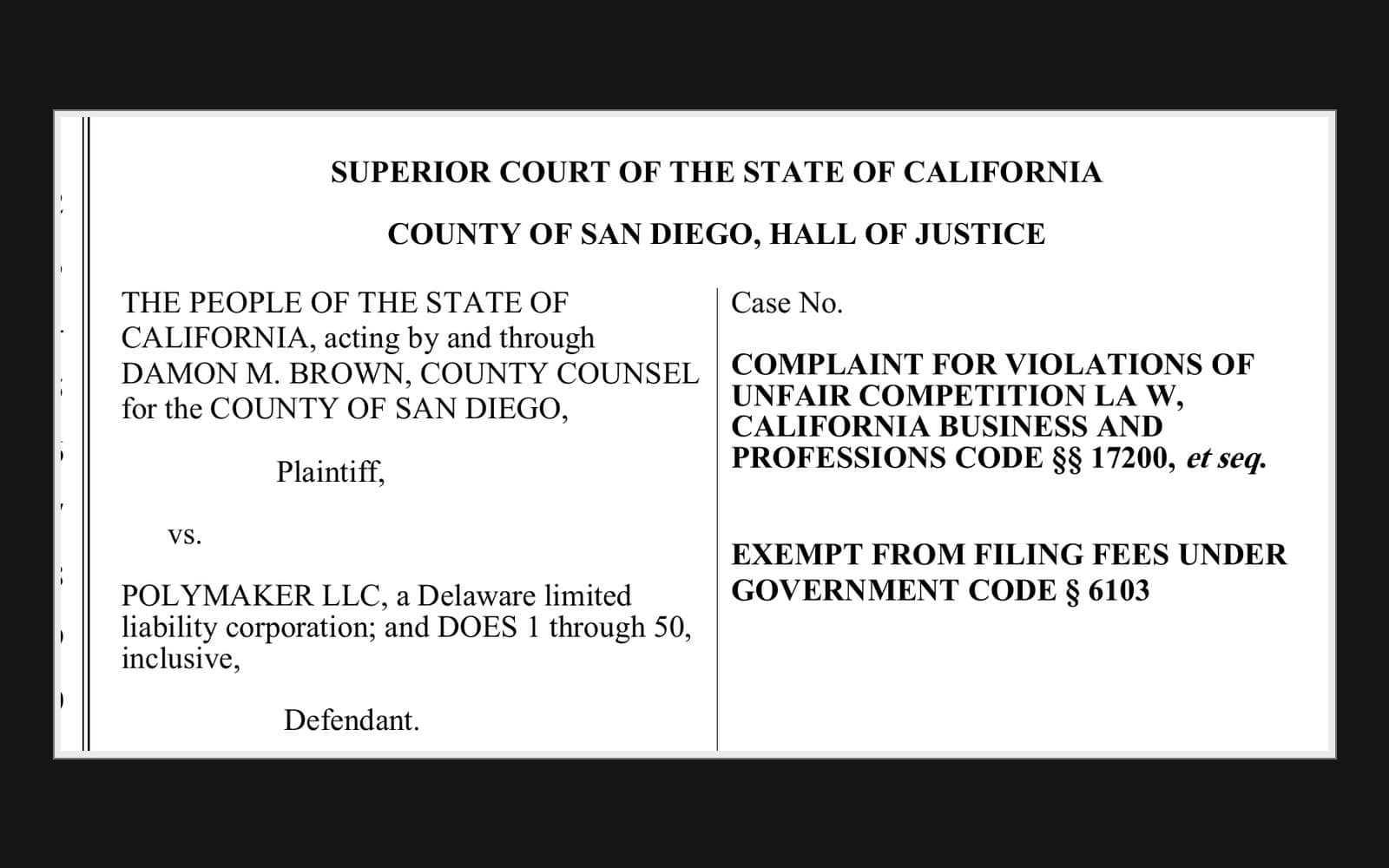
The Polymaker lawsuit that San Diego County filed on October 5 asks a state judge to treat spools of 3D-printer plastic as “firearm precursor parts,” the same legal category California applies to unfinished receivers. The county’s theory is that Polymaker’s filament is ordinary plastic right up until the company markets it to people who print guns, and that the marketing is what turns it into a gun part.
The 38-page complaint, filed in San Diego Superior Court by County Counsel Damon M. Brown with Giffords Law Center and the law firm White & Case as co-counsel, names Polymaker LLC, a Delaware company headquartered in Missouri City, Texas, plus 50 unnamed “Doe” defendants. It brings exactly one claim: a violation of California’s Unfair Competition Law, Business and Professions Code § 17200. That one claim carries a lot of freight, because the county says the “unlawful” conduct underneath it includes selling unregistered precursor parts, aiding unlicensed gun manufacture under a facilitation ban that took effect January 1, and breaking the state’s firearm-industry standard of conduct.
The theory, in the county’s words: Penal Code § 16531(a) defines a firearm precursor part to include “any forging, casting, printing, extrusion, machined body or similar article” that is “marketed or sold to the public to become or be used as the frame or receiver of a functional firearm once completed, assembled or converted.” Paragraph 80 of the complaint concedes the obvious objection before anyone raises it: “the People do not claim that all 3D printing filament qualifies as a ‘firearm precursor part.'” The county argues instead that Polymaker’s filament “meets the statutory definition” because the company “has made a conscious business choice to market and sell its products to the public for the purpose of making 3D printed ghost guns.”

The precedent the county leans on is a block of aluminum. The filing points to the California DOJ’s Firearm Precursor Part Identification Guidebook and says the department treats Ghost Gunner’s “AR-00,” an unmachined aluminum blank, as a precursor part “precisely because Ghost Gunner markets the product to the public as an object that will become a receiver.” If an unformed metal block can be a regulated part on the strength of its advertising, the county reasons, so can a spool of nylon. The lawsuit stands or falls on marketing, not on anything about the plastic itself.
The evidence stack: Most of the complaint is about what Polymaker said and whom it paid. The centerpiece is Sean Aranda, who posts as “the 3D Print General.” According to the complaint, after YouTube demonetized Aranda’s channel in September 2023, a Polymaker representative asked him, “How much is YouTube paying you? We’ll match it.” That quote is Aranda’s own account, from a video the complaint cites. Polymaker announced him as a marketing recruit that December, and he is now the company’s Head of Customer Experience. The two also produced a “3D Print General” creator spool in flat dark earth, printed with Aranda’s likeness and the slogan “Come and Make It,” which the complaint calls a play on “come and take it.”
The filing also cites product pages that showed printed gun parts, a company wiki entry recommending J-B Weld for bonding printed firearm components to metal, a Polymaker Reddit account recommending its PLA Pro for “building guns,” and affiliate links handed to gun-printing creators, including CTRL+Pew, a defendant in the attorney general’s separate February lawsuit over 3D-printed gun files. None of it has been tested in court, and the complaint labels its knowledge claims “on information and belief,” which is lawyer for “we think so, and discovery will tell.”
The incident behind the filing: On May 6, San Diego police arrested a 16-year-old at Garfield High School with a loaded handgun in his pants, KGTV reported. A search of his home turned up a 3D printer, carbon filament, four 3D-printed handgun frames, 3D-printed machine-gun conversion devices and more than 100 rounds of ammunition. The complaint says the filament was Polymaker’s and reproduces a police photo of it. That is the county’s example of “concrete harm,” and it is also the weak joint in the case: nothing in the filing says the teenager bought that filament because of an ad, a sponsorship or a Reddit reply.
Want the next one the day it lands? Add CAT Outdoors as a preferred source on Google and our coverage shows up first.
Add on GoogleWhat the county wants: Civil penalties of up to $2,500 per violation, with the complaint asking the court to count “each day” that Polymaker marketed its filament for 3D-printed guns “in a manner accessible to California audiences” as a separate violation, plus disgorgement of “all California sales revenue causally attributable” to the influencer campaigns and affiliate deals, an injunction, and attorney’s fees. Run the county’s own clock and the number gets large fast: the Aranda sponsorship dates to September 2023, more than 1,100 days ago, which puts the penalty ceiling past $2.7 million before a dollar of disgorgement. “Companies should not be able to profit by helping people evade laws designed to keep our communities safe,” Board of Supervisors Chair Terra Lawson-Remer said in the county’s release, which rolled the case out alongside suits against Roblox and the ad platform AppLovin.
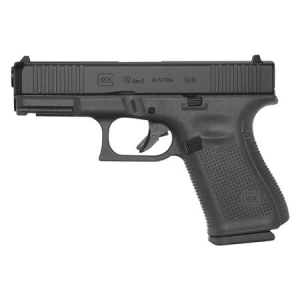
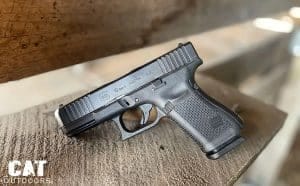
Glock 19 Gen 5 (9mm, 15+1)
The printed pistol frames in the complaint's exhibits are copies of this design. The factory version ships serialized through any FFL, and at $539 it costs less than a printer and the filament to feed it.
Who feels it: Polymaker’s California customers are mostly hobbyists printing things that are not guns, and the county says so: “this lawsuit does not seek to ban the sale of filament in California.” But the mechanism it proposes doesn’t stay in its lane. If a product becomes a precursor part because of how it is marketed, then every filament brand, every aluminum supplier and every online retailer with a California customer now has to audit its sponsorships, its forum replies and its customer reviews for anything a county counsel could read as gun-adjacent. Does 1 through 50 leave room to add them later. (The factory-made version of the frame in the county’s photos scored a 7.6 in our Glock 19 Gen 5 review. It comes with a serial number.)
The strongest objection: The county’s analogy carries less weight than it looks. The AR-00 is sold as a receiver blank; it has one purpose and its maker says so. Filament is a commodity sold by the ton for toys, tools and phone cases, and the complaint admits as much. Hanging precursor-part status on speech, meaning ads, sponsorships and a creator’s channel, also walks into the First Amendment’s protection of truthful commercial speech about a lawful product, a problem the complaint never mentions. The county’s best answer is that it isn’t regulating speech, it is using speech as evidence of what the product is for, which is exactly what the DOJ guidebook does with the AR-00. A judge will have to decide whether that distinction survives when the product underneath is lawful plastic.
Where it stands: Polymaker had not responded publicly as of Wednesday; its online store carries a fall-sale banner and nothing about the case. No hearing is set. San Diego County has done this before with the same co-counsel: in March 2025 it won a preliminary injunction that stopped Defense Distributed from selling its Coast Runner milling machine in California. This case is a longer reach, because that target was a gun-making machine and this one is the raw material.

The takeaway: This is a lawsuit about marketing dressed as a lawsuit about guns. If the county wins, California gets a precedent that a lawful commodity turns into a regulated gun part when its seller talks to the wrong audience, and the next targets write themselves. If the county loses, it still gets what filing already bought: a year or more of discovery into every influencer deal Polymaker signed. Watch for Polymaker’s first move, which could be a demurrer arguing filament can’t be a precursor part as a matter of law or a motion to send the case to federal court, and for a case number and judge assignment.
Does marketing a product to gun printers make the product a gun part? Tell us what you think in the comments.
We’ll cover Polymaker’s answer the day it lands. Sign up for the CAT Outdoors newsletter below so it doesn’t slip past you.
Sources: Complaint, People v. Polymaker LLC (San Diego Superior Court, Oct. 5, 2026); County of San Diego release (Oct. 5, 2026); California DOJ Firearm Precursor Part Identification Guidebook; AB 1263 (2025); California Attorney General release on People v. Gatalog (Feb. 6, 2026); Giffords Law Center release on the Coast Runner injunction (Mar. 28, 2025); KGTV 10News; NBC San Diego. Featured photo: Mliu92 via Wikimedia Commons, CC BY-SA 3.0.

Justin Trump is the managing editor and owner of CAT Outdoors. The son of a Vietnam veteran, he’s a Certified Glock Armorer, an avid gun enthusiast and 2A advocate. He holds two firearm patents for the CAT M4 and Talon tools. When not managing CAT Outdoors, he enjoys spending time with his family and friends, rooting for Michigan sports teams, and serving his church.