Buying a Bulletproof Vest in New York Stops Being a Crime on November 4, Unless the Second Circuit Steps In
A federal judge in Buffalo held body armor is an “arm” under the Second Amendment and permanently enjoined New York’s purchase-and-sale ban. The order is stayed 14 days so the state can appeal.

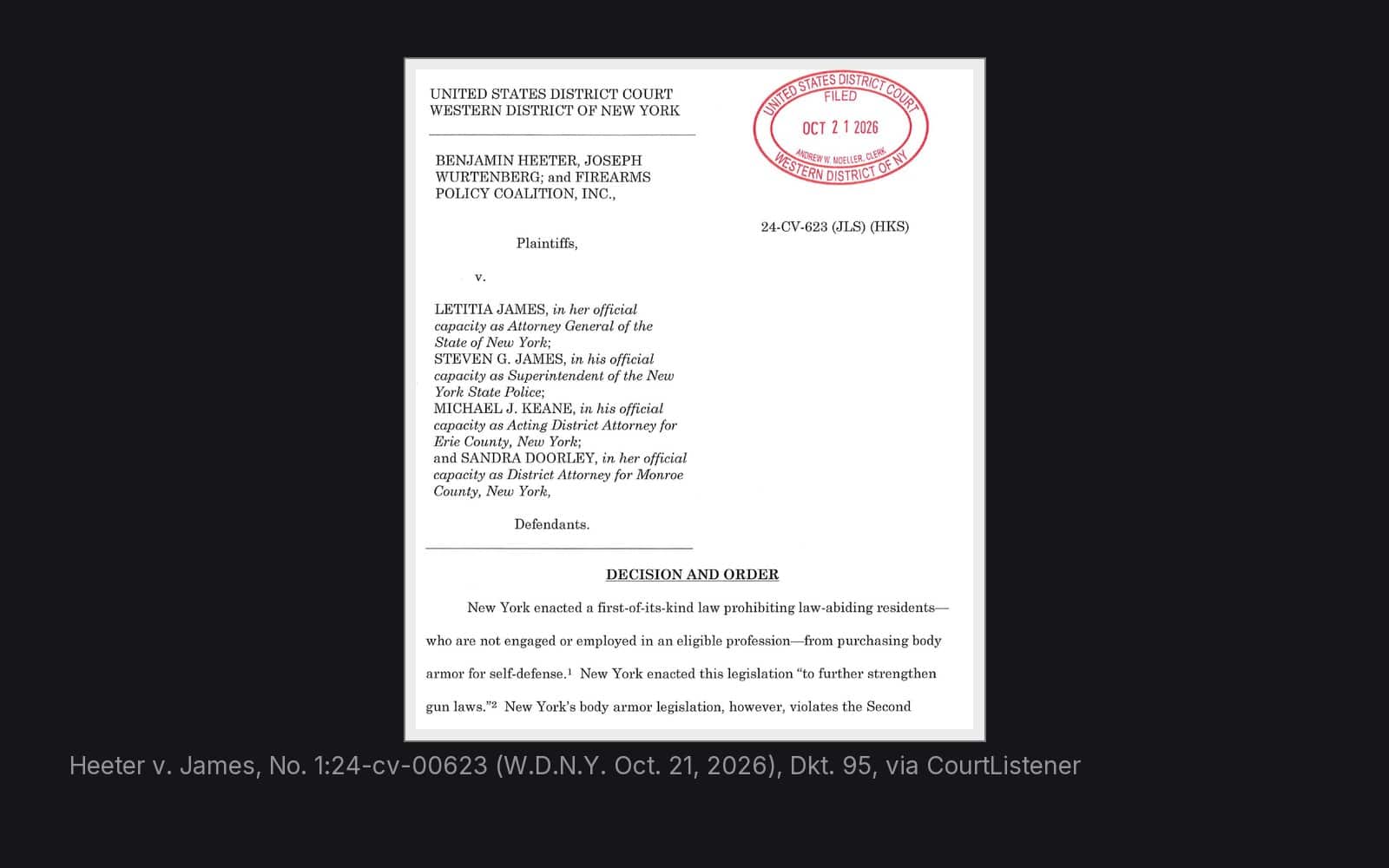
The New York body armor ban that made it a crime for most residents to buy a bullet-resistant vest was struck down on Tuesday, October 21, by a federal judge in Buffalo. U.S. District Judge John L. Sinatra Jr. granted summary judgment to two New Yorkers and the Firearms Policy Coalition in Heeter v. James, held that body armor is an “Arm” protected by the plain text of the Second Amendment, and permanently enjoined the state from enforcing its purchase-and-sale restrictions against anyone outside an “eligible profession.”
The order is stayed for 14 days so the state can appeal, which puts the injunction’s start date at Wednesday, November 4, unless the Second Circuit steps in first. As of Monday morning the docket showed no notice of appeal, and the attorney general’s office hadn’t issued a statement. For now, the ban is still the law.
What the law did: Gov. Kathy Hochul signed the ban on June 6, 2022, inside a ten-bill package passed after the Buffalo supermarket shooting and the Uvalde school shooting, and it took effect that July. Under Penal Law § 270.21, anyone not “engaged or employed in an eligible profession” who knowingly bought or took possession of body armor committed a Class A misdemeanor, and a Class E felony on any later offense. Section 270.22 put the same penalties on the seller. Eligible professions meant police officers, peace officers, military personnel, and whatever else the Department of State chose to designate. The statute defines body armor as “any product that is a personal protective body covering intended to protect against gunfire,” which reaches a soft vest, a rifle plate, and a backpack insert alike.

The court’s description of the law’s purpose is the state’s own. New York enacted it, in the words of the state’s body armor page, “to further strengthen gun laws.” Sinatra quotes that line in his first paragraph and then spends 47 pages explaining why a law that treats protective gear as a gun-control measure runs straight into the Second Amendment’s text.
Why armor is an “arm”: The ruling begins with District of Columbia v. Heller, where the Supreme Court quoted founding-era dictionaries defining “arms” as “weapons of offence, or armour of defence.” New York argued body armor isn’t a “bearable arm” and is “dangerous and unusual” besides. The court rejected both. The Second Amendment “extends, prima facie, to all instruments that constitute bearable arms,” including ones that didn’t exist in 1791, and the state offered nothing to contradict the plaintiffs’ statistical evidence, backed by amici, that body armor is in common use for lawful purposes. Sinatra called that conclusion “common sense.”
The dictionary point does most of the work. If the people who wrote the amendment used a word that included armor, the state needed a reason to read it narrower, and the only reason it offered was that armor isn’t a weapon. The court’s answer is that the text never said weapon. It said arms.
The history test New York failed: Under Bruen, once conduct falls inside the text, the government has to show its regulation is consistent with the nation’s historical tradition of firearm regulation. The decision says the state “is unable to identify a single regulation on body armor post-ratification.” New York reached instead for the Statute of Northampton, a 1328 English law against going “armed by night, nor by day, in fairs markets.” The court answered with Bruen’s own line that the statute “has little bearing on the Second Amendment adopted in 1791,” and a footnote reminds the state that Northampton predates the Constitution by more than 450 years. The ban, Sinatra wrote, is “a novel outlier unsupported by any mainstream tradition.”
That gap decides the case. New York had more than two years of litigation to produce one American law, from the founding era or Reconstruction, that barred ordinary citizens from buying armor. It produced a medieval English statute about riding armed to the fair.
The terror argument: The state’s fallback was that people wear body armor to frighten the public, which is what Northampton was about. The court turned the premise around: the public “is more likely to reach for body armor to protect themselves from terrifying circumstances.” It then cited Rahimi, where the Supreme Court allowed disarming “an individual found by a court to pose a credible threat to the physical safety of another.” A court finding about one dangerous person is a long way from a ban on everyone who hasn’t done anything.
Who this hits: Heeter and Wurtenberg are two New Yorkers who said they wanted to buy body armor and hadn’t because of the “credible threat of arrest, confiscation, prosecution, fines, and imprisonment.” Since July 2022 the same has been true of any resident who wanted a plate carrier for a home-defense setup, a store owner who had been robbed, or a delivery driver working late. One thing the ruling leaves alone, and says so in a footnote: Penal Law § 270.20(1), wearing body armor while committing a violent felony with a gun, is still a crime. That statute punishes a criminal act. The purchase ban punished shopping.
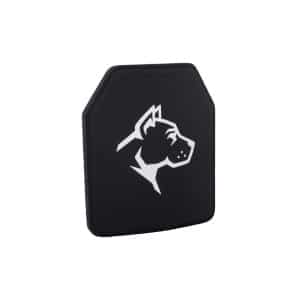
Guard Dog Body Armor Level III UHMWPE Plate (10×12)
A 3.9-pound Level III polyethylene plate in the standard 10×12 cut, running about $165 to $199 depending on the shop. New York buyers: the injunction doesn't take effect until the stay lapses, and every retailer sets its own state shipping rules, so check before you order.
Why the ban stays in force for now: Sinatra granted the state’s request for a 14-day stay, but not on the state’s terms. He rejected the argument that New York is likely to win on appeal and granted the stay on the hardship balance: the law dates to 2022, and no plaintiff ever asked for a preliminary injunction, so two more weeks costs them little. If the state appeals and asks the Second Circuit for a stay pending appeal, the ban could remain enforced for months. That is the court that upheld Connecticut’s rifle ban last year in Lamont, a decision the Supreme Court has since agreed to review as Grant v. Higgins, and Sinatra’s conclusion speaks to the Lamont standard directly: the state offered no evidence that body armor, which he calls “a purely defensive arm,” is “uniquely designed to create mayhem.”
New York also argued that a statewide injunction is barred by Trump v. CASA, the 2025 decision limiting universal injunctions. Sinatra’s footnote collects five district courts holding that CASA limits nationwide injunctions against federal action and leaves statewide injunctions against a state statute alone, and notes one Arizona court going the other way. New York’s other 2026 gun-law fight, the convertible-pistol ban that reaches most Glocks, is heading toward the same circuit.
The fair objection: The law was passed three weeks after a gunman wearing body armor killed ten people at a Tops supermarket in Buffalo. The ruling does not minimize that. It says the state already has the tool that fits the crime: § 270.20(1) punishes anyone who wears armor while committing a violent felony, and that statute stands. What the state can’t do is ban the item for every resident who hasn’t committed anything. Reporting at the time also noted that the original bill’s “body vest” language may not have covered the hard plates that shooter wore; the statute’s current definition is broader.

What happens next: The stay lapses November 4. New York has 30 days from the October 21 judgment to file a notice of appeal, so it can let the injunction take effect and appeal afterward, or move the Second Circuit for a longer stay before the clock runs. FPC, which called the ruling a “first-in-history win,” will oppose any stay. The decision itself calls New York’s law “first-of-its-kind,” which means there is no other state ban for a second court to test the reasoning on.
Would a ruling like this change what you keep in your home-defense kit? Tell us in the comments.
Get the next ruling before it hits the feed: sign up for the CAT Outdoors newsletter below.
Sources: Decision and Order, Heeter v. James, No. 1:24-cv-00623 (W.D.N.Y. Oct. 21, 2026), Dkt. 95; case docket via CourtListener; N.Y. Penal Law § 270.20, § 270.21, § 270.22; New York Department of State, Body Armor; Spectrum News, June 8, 2022; Firearms Policy Coalition release, Oct. 21, 2026. Featured photo: Robert H. Jackson U.S. Courthouse, Buffalo, by Philcomanforterie, CC BY-SA 4.0, via Wikimedia Commons.

Justin Trump is the managing editor and owner of CAT Outdoors. The son of a Vietnam veteran, he’s a Certified Glock Armorer, an avid gun enthusiast and 2A advocate. He holds two firearm patents for the CAT M4 and Talon tools. When not managing CAT Outdoors, he enjoys spending time with his family and friends, rooting for Michigan sports teams, and serving his church.